
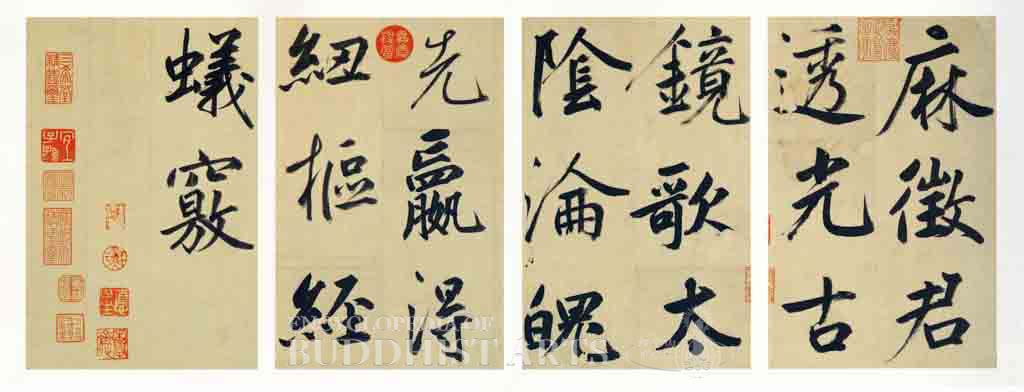
Song on an Ancient Light-Transmitting Mirror by Xianyu Shu (detail); Yuan dynasty
Ink on paper
Xianyu Shu
CHINA, Tianjin; Southern Song to Yuan dynasty (1127–1368)
Xianyu Shu, also known as Boji or Kunxue, was a calligrapher from Yuyang (present day Jixian, Tianjin). He is also thought to be from Dadu (present day Beijing). Erudite and capable, he served in the imperial government as a documentary officer and a clerical officer in Zhejiang.
In his later years, Xianyu lived as a recluse at West Lake in Hangzhou, Zhejiang and devoted himself to reading and antique appreciation. He authored publications including Collection of Kunxuezhai and Miscellanies of Kunxuezhai. His running and regular script calligraphy captured the agile and vigorous charm of the Jin (265–420) and Tang (618–907) dynasties, and his cursive script, which followed monk Huaisu’s style, was highly regarded by Zhao Mengfu whom he collaborated with in writing the Thousand Character Classic.
Xianyu’s existing calligraphic works, Laozi’s Tao Te Ching, Du Fu’s Poem on Visiting Zhaoling Mausoleum, and Su Shi’s Begonia Flowers, are kept at the Palace Museum in Beijing; Han Yu’s Explanation upon Entering the Academy are at the Capital Museum in Beijing; Collection of Wang Anshi’s Poems is at the Liaoning Provincial Museum; and Song on an Ancient Light-Transmitting Mirror is kept at National Palace Museum, Taipei, Taiwan. Several other works are collected at museums throughout both China and Japan.
For more details, go to the Encyclopedia of Buddhist Arts: People, page 303.
Cite this article:
author = Hsingyun and Youheng and Youlu and Pokorski, Stefanie and Yichao and Mankuang and Miaohsi,
booktitle = {Encyclopedia of Buddhist Arts: People },
pages = 303,
title = {{Xianyu Shu}},
volume = 19,
year = {2016}}