

Toji Temple Sculptures: Lecture Hall (interior)
Wood
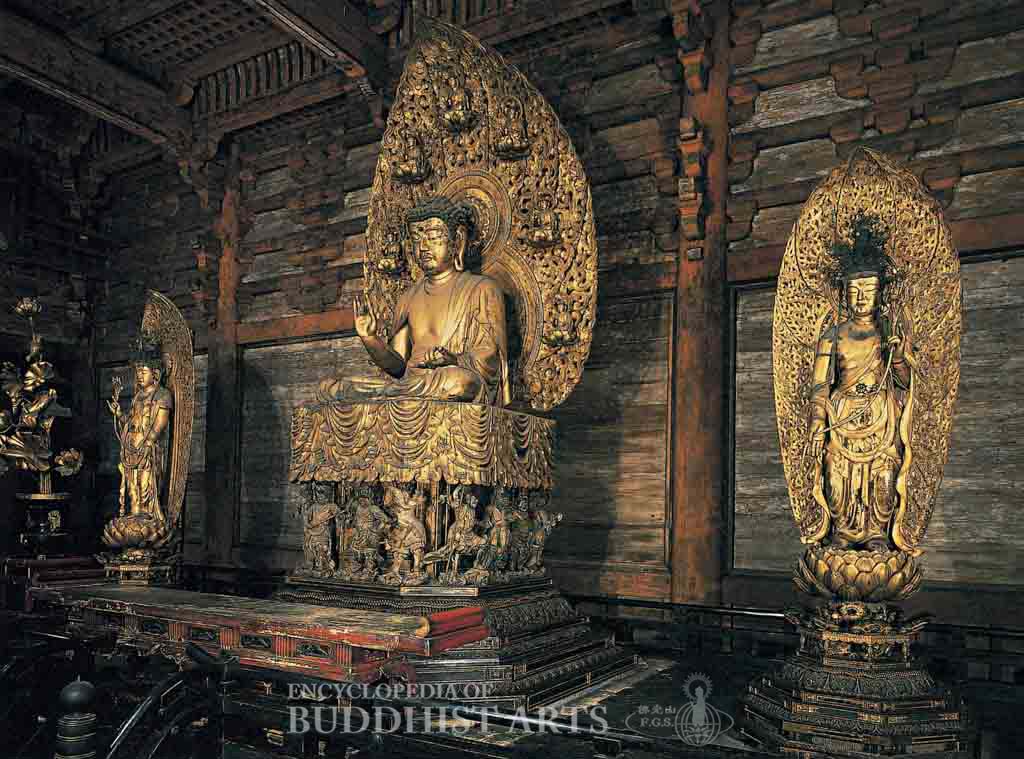
Toji Temple Sculptures: Lecture Hall - Medicine Buddha Triad
Wood

Toji Temple Sculptures: Lecture Hall (plan)
Toji Temple Sculptures
JAPAN, Kyoto; Heian period
Toji Temple is the head temple of the Toji Shingon school of Japanese Buddhism. Emperor Saga (reigned 809–823) in his final year honored the school’s founder, Master Kukai, with the temple and gave it the official name Kyoogokokuji (Temple of National Protection by the King of Doctrines).
Twenty-one statues are displayed on the Sumeru platform in the lecture hall, including Buddhas, Bodhisattvas, Wisdom Kings, and the Four Heavenly Kings. The statues in the center are of the Five Dhyani Buddhas with Vairocana Buddha in the middle. There are five Bodhisattvas to the east, centered around Vajraparamita Bodhisattva. Five Wisdom Kings in wrathful manifestations are on the west, with Acala as the principal statue. He is believed to be the oldest existing Acala statue in Japan.
The Four Heavenly Kings stand guard at each corner of the platform, with Brahma and Sakra on the sides of the hall. The majority of the statues were created during the Heian period (794–1185), with the exception of the later Five Dhyani Buddhas and Vajraparamita Bodhisattva. Their arrangement is based on the Vajrayana Mandala described by Kukai. The group is regarded as the treasure of Vajrayana Buddhism and is an example for later works. The Five Dhyani Buddhas are listed as Important Cultural Properties while the rest are listed as National Treasures.
There are also sculptures created from the Kamakura period (1185–1333) onwards. The Medicine Buddha Triad of 1603 that is housed in the Golden Hall is listed as an Important Cultural Property. Kosho’s image of Kukai from 1233 is the oldest statue of the Master in Japan and was listed as a National Treasure. The statues of the Five Great Akasagarbha Bodhisattvas, housed in the Kanchiin and listed as Important Cultural Properties, were carved out of whole blocks of camphor wood and brought to Japan from China by the Japanese monk Eun in the year 847.
The Tang dynasty (618–907) cherry wood statue of Vaisravana is housed in the temple museum. The statue is the prototype which later creations were based on in Japan.
For more details, go to the Encyclopedia of Buddhist Arts: Sculpture St-Z, page 1230.
Cite this article:
author = Hsingyun and Youheng and Lovelock, Yann and Chou, Yuan and Huntington, Susan and Edson, Gary and Neather, Robert,
booktitle = {Encyclopedia of Buddhist Arts: Sculpture St-Z},
pages = 1230,
title = {{Toji Temple Sculptures}},
volume = 13,
year = {2016}}