
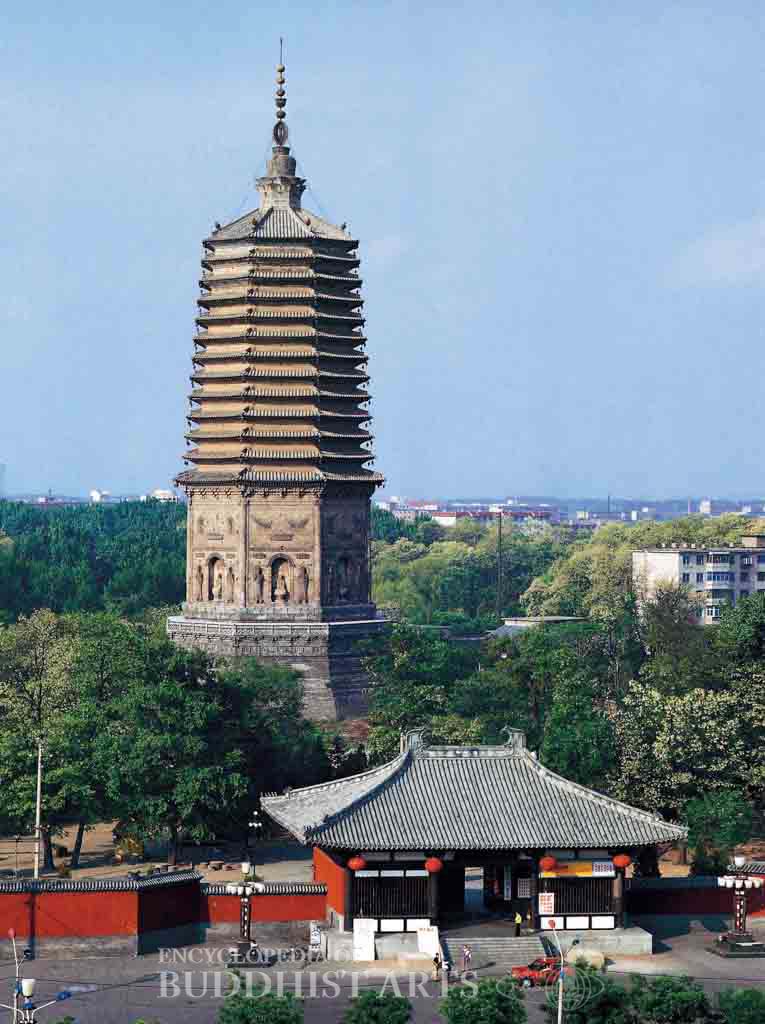
Liaoyang White Pagoda

Liaoyang White Pagoda (detail)
Liaoyang White Pagoda
CHINA, Liaoning, Liaoyang
The pagoda is located within the grounds of the former Guangyou Temple and is the highest pagoda in northeast China. Based on its architecture, the materials used, and its decorations, experts believe that it was built in the late Liao dynasty (907–1125). It was listed as a National Cultural Heritage Site in 1988.
The octagonal brick pagoda has 13 tiers and is 70.4 m high. The base platform of the pagoda has sloping sides and is topped by a Sumeru base. A series of bracket sets support balustrades surrounding the first tier, which is much taller than the remaining tiers. The lower section has a niche in the center of each side containing statues of a seated Buddha flanked by attendant Bodhisattvas with canopies above their heads. There are peonies, floral patterns, and a pair of dragons carved onto the arched lintel of the niches. In the upper section there is a large central canopy with an apsara on either side. Each side is bordered by rounded pilasters. The subsequent 12 tiers decrease in size with height. The pagoda is surmounted by an octagonal pyramidal roof. The spire consists of two sets of upturned lotuses, an inverted bowl, a flame, and the jewels of the finial.
For more details, go to the Encyclopedia of Buddhist Arts: Architecture G-L, page 658.
Cite this article:
author = Hsingyun and Youheng and Johnson, Peter and Mankuang and Lancaster, Lewis,
booktitle = {Encyclopedia of Buddhist Arts: Architecture G-L},
pages = 658,
title = {{Liaoyang White Pagoda}},
volume = 2,
year = {2016}}