
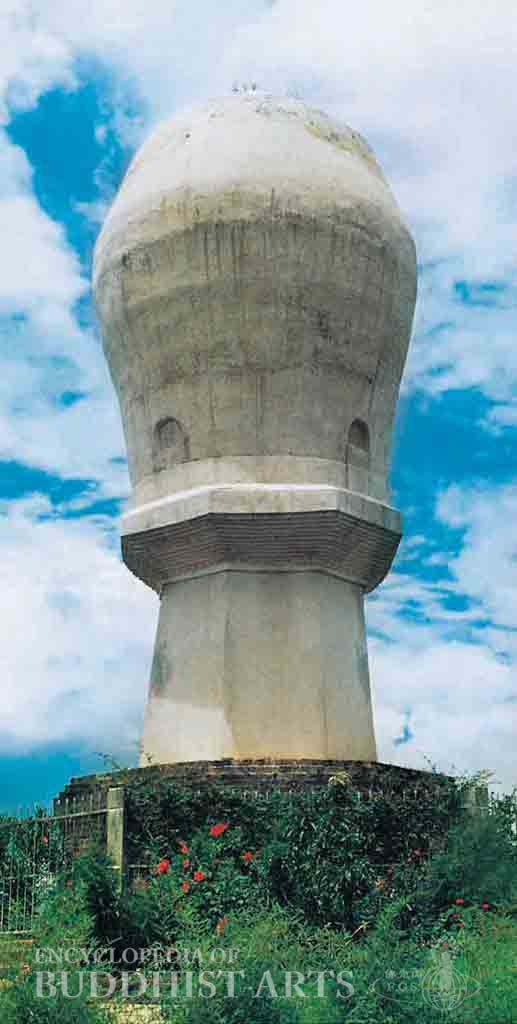
Dayao White Pagoda
Dayao White Pagoda
CHINA, Yunnan, Dayao
It is the earliest and highest seamless pagoda in China. According to local gazetteers, it was built by a Tibetan monk between 742 and 756 during the Tang dynasty. Originally there was a temple there but it was destroyed in wartime and only this pagoda has survived. It was reconstructed in 1872 during the Qing dynasty and renovated in 1975. It was listed as a Provincial Cultural Heritage Site in 1965.
The hollow, brick pagoda is around 18 m high and painted white. It has a double-layer octagonal base with a perimeter of 25 m. The lower part of the pagoda body is in the form of a tapered octagonal pillar, while the upper part is an inverted bowl. This design is unusual, with the top being wider than the bottom, giving it the appearance of the mallet which is used to strike the gong, hence the local people also call it Gong’s Mallet Pagoda. There are inscriptions in Sanskrit and Chinese characters on the body of the pagoda. During renovations in 1975 a hole 40 cm wide was found at the top of the pagoda and it is presumed that it was used to hold the spire, which no longer exists.
For more details, go to the Encyclopedia of Buddhist Arts: Architecture A-F, page 219.
Cite this article:
author = Hsingyun and Youheng and Johnson, Peter and Mankuang and Lancaster, Lewis,
booktitle = {Encyclopedia of Buddhist Arts: Architecture A-F},
pages = 219,
title = {{Dayao White Pagoda}},
volume = 1,
year = {2016}}