
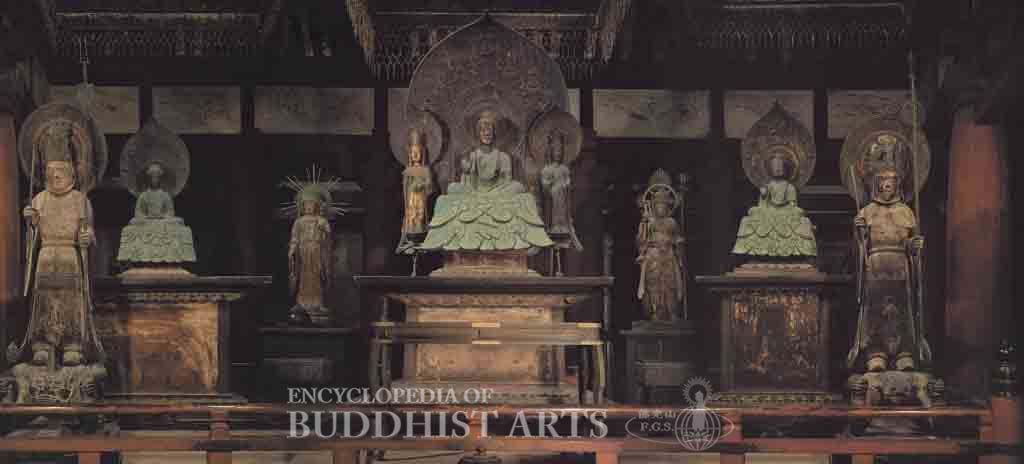
Horyuji Temple Sculptures: Golden Hall
Horyuji Temple Sculptures
JAPAN, Nara, Ikoma; Asuka to Nara period (538–794)
Horyuji Temple was founded in 607. Counted as one of the Seven Major Temples in Nara, it became the head temple of the Shotoku school. Despite fires in both the eastern and western compounds, a number of masterpieces that represent the Asuka (538–645) and Hakuho (645–710) periods have survived and are kept in various places throughout the temple compound. They are listed as National Treasures and Important Cultural Properties.
The Sakyamuni Buddha Triad in the Golden Hall is dated to the year 623 and was the work of the renowned sculptor Tori. They are regarded as masterpieces of the Asuka period. The Four Heavenly Kings from the end of the Asuka period stand at each corner of the triad. They are the oldest examples of such figures in Japan. One of the sculptures credited to the sculptor Yamaguchi no Atai based on the inscriptions on the back of Virupaksa and Vaisravana. Another Vaisravana and Mahadevi stand at either side of the main statue of Sakyamuni. The goddess of prosperity and the embodiment of beauty, Mahadevi’s image is deemed to portray a contemporary court beauty. The famous Avalokitesvara Bodhisattva statue in the Hall of Dreams within the eastern compound also dates to this period. The Avalokitesvara Bodhisattva statue in the Baekje Avalokitesvara Hall is said to be influenced by the Chinese Southern Dynasties (420–589) art style.
The Avalokitesvara Bodhisattva statue currently housed in the Great Treasure Hall dates to the Hakuho period. The realistic lower garment and the affluent lines of the cloth folds are stylistic features of the Early Tang period (618–712). The Amitabha Buddha and two standing attendants, dedicated by Lady Tachibana, in the miniature shrine were also created at that time. They show the fine metal craftsmanship of the time. Nara period (710–794) statues also show significant Tang influence as characterized by the realistic depiction of the figures. The clay sculptures on the Sumeru altar, located around the central pillar in the first story of the five-story pagoda, are representative examples.
Heian period (794–1185) sculptures are represented by the Medicine Buddha Triad in the Great Lecture Hall, the Master Dosen in the Hall of Dreams and the Ksitigarbha Bodhisttava in the Golden Hall. Ksitigarbha’s sturdy appearance in his heavy robes is a typical feature of early Heian style.
For more details, go to the Encyclopedia of Buddhist Arts: Sculpture G-M, page 441.
Cite this article:
author = Hsingyun and Youheng and Lovelock, Yann and Chou, Yuan and Huntington, Susan and Edson, Gary and Neather, Robert,
booktitle = {Encyclopedia of Buddhist Arts: Sculpture G-M},
pages = 441,
title = {{Horyuji Temple Sculptures}},
volume = 11,
year = {2016}}