
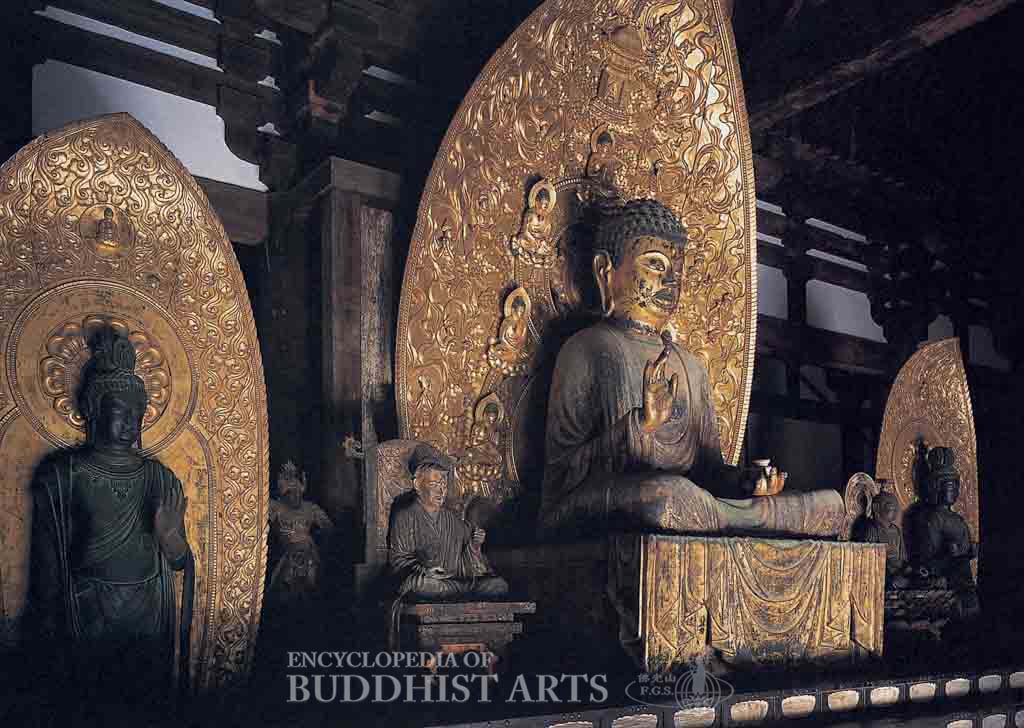
Kofukuji Temple Sculptures: East Golden Hall - Medicine Buddha; H: 255 cm
Copper alloy
Kofukuji Temple Sculptures
JAPAN, Nara
Founded in the 7th century, the Kofukuji Temple is the head temple of the Hosso school. The extant statues that have escaped fire and other disasters are scattered around the East Golden Hall, West Golden Hall, North Octagonal Hall, and South Octagonal Hall.
The statues of the Ten Great Disciples and Eight Classes of Dharma Protectors are dated to the Nara period (710–794). They were created using the hollow dry-lacquer technique and were sculpted by Shogun Manpuku. They are currently housed in the National Treasure Museum.
Heian period (794–1185) statues include the Four Heavenly Kings in the North Octagonal Hall and those from the early 9th century in the East Golden Hall.
Statues created during the Kamakura period (1185–1333) include Amoghapasa Avalokitesvara and the Four Heavenly Kings in the South Octagonal Hall; Manjusri Bodhisattva, Twelve Yaksa Generals, and Vimalakirti in the East Golden Hall; Maitreya Buddha, Asanga and Vasubandhu Bodhisattva in the North Octagonal Hall; and Narayana and Guhyapada in the West Golden Hall. Other reputed statues include the Thousand-Armed Avalokitesvara Bodhisattva originally in the dining hall, and the Demons Carrying Lamps created by the sculptor Koben. A large number of the Buddhist statues of the Kamakura period were created by the sculptors of the Kei school, headed by Kokei and Unkei. Kokei’s work on the Six Patriarchs of the Hosso school pioneered the emerging realism of that time.
The center piece of the East Golden Hall is the copper Medicine Buddha statue created in 1415 during the Muromachi period (1392–1573) and is listed as an Important Cultural Property. The Medicine Buddha sits cross-legged with the right hand raised in abhaya (fearlessness) mudra and a medicine pot cupped in the left hand. Behind him is a large mandorla with his seven manifestations surrounding his aureole and lotus-pattern nimbus. On either side are the attendant Bodhisattvas, Suryaprabha and Candraprabha, dating from the early Nara period. These are also Important Cultural Properties. The smaller statues between them and the main figure, represent Vimalakirti and Manjusri in debate.
For more details, go to the Encyclopedia of Buddhist Arts: Sculpture G-M, page 536.
Cite this article:
author = Hsingyun and Youheng and Lovelock, Yann and Chou, Yuan and Huntington, Susan and Edson, Gary and Neather, Robert,
booktitle = {Encyclopedia of Buddhist Arts: Sculpture G-M},
pages = 536,
title = {{Kofukuji Temple Sculptures}},
volume = 11,
year = {2016}}