
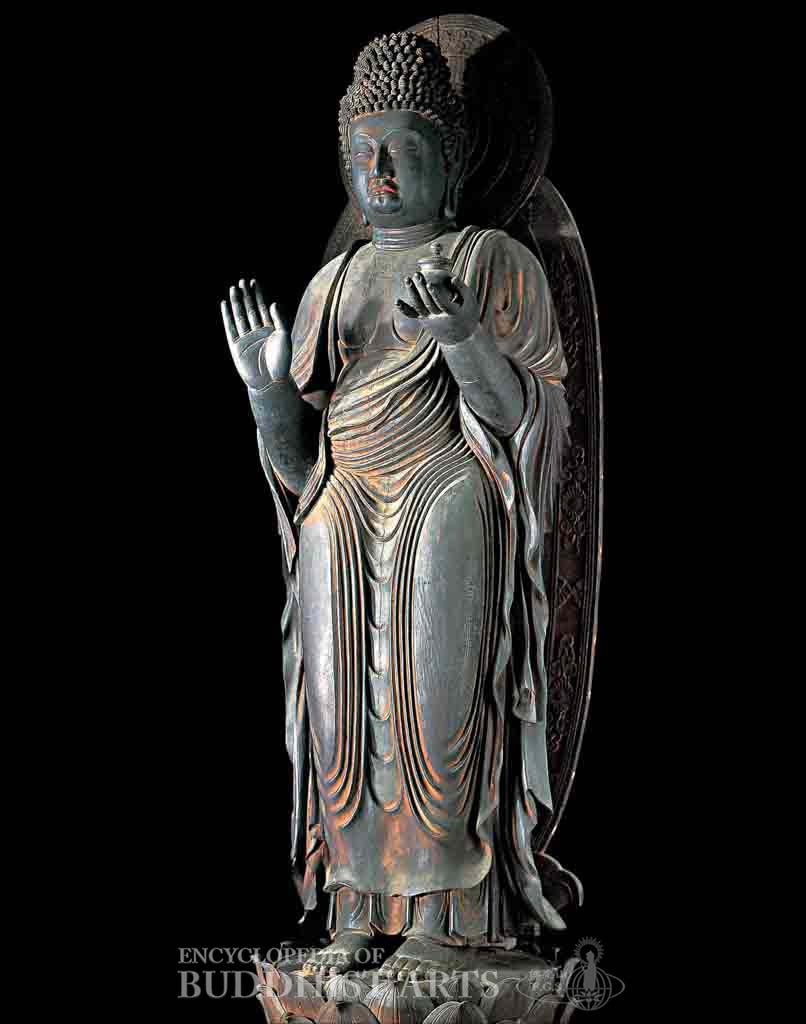
Jingoji Temple Golden Hall: Medicine Buddha
Cypress wood
Jingoji Temple Golden Hall: Medicine Buddha
JAPAN, Kyoto; Heian period
The sculpture is recorded as being carved from 782 to 806 following an attempt on the imperial throne. Throughout the Heian period (794–1185), it was the principal figure used in the Medicine Buddha Repentance Services for the country’s prosperity. It was listed as a National Treasure in 1951.
Most of the statue was carved from a single block of wood. Some tincturing of facial details apart, the statue has been left unstained to reveal the natural texture of the wood. The standing figure is dressed in monastic robes, the undulating folds of which are artfully carved as they ripple over the abdomen and fall below the waist. The Buddha raises a medicine pot in the left hand while the right hand is in abhaya (fearlessness) mudra.
For more details, go to the Encyclopedia of Buddhist Arts: Sculpture G-M, page 495.
Cite this article:
author = Hsingyun and Youheng and Lovelock, Yann and Chou, Yuan and Huntington, Susan and Edson, Gary and Neather, Robert,
booktitle = {Encyclopedia of Buddhist Arts: Sculpture G-M},
pages = 495,
title = {{Jingoji Temple Golden Hall: Medicine Buddha}},
volume = 11,
year = {2016}}