
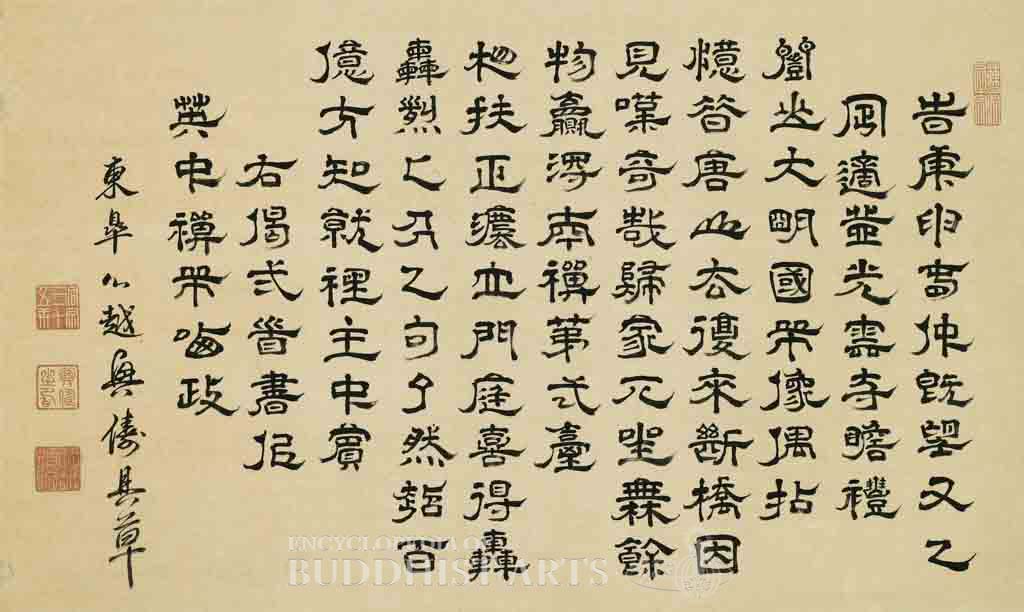
Poems on Praising Master Mukan Fumon
Ink on paper
Poems on Praising Master Mukan Fumon
CHINA; Qing dynasty
When Chan Master Donggao Xinyue traveled to Kofukuji Temple in Japan, he encountered a sculpture of Master Mukan Fumon and immediately composed a poem in his honor. He started by eulogizing the great work of the master and continued by extolling the personal sentiments of the Japanese monk. Upon finishing his composition, he wrote a copy and sent it to another monk.
The script features an eccentric excess of bends and turns in the brushstrokes. It carries aspects of both seal and clerical scripts, which could be attributed to the artist’s study of the Xia Cheng Stele clerical style. A uniform speed of writing and a consistent character form were employed, which help to rationalized the tall and archaic configurations that are reminiscent of past scripts. Also inspired perhaps by the Cao Quan Stele, the calligraphy was rendered fluently, but assumes the appearance of a handwritten correspondence rather than an engraved inscription. The vigorous goose tails and “na” (right-falling) diagonal strokes demonstrate the passion and assertiveness of the calligrapher.
For more details, go to the Encyclopedia of Buddhist Arts: Calligraphy, page 182.
Cite this article:
author = Hsingyun and Youheng and Youlu and Pokorski, Stefanie and Mankuang and Edson, Gary,
booktitle = {Encyclopedia of Buddhist Arts: Calligraphy },
pages = 182,
title = {{Poems on Praising Master Mukan Fumon}},
volume = 17,
year = {2016}}