

Miyin Temple: Main Temple Gate

Miyin Temple: Ten Thousand Buddha Hall (interior)
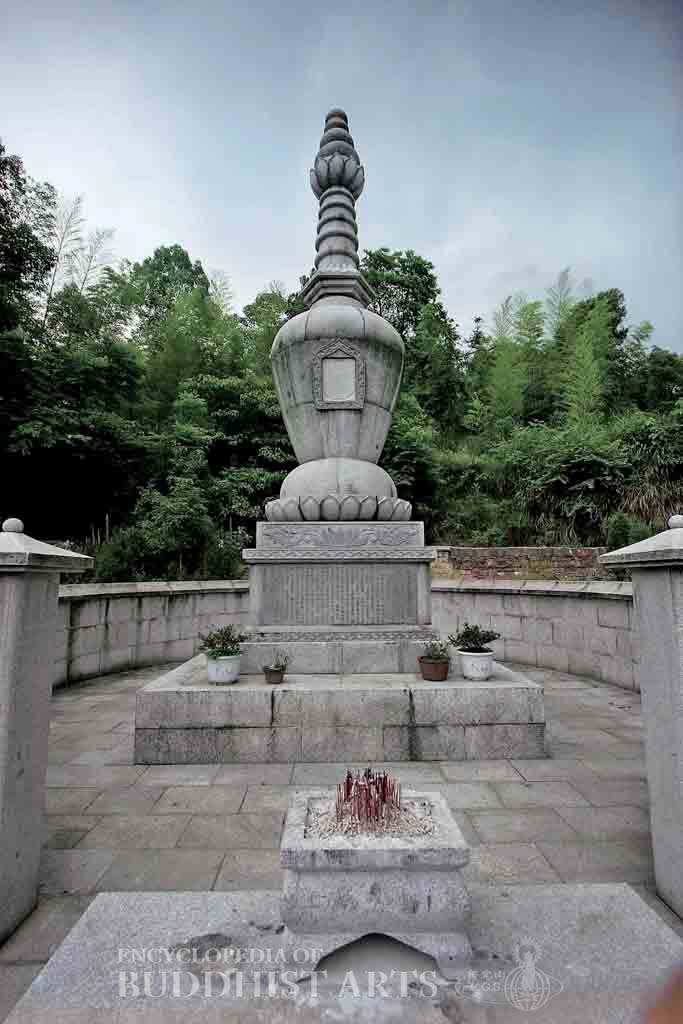
Miyin Temple: Patriarch Stupa
Miyin Temple
CHINA, Hunan, Changsha
Miyin means Secret Seal, which derives from the wordless and inexpressible transmission of the Dharma in Chan Buddhism, and the Chan Master’s confirmation of a disciple’s attainment. The temple stands at the foot of Vairocana Peak of Weishan Mountain. The Guiyang school of Chinese Chan Buddhism originated at this temple. The records state that Master Lingyou arrived at Weishan in 801 during the Tang dynasty to propagate the Dharma, and built a temple in 807 with the help of the Prime Minister. At one time it had more than 1,000 resident monastics. When Master Lingyou retired, the emperor built Tongqing (Celebrate Together) Temple as a place for him to reside. This is the current location of the Patriarch Stupa. Master Lingyou followed the motto of his master, Baizhang Huaihai: “A day without work is a day without food” by leading his disciples to cultivate the land. Throughout its history, the temple has flourished and declined a number of times. It was listed as a Provincial Cultural Heritage Site in 1950.
Along the central axis there are the main temple gate, Ten Thousand Buddha Hall and the Alert Hall. Along either side there are the Place for Selecting Buddhas and the sutra repository. The three-bay wide main temple gate has an arched doorway in the center. It is constructed from brick and stone and the roof is covered with yellow glazed tiles.
The 27 m high Ten Thousand Buddha Hall has a double-eave hip-and-gable roof, which is covered in golden glazed tiles. Its base platform, as well as the 38 columns on the interior and exterior, are made from white granite. Inside, the walls are inlaid with 12,182 small golden Buddha statues.
For more details, go to the Encyclopedia of Buddhist Arts: Architecture M-S, page 745.
Cite this article:
author = Hsingyun and Youheng and Johnson, Peter and Mankuang and Lancaster, Lewis,
booktitle = {Encyclopedia of Buddhist Arts: Architecture M-S},
pages = 745,
title = {{Miyin Temple}},
volume = 3,
year = {2016}}