
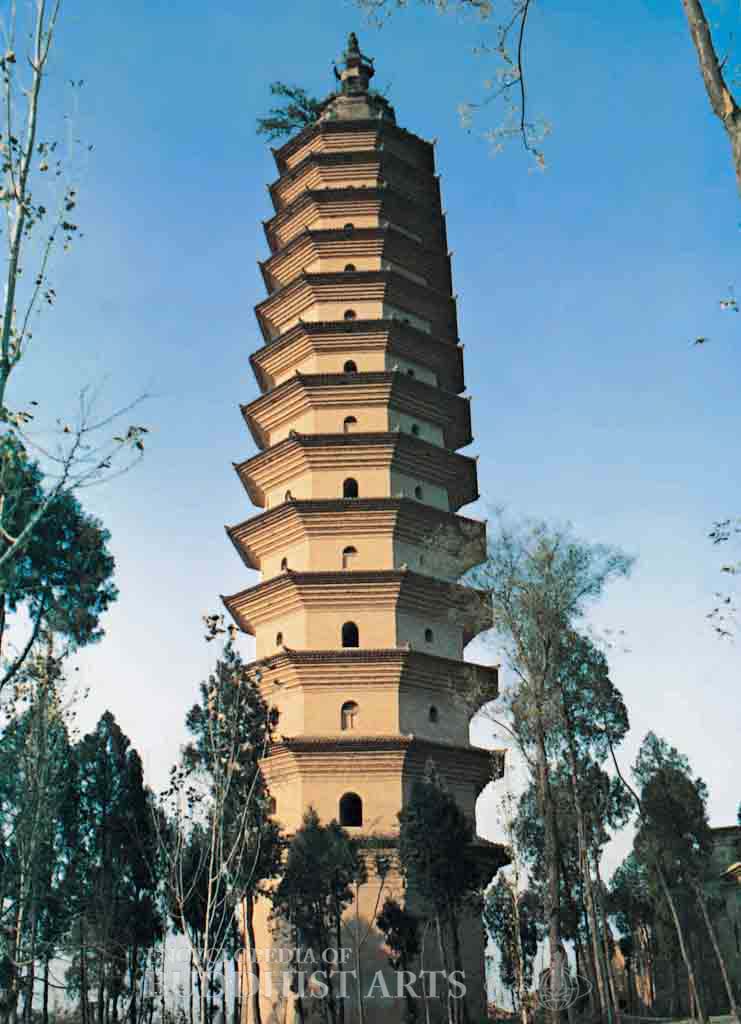
Wangu Temple: Prabhutaratna Pagoda
Wangu Temple
CHINA, Shanxi, Yongji
The temple is located at the foot of Zhongtiaoshan (Central Range Mountain). It was built during the Northern Wei dynasty (386–534) and was expanded in 854 during the Tang dynasty. During the rule of Emperor Hongwu (reigned 1368–1398) of the Ming dynasty, Shifo Temple and Zhuxi Temple merged with this temple to become the largest Buddhist monastery on Zhongtiaoshan. Wangu Temple flourished and declined throughout its history, and it is listed as a Provincial Cultural Heritage Site.
Built to integrate with the surrounding terrain, the main temple gate faces south, while the other buildings face west. Most of the buildings are made of brick and consist of the front hall, Great Hero Hall, Medicine Buddha Hall, Water and Land Hall, Prabhutaratna Pagoda, Infinity Hall, and the Arhat Hall. The placement of a pagoda behind the halls is a layout from after the Tang dynasty (618–907). The Water and Land Hall was reconstructed recently. Inside, there is a remolded statue of the Reclining Buddha as well as the 33 Manifestations of Avalokitesvara Bodhisattva.
Built in 1586 during the Ming dynasty, the 13-story octagonal Prabhutaratna Pagoda is made of bricks and is 54.7 m high. The octagonal underground palace houses a stele carved with the pagoda’s history. On every story arched doors alternate with arched windows. The eaves are in the form of distinctive brick corbeling. The spire consists of a harmika, canopy, stacked rings, and finial.
For more details, go to the Encyclopedia of Buddhist Arts: Architecture T-Z, page 1177.
Cite this article:
author = Hsingyun and Youheng and Johnson, Peter and Mankuang and Lancaster, Lewis,
booktitle = {Encyclopedia of Buddhist Arts: Architecture T-Z},
pages = 1177,
title = {{Wangu Temple}},
volume = 4,
year = {2016}}