
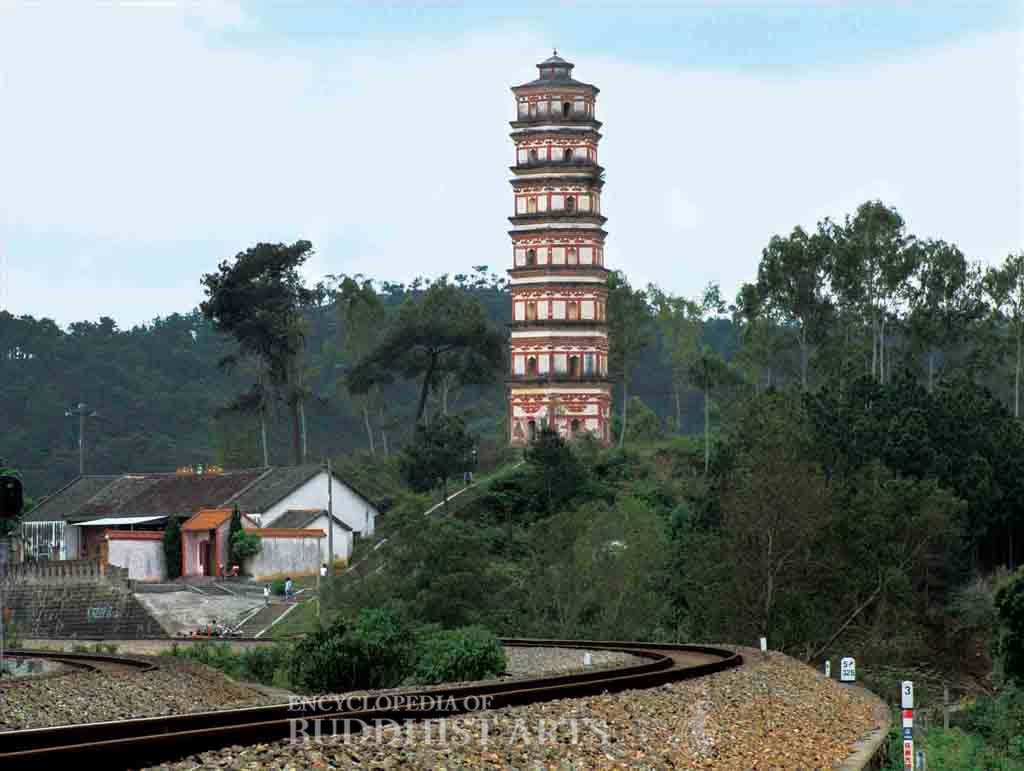
Zhengxiang Temple Pagoda
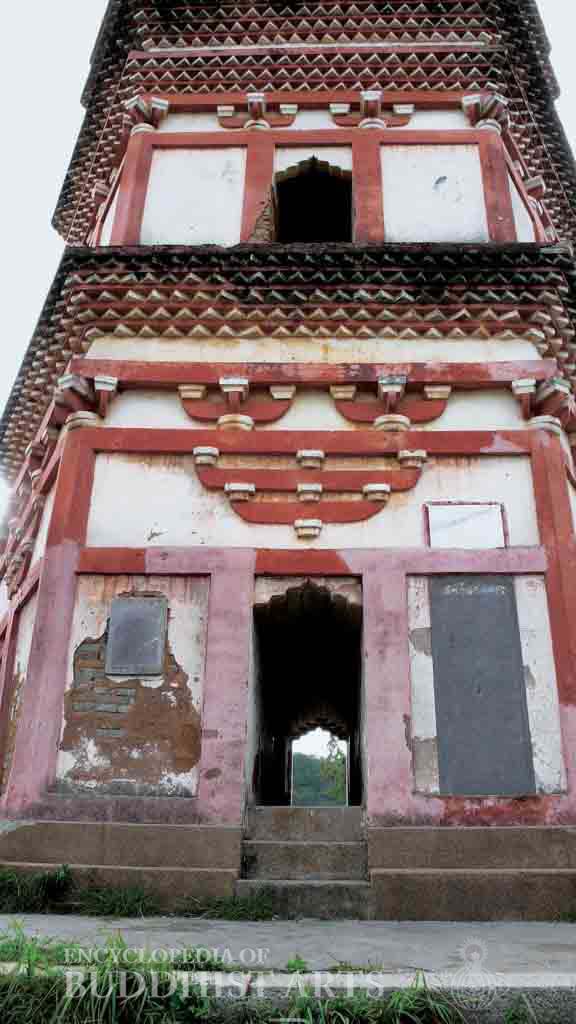
Zhengxiang Temple Pagoda (detail)
Zhengxiang Temple Pagoda
CHINA, Guangdong, Heyuan
The pagoda is also known as the Immortal Pagoda and locally called the Old Pagoda. It is also called Kaiyuan Pagoda because a brick embossed with the third year of the Kaiyuan reign was found nearby, dating it to 715 of the Tang dynasty. The structure was repaired in 1959, 1980, and again in 1985. It was listed as a Provincial Cultural Heritage Site in 1962.
The seven-story, hexagonal, brick pagoda is 32 m high. The eaves consist of courses of dogtooth bricks in the form of corbeling supporting the flat base of the next story. At each corner there are octagonal pilasters connected to each other by architraves. At the center there is a doorway with a corbel arch. In between the interconnecting beams and architraves, there is a large bracket set which is purely for decorative purposes. This is rarely seen in Chinese architecture. There are chambers on every story, which are accessible by stairs between the inner and outer walls.
For more details, go to the Encyclopedia of Buddhist Arts: Architecture T-Z, page 1398.
Cite this article:
author = Hsingyun and Youheng and Johnson, Peter and Mankuang and Lancaster, Lewis,
booktitle = {Encyclopedia of Buddhist Arts: Architecture T-Z},
pages = 1398,
title = {{Zhengxiang Temple Pagoda}},
volume = 4,
year = {2016}}