
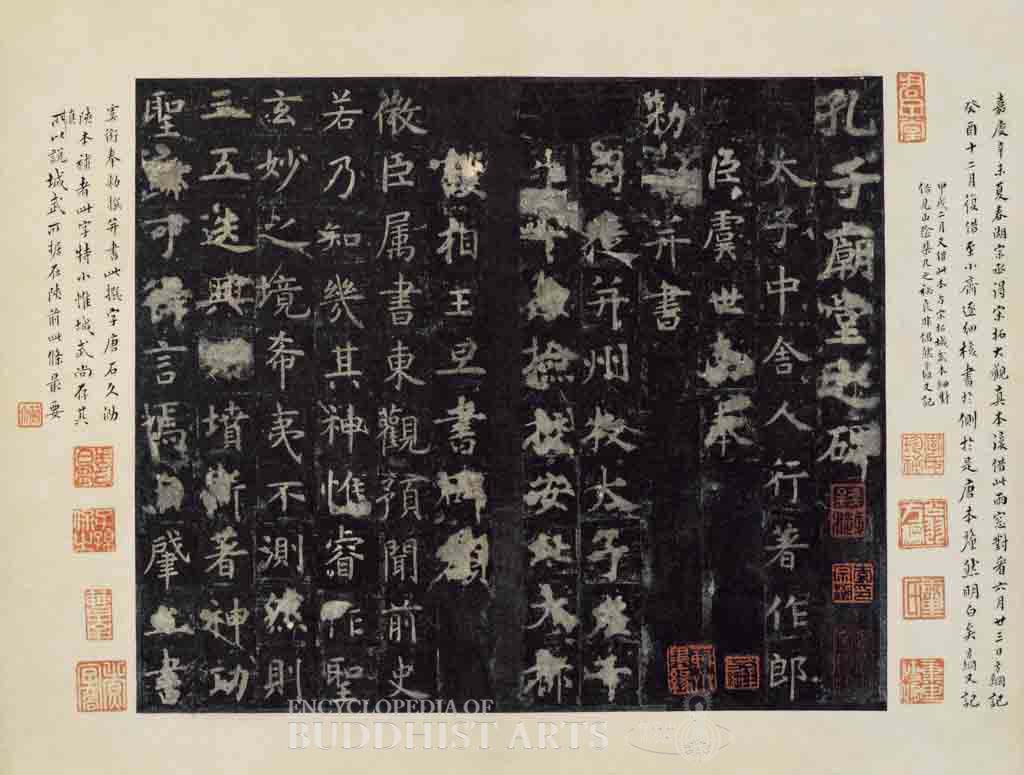
Stele of Confucius Temple by Yu Shinan; Tang dynasty, dated 626
Rubbing
Yu Shinan
CHINA, Zhejiang, Ningbo; Chen to Tang dynasty (557–907)
Yu Shinan, also known as Shibo, was a calligrapher and poet from Yuezhou (present day Yuyao, Ningbo). A quiet individual who lead a simple life, he was studious, diligent, and determined. He served as the head of the imperial library during the Early Tang period (618–712) and was granted a position as a nobleman of Yongxing county, thus he was also referred to as Yu Yongxing. Posthumously, he was bestowed the name Wenyi. Emperor Taizong (reigned 626–649) of the Tang dynasty once stated in an imperial edict: “Shinan is a man of extraordinary talents with five outstanding qualities: loyal, brotherly, erudite, rhetorical, and literate.”
Having learned calligraphy from Chan Master Zhiyong, Yu carried forth the traditions of the famous calligraphers Wang Xizhi and Wang Xianzhi. The style of Yu’s calligraphy was reminiscent of the Wangs’ energetic appeal in composition, having just the right amount of firmness and softness, utilizing square and round strokes, and wielding a vigorous and sturdy hand. His style was later known as the Yu font. Along with Ouyang Xun, Chu Suiliang, and Xue Ji, he was renowned as one of the Four Great Calligraphers of the Early Tang period. As remarked in Xuanhe Catalog of Calligraphy, “Yu’s form inwardly contains firmness and softness, while Ouyang’s outward style displays boldness and strength. As for the concealed abilities that a gentleman internally possesses, Yu is superior.” His Essay on the Essence of Calligraphy elaborated the writing rules and the spirit and charm of various calligraphic forms, and was respected and modeled after by many artists.
Yu’s calligraphic work, the Stele of Confucius Temple, is the most famous among his few works that remain today; a rubbing copy is currently kept at the Mitsui Memorial Museum in Tokyo, Japan. Epitaph of Princess Runan is kept at the Shanghai Museum, while Accumulating Time, Virtuous Person, and Borrowing a Milk Bowl comprise his well-known works in running script. Notes on the Principles of Calligraphy and Notes on Within the Boundaries are two works in cursive script, while Stele of Zhaoren Temple in regular script is said to also be the work of Yu.
For more details, go to the Encyclopedia of Buddhist Arts: People, page 326.
Cite this article:
author = Hsingyun and Youheng and Youlu and Pokorski, Stefanie and Yichao and Mankuang and Miaohsi,
booktitle = {Encyclopedia of Buddhist Arts: People },
pages = 326,
title = {{Yu Shinan}},
volume = 19,
year = {2016}}