
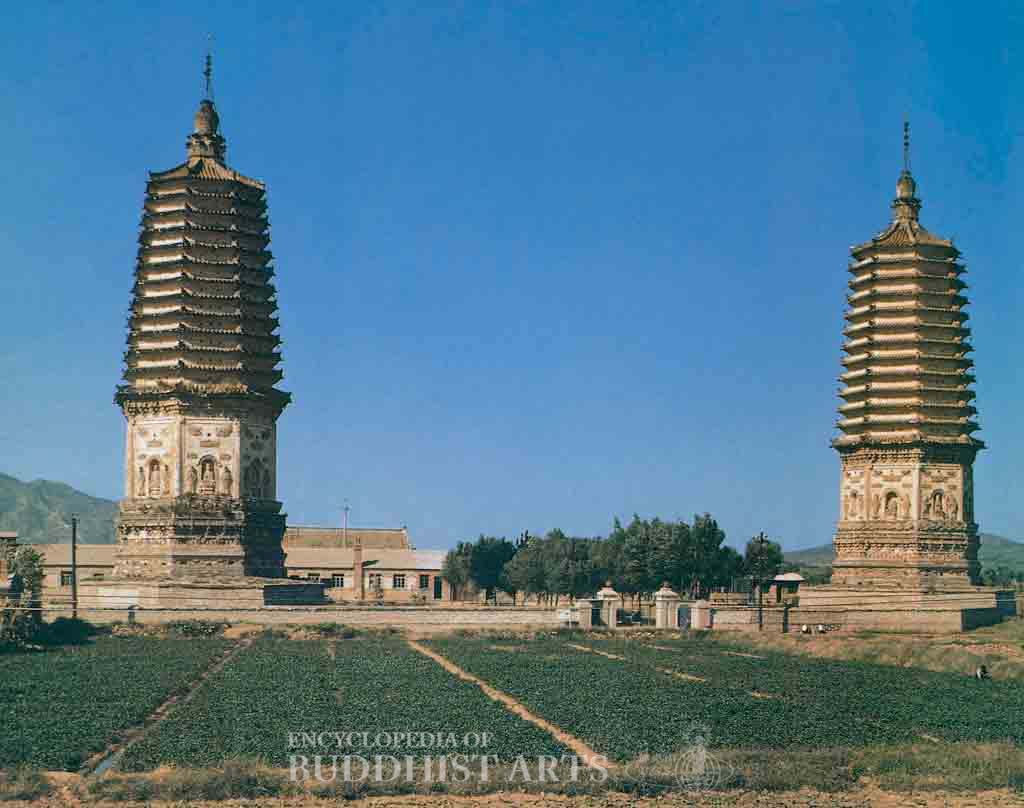
Chongxing Temple Twin Pagodas
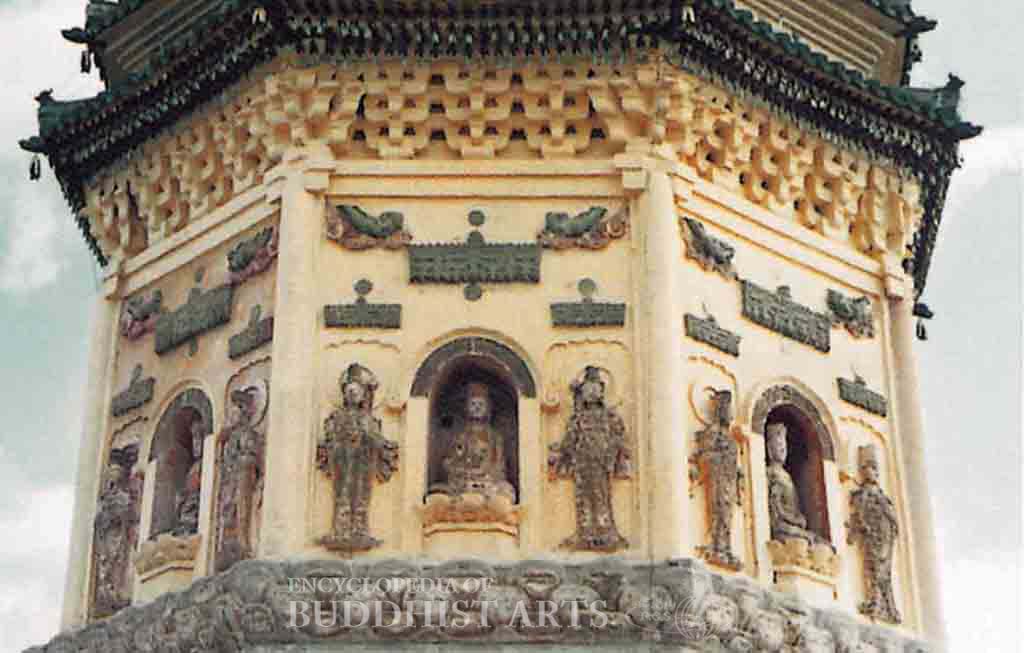
Chongxing Temple Twin Pagodas: West Pagoda (detail)
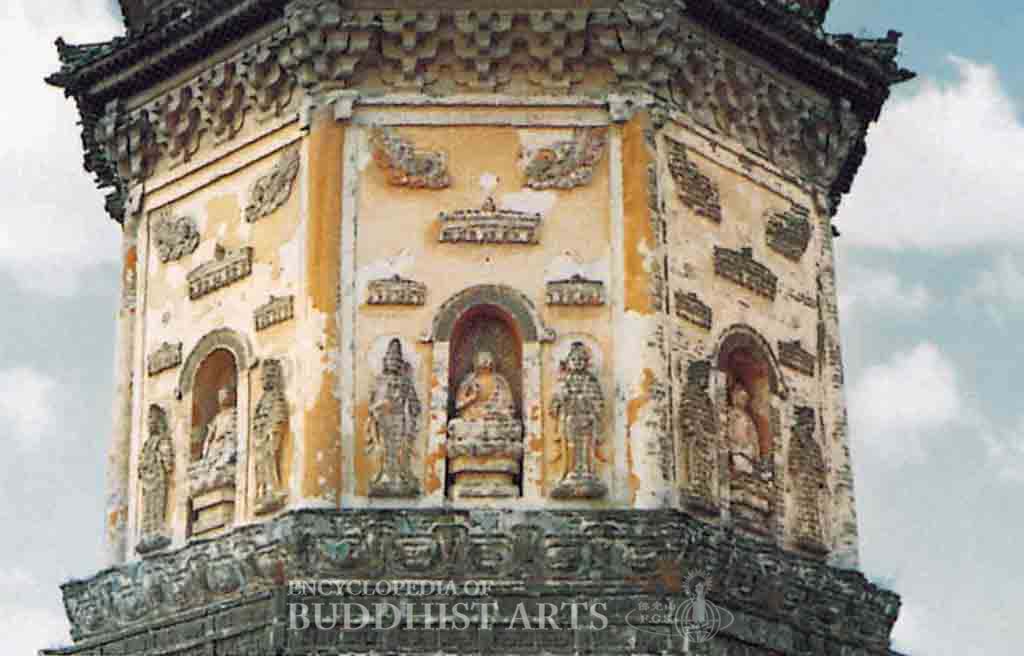
Chongxing Temple Twin Pagodas: East Pagoda (detail)
Chongxing Temple Twin Pagodas
CHINA, Liaoning, Jinzhou
The exact year of their construction is unknown but, based on the design and style of the pagodas, they were most likely built between 1055 and 1125 during the Liao dynasty. They were repaired a number of times from the Yuan (1271–1368) to Qing (1644–1911) dynasties. They appear well-preserved and were listed as National Cultural Heritage Sites in 1988.
The twin pagodas stand 43 m apart on an east-west axis. Both brick pagodas are solid and built in the same style: they are octagonal and have thirteen tiers. The East Pagoda is 44.5 m high, while the West Pagoda is 42.6 m high. They stand on octagonal base platforms followed by Sumeru-shaped platforms, with warriors carved at the corners of the indented sections. Brick bracket sets support a flat base that is surrounded by balustrades. The swastika symbol is carved upon every panel, which is a typical design of the Liao (907–1125) and Jin (1115–1234) dynasties. At the very top of the Sumeru-shaped platform there are lotus-shaped platforms supporting the pagoda body. The first tier is much higher than the remaining tiers. Arched niches can be found on every side of the first tier, each featuring a seated Buddha inside the niche and two attendants outside. Canopies and apsaras inlaid with mirrors are carved above the niches. The pagodas have octagonal pyramidal roofs surmounted by spires in excellent condition. The spires consist of an octagonal base, an upturned lotus, a vase, and a finial with jewels. On the wall of the West Pagoda there is a stele, dated 1600 during the Ming dynasty, recording the repairs undertaken on the pagodas.
For more details, go to the Encyclopedia of Buddhist Arts: Architecture A-F, page 166.
Cite this article:
author = Hsingyun and Youheng and Johnson, Peter and Mankuang and Lancaster, Lewis,
booktitle = {Encyclopedia of Buddhist Arts: Architecture A-F},
pages = 166,
title = {{Chongxing Temple Twin Pagodas}},
volume = 1,
year = {2016}}