
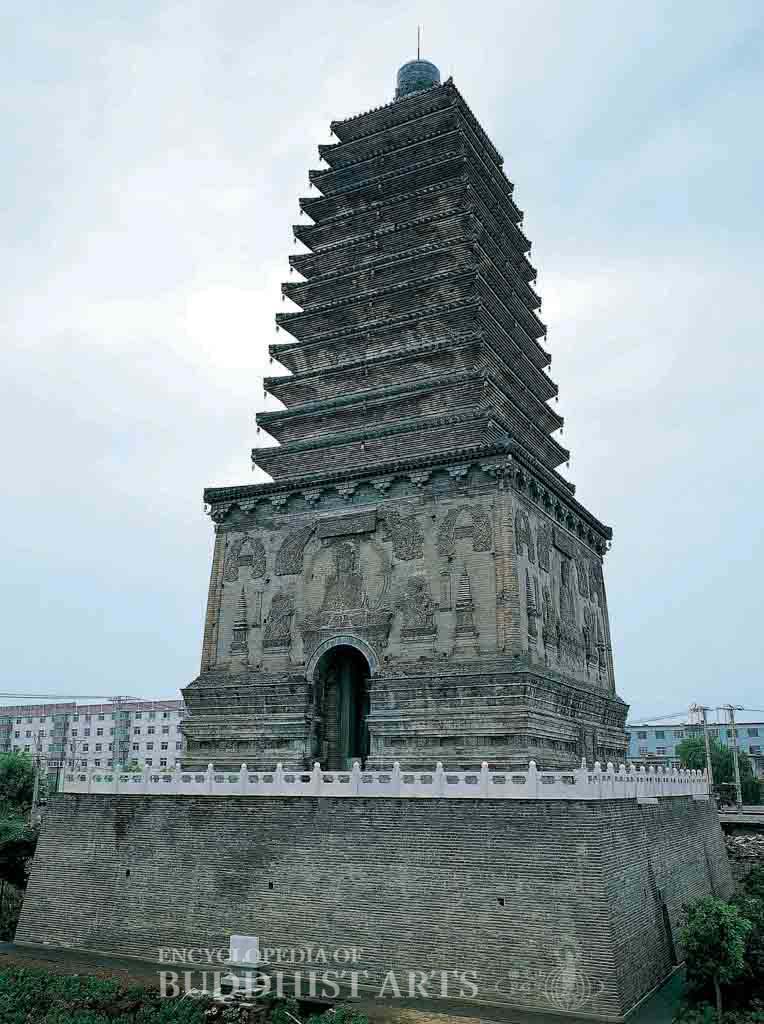
Chaoyang North Pagoda
Chaoyang North Pagoda
CHINA, Liaoning, Chaoyang
There were initially three pagodas in the city of Chaoyang and this one was located to the north. It is the oldest extant pagoda in the northeast of China. The original pagoda was built between 477 and 499 during the Northern Wei dynasty, and it was reconstructed during the Tang dynasty (618–907). Bricks were added to the exterior of the pagoda in 1044 during the Liao dynasty, resulting in its present appearance. It was listed as a National Cultural Heritage Site in 1988.
The hollow square brick pagoda is 42.6 m high and has 13 tiers. The first tier is much higher than the subsequent ones. It has an arched doorway on the south side leading to a chamber. On the sides there are brick reliefs of four of the Five Dhyani Buddhas, Ratnasambhava, Amitabha, Amoghasiddhi and Aksobhya, together with Eight Great Bodhisattvas and Eight Major Pagodas. Rounded pilasters can be found at the corners. There are imitation architraves mounted with bracket sets. From the second tier upwards the eaves consist of corbeling.
During renovations carried out in recent years, an underground palace and a heavenly palace were discovered. The underground palace is located directly beneath the central chamber and contains a stone sutra pillar. The heavenly palace is located above the central chamber. Inside there are reliquaries and treasures from the Liao dynasty (907–1125).
For more details, go to the Encyclopedia of Buddhist Arts: Architecture A-F, page 125.
Cite this article:
author = Hsingyun and Youheng and Johnson, Peter and Mankuang and Lancaster, Lewis,
booktitle = {Encyclopedia of Buddhist Arts: Architecture A-F},
pages = 125,
title = {{Chaoyang North Pagoda}},
volume = 1,
year = {2016}}