
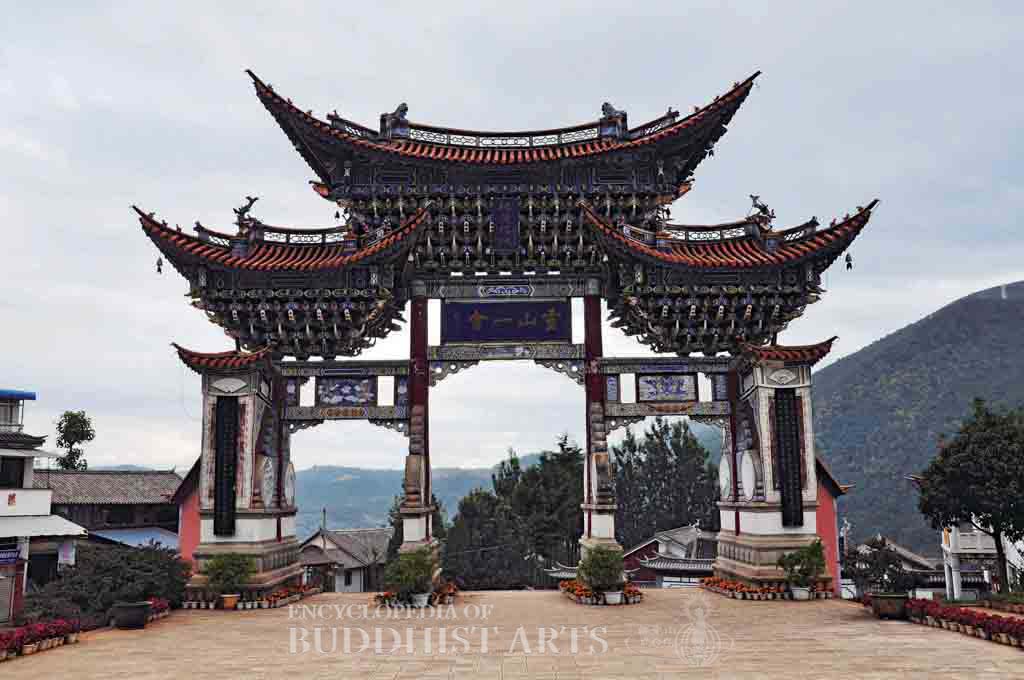
Jizushan: Gateway
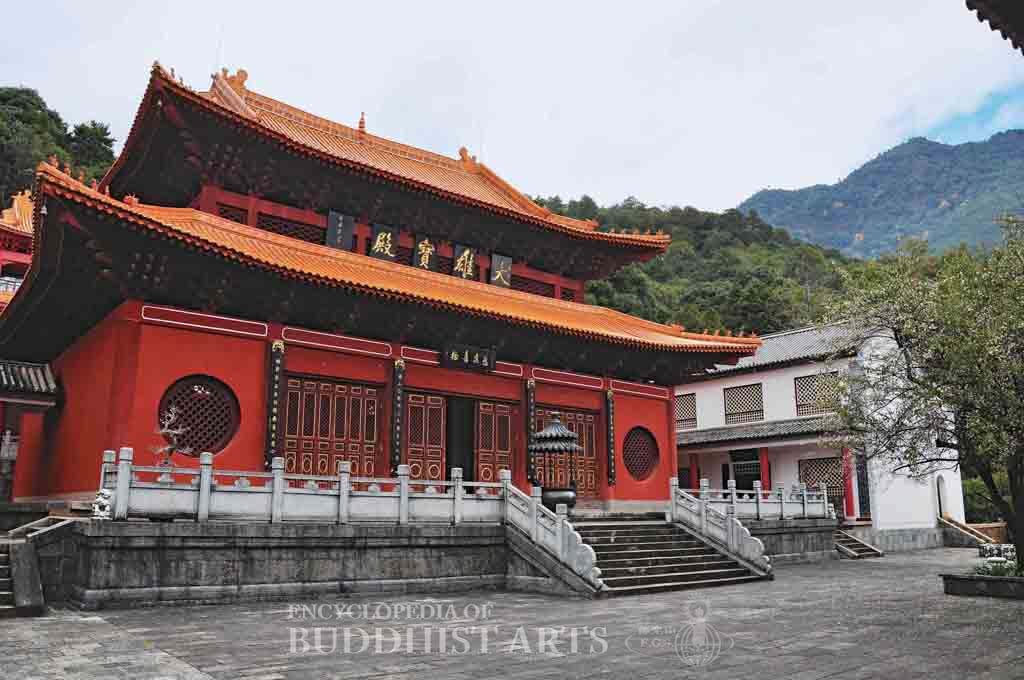
Jizushan: Xuyun Temple - Great Hero Hall
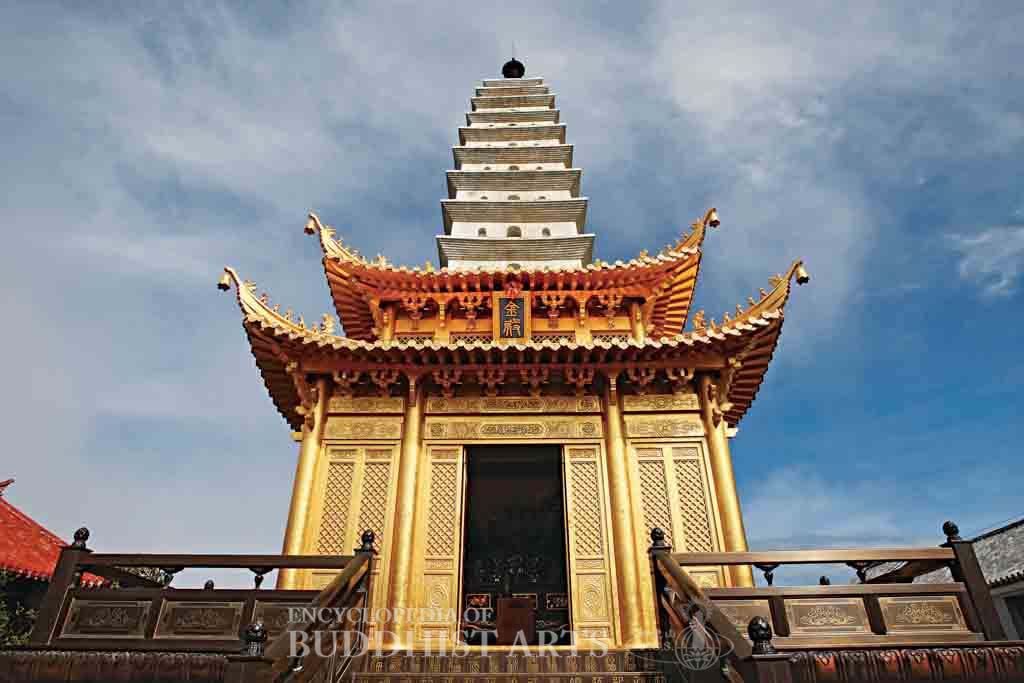
Jizushan: Jinding Temple - Golden Spire

Jizushan
CHINA, Yunnan, Dali
Jizushan means Chicken Foot Mountain. The mountain’s highest peak is 3,240 m above sea level. The name comes from the appearance of the mountain range, which is said to resemble a chicken’s foot. This area became a hub of Buddhism during the Kingdom of Nanzhao (752–902). The Jizushan area expanded during the Dali Kingdom (937–1253), its fame spread in the Yuan dynasty (1271–1368), and it prospered during the Ming dynasty (1368–1644). By the 1920s the temples atop the mountain were in complete decline; however, through the efforts of Master Xuyun, many of them were restored to their former glory.
Jizushan covers 2,822 ha and has many temples built upon its slopes. At the height of its success, there were 36 large temples, 72 small temples, and 167 hermitages. The most famous temples were Zhusheng, Shizhong, Jiashe, Dajue, Huayan, Fangguang, Jiguang, and Xitan, which were collectively known as the Eight Major Temples. Dajue Temple has since been renamed Xuyun Temple to commemorate Master Xuyun’s dedicated restoration work. In addition, the Jinding Temple was built on one of the cliffs, as well as the 40 m high Surangama Pagoda, which is a prominent landmark. More than 230 structures are distributed throughout the mountain range, including pavilions, terraces, towers, halls, gateways, steles, pagodas, ponds and bridges. A stone gate, known as Huashou, is situated on a cliff; it is said that this is where Mahakasyapa waited in samadhi for the descent of Maitreya.
For more details, go to the Encyclopedia of Buddhist Arts: Architecture G-L, page 546.
Cite this article:
author = Hsingyun and Youheng and Johnson, Peter and Mankuang and Lancaster, Lewis,
booktitle = {Encyclopedia of Buddhist Arts: Architecture G-L},
pages = 546,
title = {{Jizushan}},
volume = 2,
year = {2016}}