
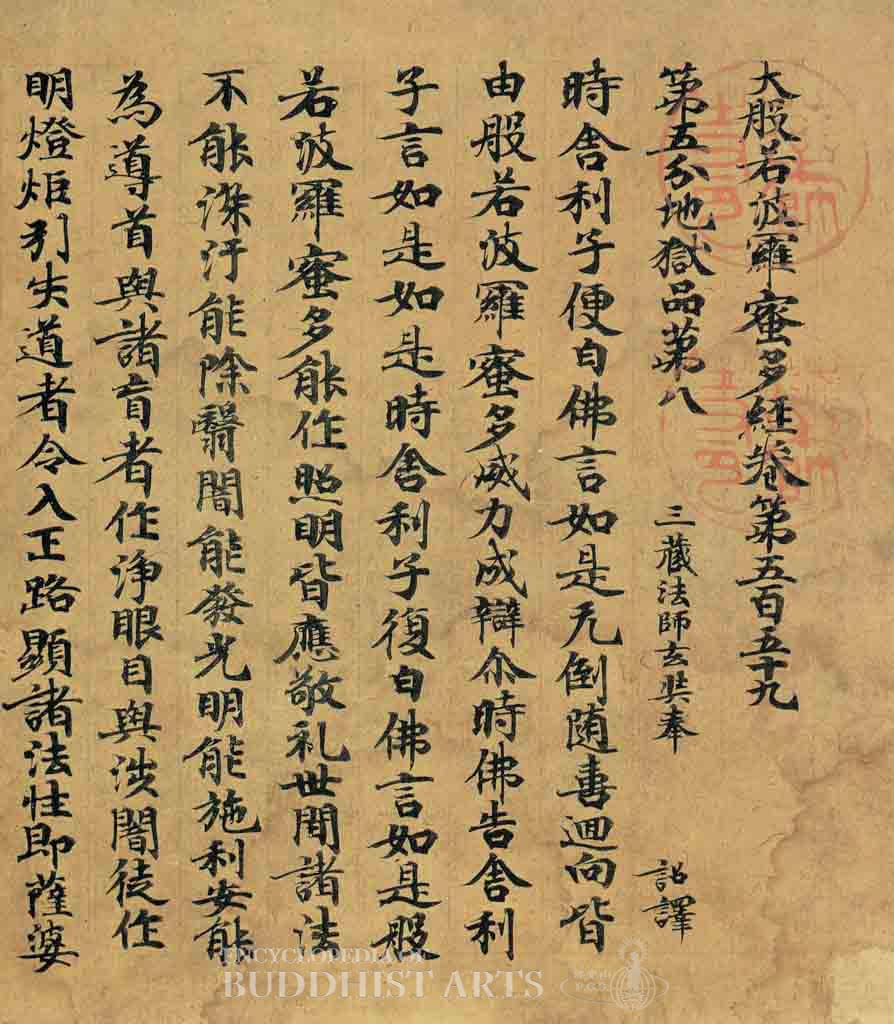
Mahaprajnaparamita Sutra - Fascicle 559 (right end section)
Ink on paper
Mahaprajnaparamita Sutra
JAPAN; Nara period
Dating from the Nara period (710–794), this manuscript is a copy of the Mahaprajnaparamita Sutra as translated by Tripitaka Master Xuanzang of the Tang dynasty (618–907). Originally in the possession of Yakushiji Temple in Nara, the complete set of 600 fascicles were later scattered across the country, of which 387 fascicles are currently kept at the Fujita Art Museum in Osaka. This collection was listed as a National Treasure of Japan in 1967.
The regular and balanced characters were rendered with a sure hand, revealing a sense of confidence and determination. Each polished character, composed of a rich variety of unconstrained strokes, invoke the essence of Buddhist thought and further evince the artist’s mastery and conscientiousness.
For more details, go to the Encyclopedia of Buddhist Arts: Calligraphy, page 149.
Cite this article:
author = Hsingyun and Youheng and Youlu and Pokorski, Stefanie and Mankuang and Edson, Gary,
booktitle = {Encyclopedia of Buddhist Arts: Calligraphy },
pages = 149,
title = {{Mahaprajnaparamita Sutra}},
volume = 17,
year = {2016}}