
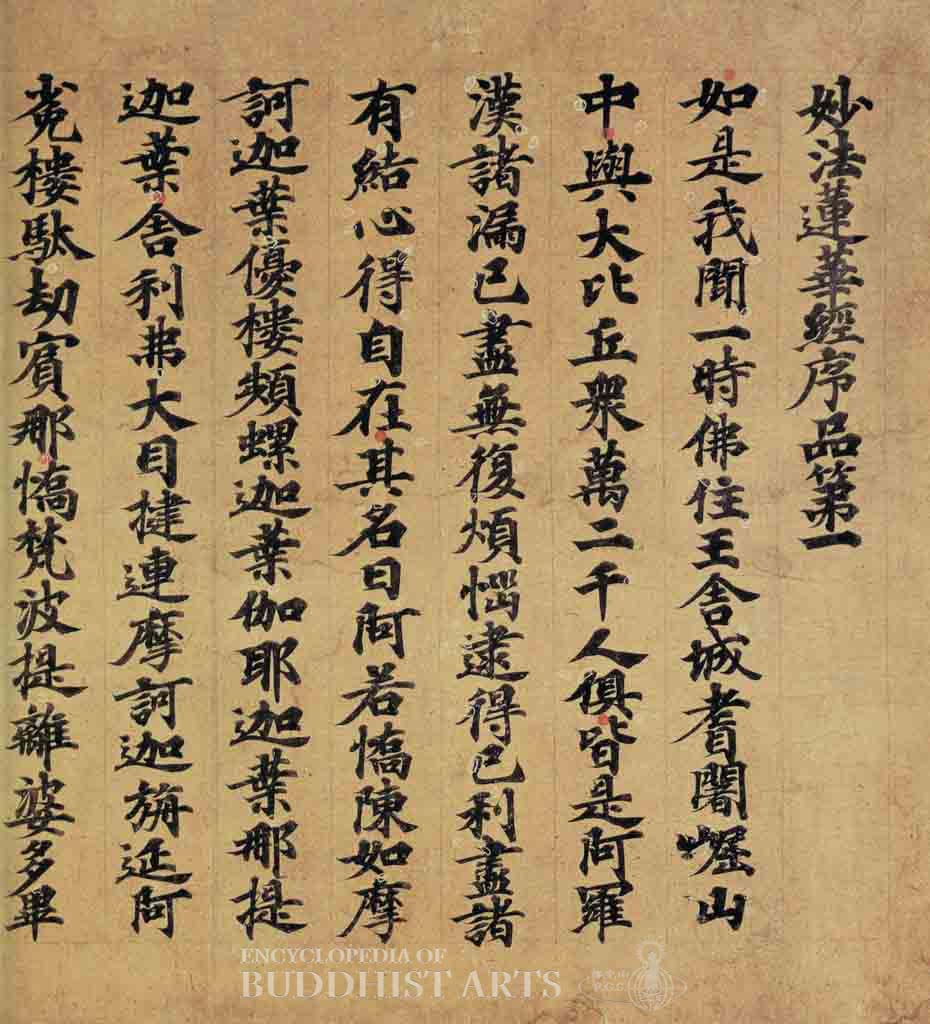
Ryokoin Temple: Lotus Sutra - Fascicle 1 (right end section)
Ink on paper
Ryokoin Temple: Lotus Sutra
JAPAN, Wakayama, Ito; Nara period
This calligraphic piece, listed as a National Treasure in 1952, is also known as the “Lotus Sutra in Large Characters,” as it was written with 15 characters per line in large, broad strokes. It was scripted during the Nara period (710–794) and originated with eight fascicles, the third fascicle of which is missing. There is a postscript written by monk Meizan from Koyasan in Wakayama which carries the line, “With this encounter, I hereby wish for instant enlightenment without having to endure the three asamkhyeyakalpas (innumerable eons).” Bold, simple strokes are largely used, and each articulation is diligently executed with clear, concise rhythm. Even the treatments at thinner strokes are applied with confidence. Each character is proportionately wide in shape and presented in an upright, balanced form, exhibiting the characteristics of an elegant and exceptional piece of calligraphy.
For more details, go to the Encyclopedia of Buddhist Arts: Calligraphy, page 207.
Cite this article:
author = Hsingyun and Youheng and Youlu and Pokorski, Stefanie and Mankuang and Edson, Gary,
booktitle = {Encyclopedia of Buddhist Arts: Calligraphy },
pages = 207,
title = {{Ryokoin Temple: Lotus Sutra}},
volume = 17,
year = {2016}}