
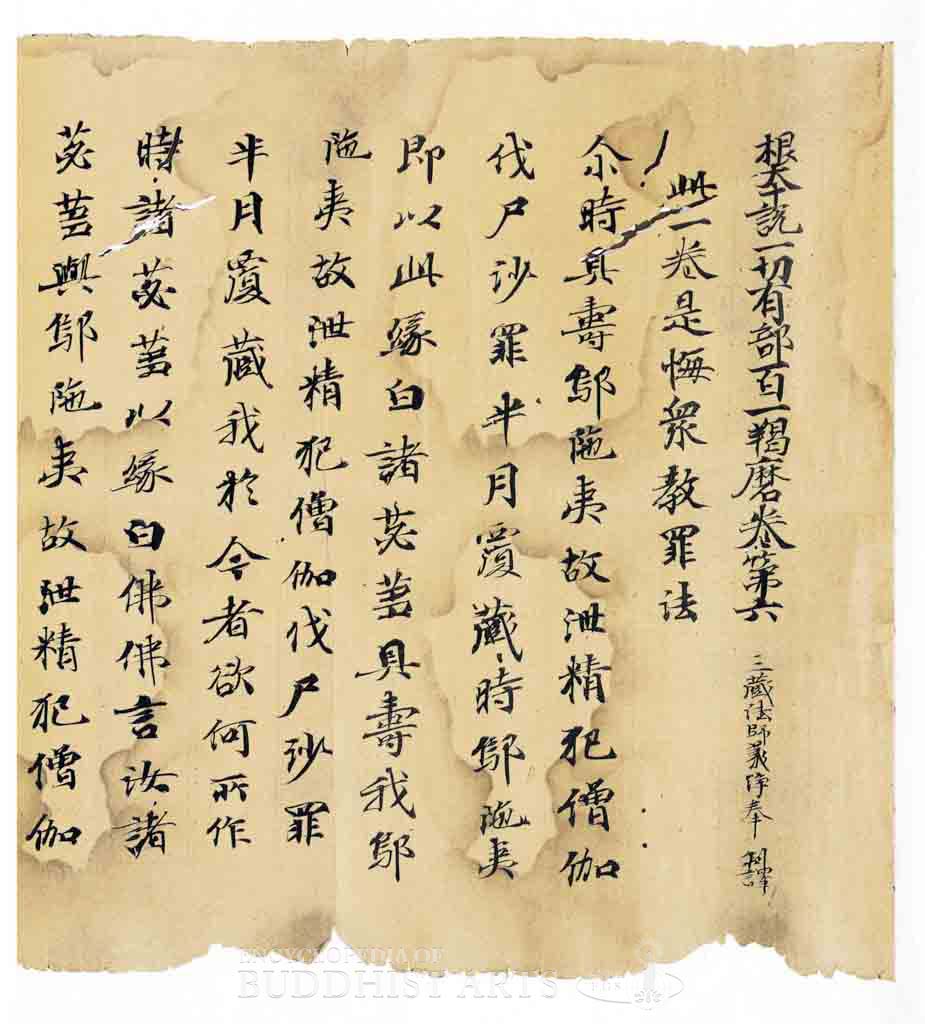
Complete Karma Rituals - Fascicle 6 (detail)
Ink on hemp paper
Complete Karma Rituals - Fascicle 6
JAPAN; Nara period
This work is a copy of the original sutra that was translated by Tripitaka Master Yijing of the Tang dynasty (618–907). Its contents relate to the concept of how Buddhist monks and lay people work together to accomplish tasks. There is an inscription at the end of the scroll which infers that the piece was once kept at Todaiji Temple in Nara, and that it could have been written by a clerical staff of the Shosoin, a warehouse that retains ancient temple treasures. This fascicle, which is well-preserved, consists of a scroll that is tied with a single rope. It was listed as a National Treasure of Japan in 1951.
The calligraphy was scripted with sparse and clear strokes, and the ample spacing between the characters gives a sense of order and organization. The speed of the writing appears fluid, implying that it was executed according to a carefully considered plan.
For more details, go to the Encyclopedia of Buddhist Arts: Calligraphy, page 36.
Cite this article:
author = Hsingyun and Youheng and Youlu and Pokorski, Stefanie and Mankuang and Edson, Gary,
booktitle = {Encyclopedia of Buddhist Arts: Calligraphy },
pages = 36,
title = {{Complete Karma Rituals - Fascicle 6}},
volume = 17,
year = {2016}}