
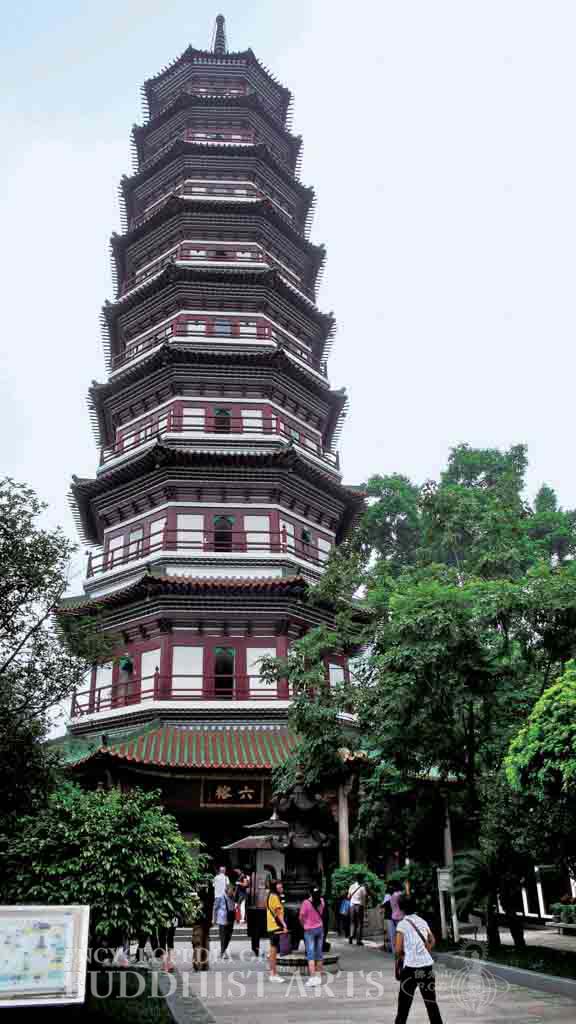
Liurong Temple Pagoda
Liurong Temple Pagoda
CHINA, Guangdong, Guangzhou
This pagoda is located within Liurong Temple and is the tallest existing Song-style pagoda in Lingnan. It was built in 537 during the Southern Liang dynasty, at the same time as the temple. Its purpose was to enshrine the Buddha’s relic that the monk Tanyu, uncle of Emperor Wu (reigned 502–549), had brought back from Cambodia. It was listed as a National Cultural Heritage Site in 2006.
The octagonal 57 m high pagoda has nine external stories but 17 stories internally. The stone base is bordered by stone balustrades with panels decorated with engravings of auspicious symbols. Apart from the wooden bracket sets, rafters, and floors, the rest of the structure is made of brick. The eaves consist of brick corbeling. There are pilasters, corner columns, architraves, and upper architraves around the exterior of the pagoda body. Bricks with inscriptions from the Song dynasty (960–1279) dot the inside walls. The spire was cast in 1358 during the Yuan dynasty. Its unusual copper body is covered in 1,023 reliefs of Buddha images, and illustrations of heavenly palace pagodas surrounded by clouds. Although the pagoda has been repaired numerous times, it still retains Song dynasty characteristics.
For more details, go to the Encyclopedia of Buddhist Arts: Architecture G-L, page 681.
Cite this article:
author = Hsingyun and Youheng and Johnson, Peter and Mankuang and Lancaster, Lewis,
booktitle = {Encyclopedia of Buddhist Arts: Architecture G-L},
pages = 681,
title = {{Liurong Temple Pagoda}},
volume = 2,
year = {2016}}