
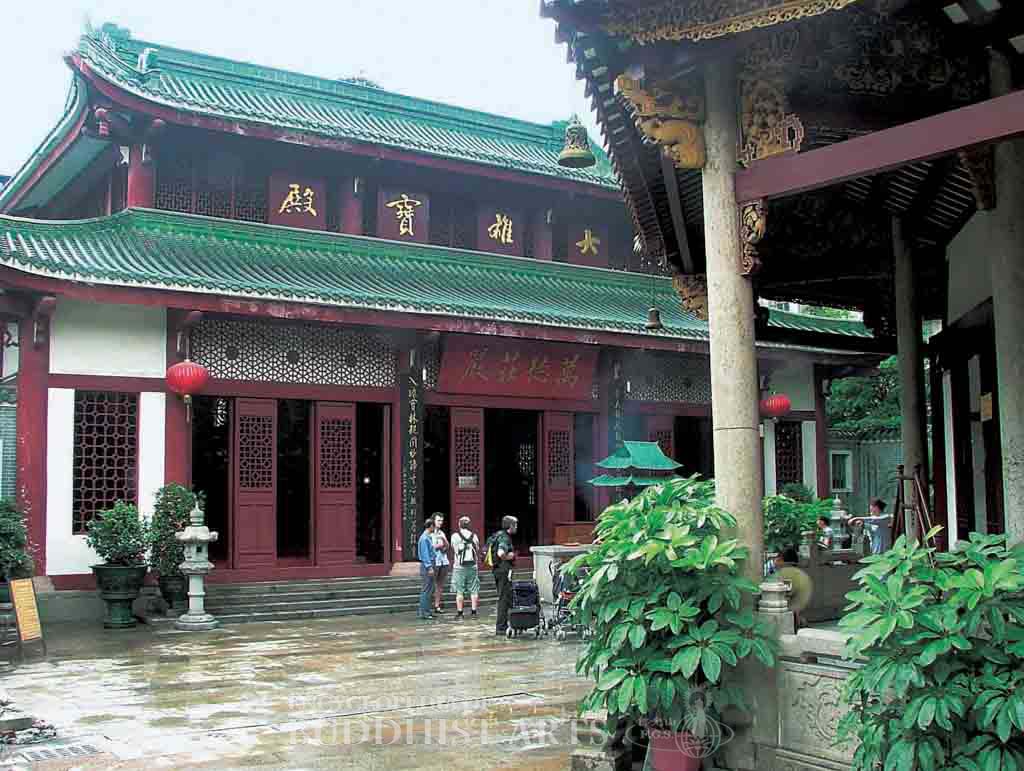
Liurong Temple: Great Hero Hall
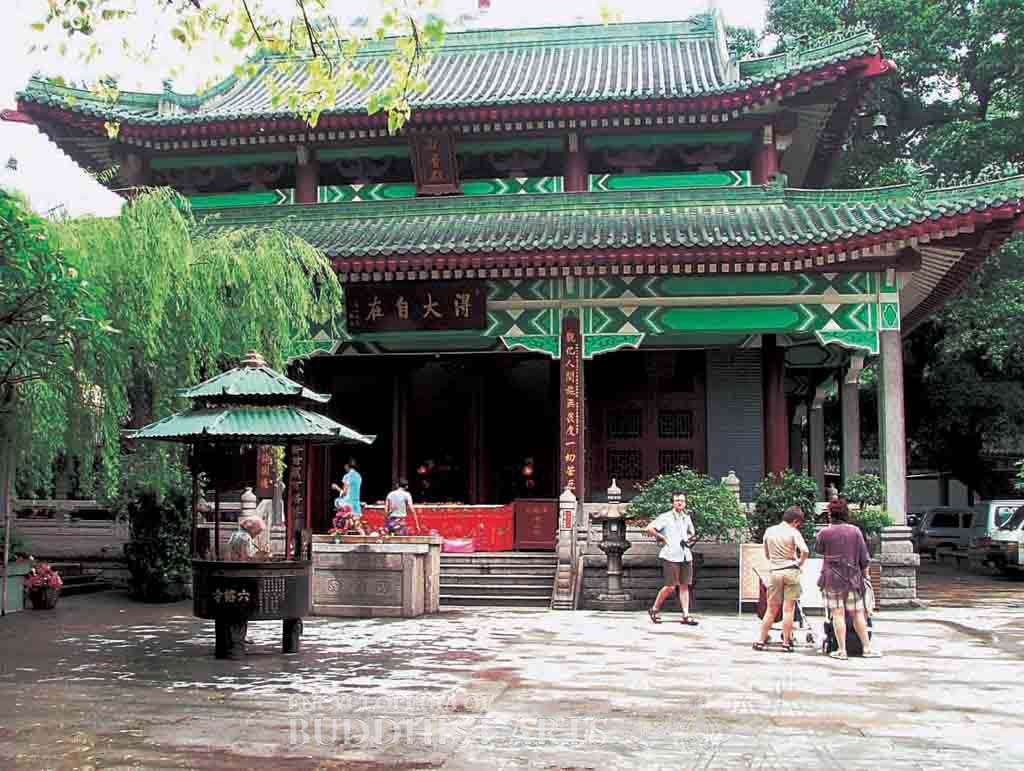
Liurong Temple: Avalokitesvara Hall
Liurong Temple
CHINA, Guangdong, Guangzhou
Liurong means Six Banyan Trees. The temple was built in 537 during the Southern Liang dynasty by the monk Tanyu to enshrine Buddha relics brought back from Cambodia. It was listed as a key Buddhist temple in the Han region of China in 1983.
The most important buildings of the temple include the main temple gate, Heavenly King Hall, Skanda Hall, Great Hero Hall, Flower Pagoda, Avalokitesvara Hall, Sixth Patriarch Hall, lecture hall, and sutra repository.
Occupying an area of 300 sq m, the Great Hero Hall has a double-eave hip-and-gable roof and is five bays wide. It contains 6 m bronze statues of Sakyamuni Buddha, Amitabha Buddha, and the Medicine Buddha. They were cast in 1663 during the Qing dynasty and as the largest brass statues in Guangdong weigh around 10 t each. The Avalokitesvara Hall has a double-eave hip-and-gable roof and is three bays wide. The Sixth Patriarch Hall has an overhanging gable roof and is three bays wide. A copper statue of Master Huineng, the Sixth Chan Patriarch, cast in 989 during the Northern Song dynasty, is enshrined within the hall. Two stele passageways, with over 20 ancient steles, can be found within the temple.
For more details, go to the Encyclopedia of Buddhist Arts: Architecture G-L, page 680.
Cite this article:
author = Hsingyun and Youheng and Johnson, Peter and Mankuang and Lancaster, Lewis,
booktitle = {Encyclopedia of Buddhist Arts: Architecture G-L},
pages = 680,
title = {{Liurong Temple}},
volume = 2,
year = {2016}}