

Nanhua Temple: Caoxi Gate
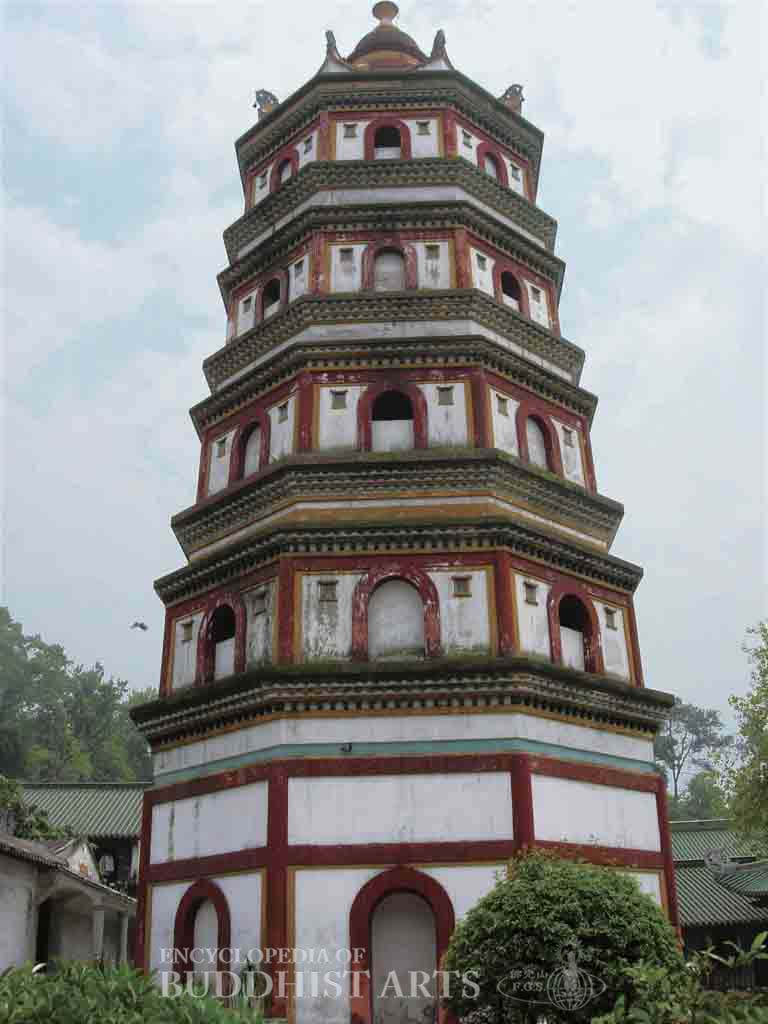
Nanhua Temple: Linzhao Pagoda
Nanhua Temple
CHINA, Guangdong, Shaoguan
The temple was built in 502 by Emperor Wu (reigned 502–549) of the Liang dynasty. Master Huineng, the Sixth Chan Patriarch, became the abbot of the temple in 677 during the Tang dynasty. For this reason this place is considered to be the ancestral temple of Southern Chan Buddhism. The temple was given its present name in 968 during the Northern Song dynasty. In the late Yuan dynasty (1271–1368) it was taken over by the army. It was not until 1600 during the Ming dynasty that the temple revived under the care of Chan Master Hanshan Deqing. Since then, the temple has been repaired a number of times, including a major restoration undertaken in 1934 by Master Xuyun. It was listed as a National Cultural Heritage Site in 2001.
The structures on the grounds of the temple cover an area of 1.2 ha. The buildings along the central axis include the Caoxi Gate, Baolin Gate, Heavenly King Hall, Great Hero Hall, Lingzhao Pagoda, sutra repository, ancestral hall, the abbot’s quarters, as well as the bell and drum Towers. To the north there is a stone platform upon which Master Huineng meditated, as well as the Zhuoxi Spring where he washed his monastic robe.
The Great Hero Hall has a double-eave hip-and-gable roof and contains gilded statues of Sakyamuni Buddha, Amitabha Buddha, and Medicine Buddha, all of which are 6.4 m high. Colored molded statues of the Five Hundred Arhats line the walls along the sides and at the back. The octagonal five-story Lingzhao Pagoda is 29.6 m high. At the center of the ancestral hall there are three Buddha niches, in which the relics of Masters Huineng, Hanshan Deqing, and Dantian are enshrined. Within the lower level of the drum tower there is a square, five-tier iron pagoda, which has a Sumeru base from the Five Dynasties (917–971), and a pagoda body from the Qing dynasty (1644–1911).
The temple houses valuable artifacts, such as the kasaya of A Thousand Buddhas, imperial edicts from the Tang dynasty (618–907), wooden Arhat statues from the Northern Song dynasty (960–1127), a Southern Song dynasty (1127–1279) giant bronze bell weighing 10 t, and a copy of the Avatamsaka Sutra printed in gold dust bestowed by Emperor Ying (reigned 1435–1449) of the Ming dynasty.
For more details, go to the Encyclopedia of Buddhist Arts: Architecture M-S, page 781.
Cite this article:
author = Hsingyun and Youheng and Johnson, Peter and Mankuang and Lancaster, Lewis,
booktitle = {Encyclopedia of Buddhist Arts: Architecture M-S},
pages = 781,
title = {{Nanhua Temple}},
volume = 3,
year = {2016}}