
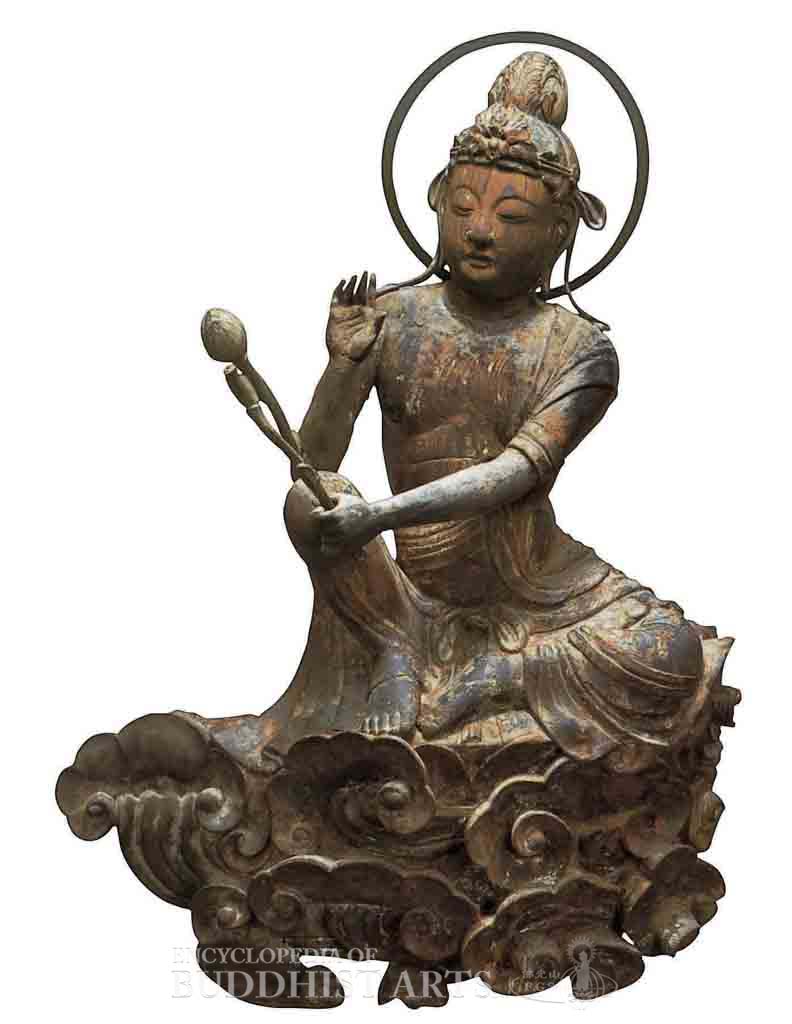
Byodoin Temple Phoenix Hall: Figures Making Offerings - Bodhisattva
Wood
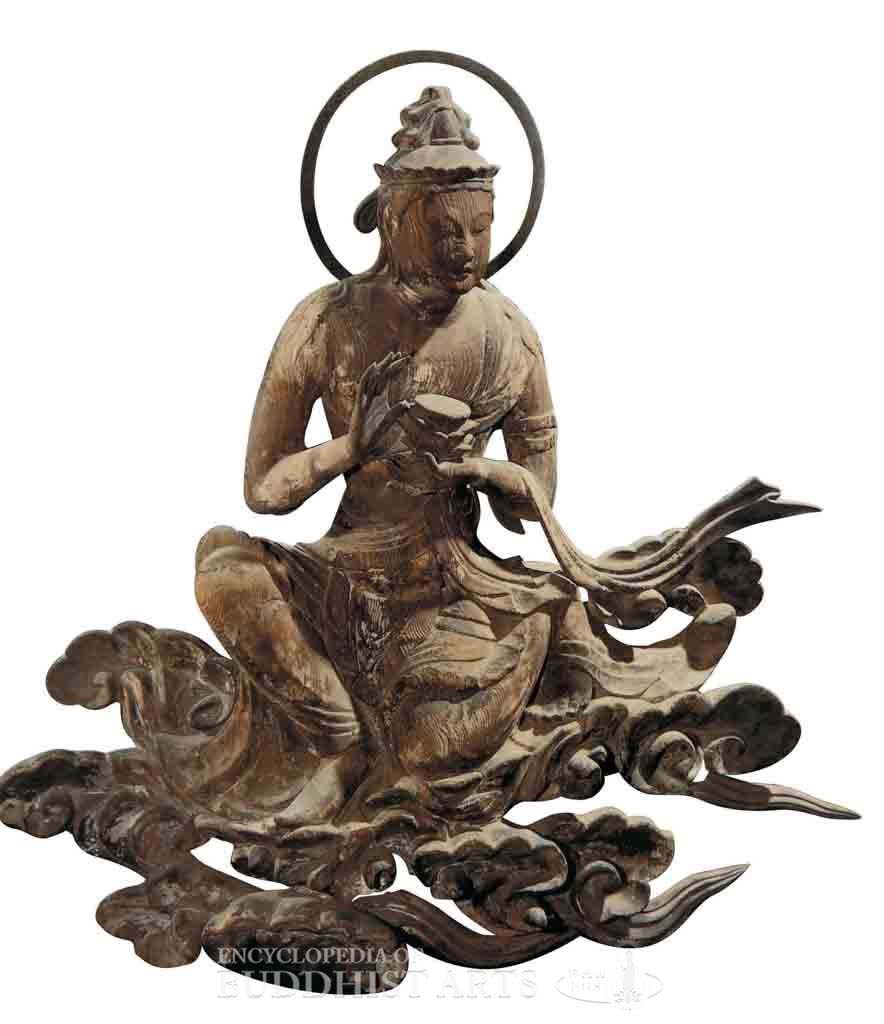
Byodoin Temple Phoenix Hall: Figures Making Offerings - Heavenly Musician

Byodoin Temple Phoenix Hall: Figures Making Offerings - Heavenly Dancer
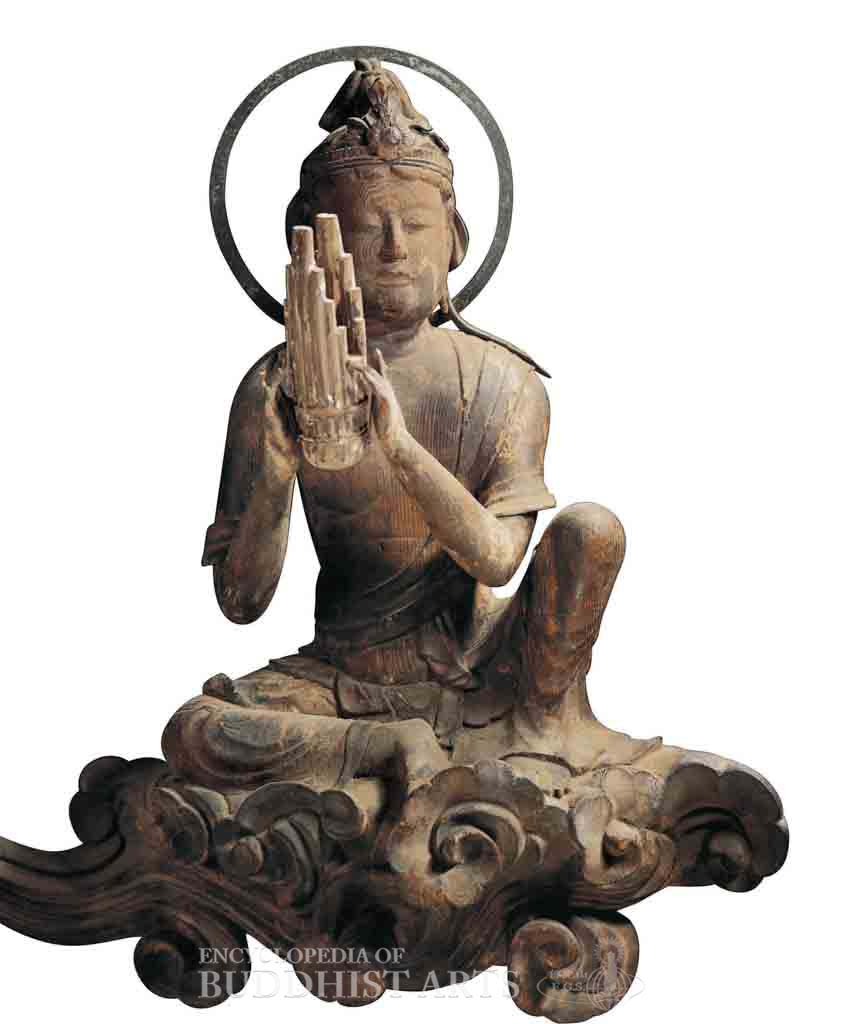
Byodoin Temple Phoenix Hall: Figures Making Offerings - Heavenly Musician
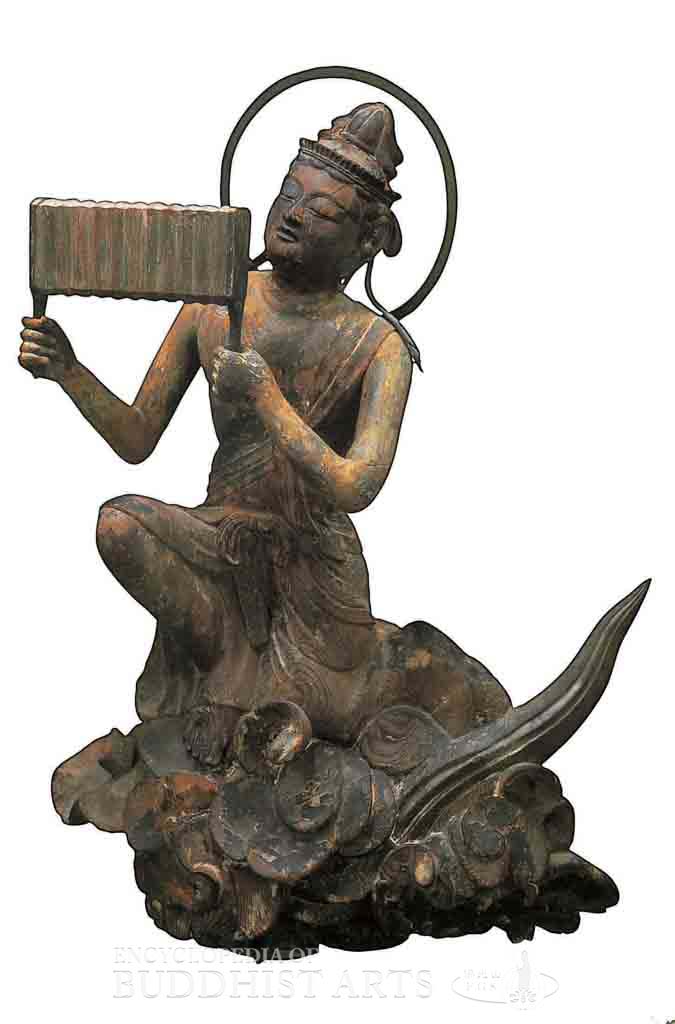
Byodoin Temple Phoenix Hall: Figures Making Offerings - Heavenly Musician
Byodoin Temple Phoenix Hall: Figures Making Offerings
JAPAN, Kyoto, Uji; Heian period
These figures are found attached to the four walls surrounding the seated Amitabha Buddha within the Phoenix Hall. There are 51 carvings; 25 Bodhisattvas and 26 heavenly musicians and dancers, ranging between 40 cm to 80 cm in height. Sculptors from the studio of Jocho were tasked with most of the work but a few were masterpieces by Jocho, his son Kakujo, and his disciple Chosei. The ensemble is the earliest example of Bodhisattva and heavenly figures employed as wall decorations in Japan. They were recognized as National Treasures in 1955.
The Fujiwara period (897–1185) suffered numerous natural and man-made disasters, which saw the concept of Mappo (the age of the decline of the Dharma) becoming deeply rooted among aristocratic society. Sculptures with the Pure Land as the subject consequently became increasingly popular. Fujiwara Yorimichi constructed the Phoenix Hall in 1053 as a representation of the Western Pure Land. The heavenly musicians are playing musical instruments such as the drum, rattle drums, gongs, flute, reed instrument, pipa, zither, and harp. They are shown in various seated postures such as full or half lotus, kneeling, or royal ease. Other figures carry lotuses, banners, canopies, or hold their hands in various mudras.
The Bodhisattvas wear headdresses, and have plain nimbuses. They are mounted on clouds with their garments fluttering about them, in a carefree manner. The clouds are carved in bas-relief to enhance visibility, while the figures above them are in high relief. The original pigments and gold leaf have flaked away, revealing the raw wood grain below.
For more details, go to the Encyclopedia of Buddhist Arts: Sculpture A-F, page 234.
Cite this article:
author = Hsingyun and Youheng and Lovelock, Yann and Chou, Yuan and Huntington, Susan and Edson, Gary and Neather, Robert,
booktitle = {Encyclopedia of Buddhist Arts: Sculpture A-F},
pages = 234,
title = {{Byodoin Temple Phoenix Hall: Figures Making Offerings}},
volume = 10,
year = {2016}}