
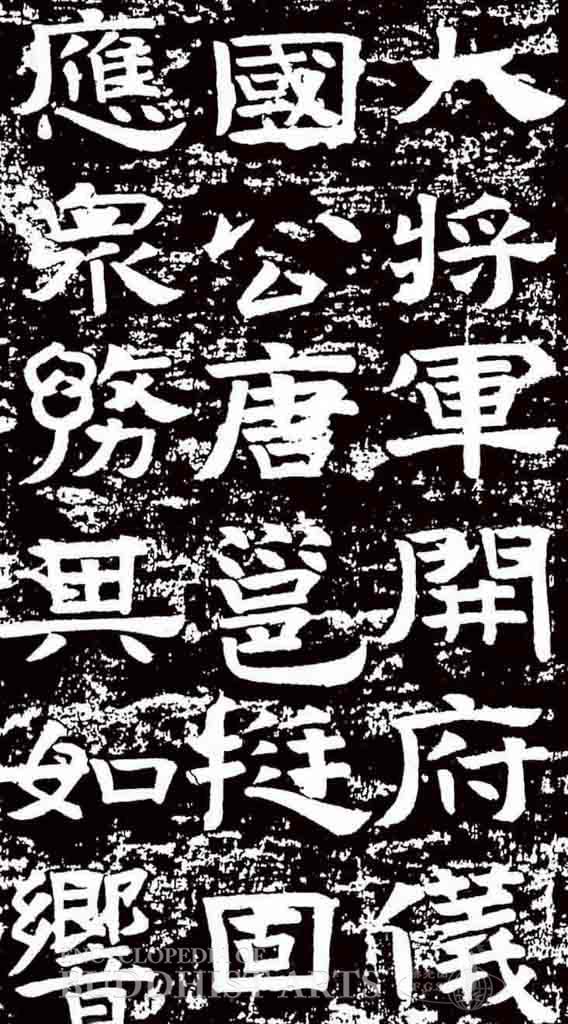
North Xiangtangshan Grotto 3: Stele of Tang Yong’s Sutra Inscriptions (detail)
Rubbing
North Xiangtangshan Grotto 3: Stele of Tang Yong’s Sutra Inscriptions
CHINA, Hebei, Handan; Northern Qi dynasty
Inscribed onto the exterior wall of North Xiangtangshan Grotto 3 in Hebei, this stele consists of 20 lines with 34 characters each. It records Tang Yong’s attempt to ensure the survival of Buddhist scriptures by inscribing them onto the rock faces of the caves. Tang piously inscribed four sutras, namely, the Vimalakirti Sutra, Srimala Sutra, Sutra of Innumerable Meanings, and the Sutra on Maitreya Attaining Buddhahood between 568 and 572.
The calligraphy employs a stable character form with traces of clerical script and is executed with mostly curvilinear strokes that are thick in line weight. There is little use of pressure at the start, end, and corners of strokes, and the overall style is expansive and robust, but with a sense of ease and serenity. Tang Yong was a calligrapher from the Northern Qi dynasty (550–577). His calligraphy in both regular and clerical scripts is heavy and firm, albeit simple. Yang Shoujing remarked in his commentary that the broad strokes are similar to the stone inscription of the Saptasatika Prajnaparamita Sutra on Shuiniushan. The work was recorded in Jigu Qiuzhen as “having strokes that are round and written with vigor, carrying signs of clerical script; these eventually influenced the masters of the Tang dynasty.”
For more details, go to the Encyclopedia of Buddhist Arts: Calligraphy, page 172.
Cite this article:
author = Hsingyun and Youheng and Youlu and Pokorski, Stefanie and Mankuang and Edson, Gary,
booktitle = {Encyclopedia of Buddhist Arts: Calligraphy },
pages = 172,
title = {{North Xiangtangshan Grotto 3: Stele of Tang Yong’s Sutra Inscriptions}},
volume = 17,
year = {2016}}