
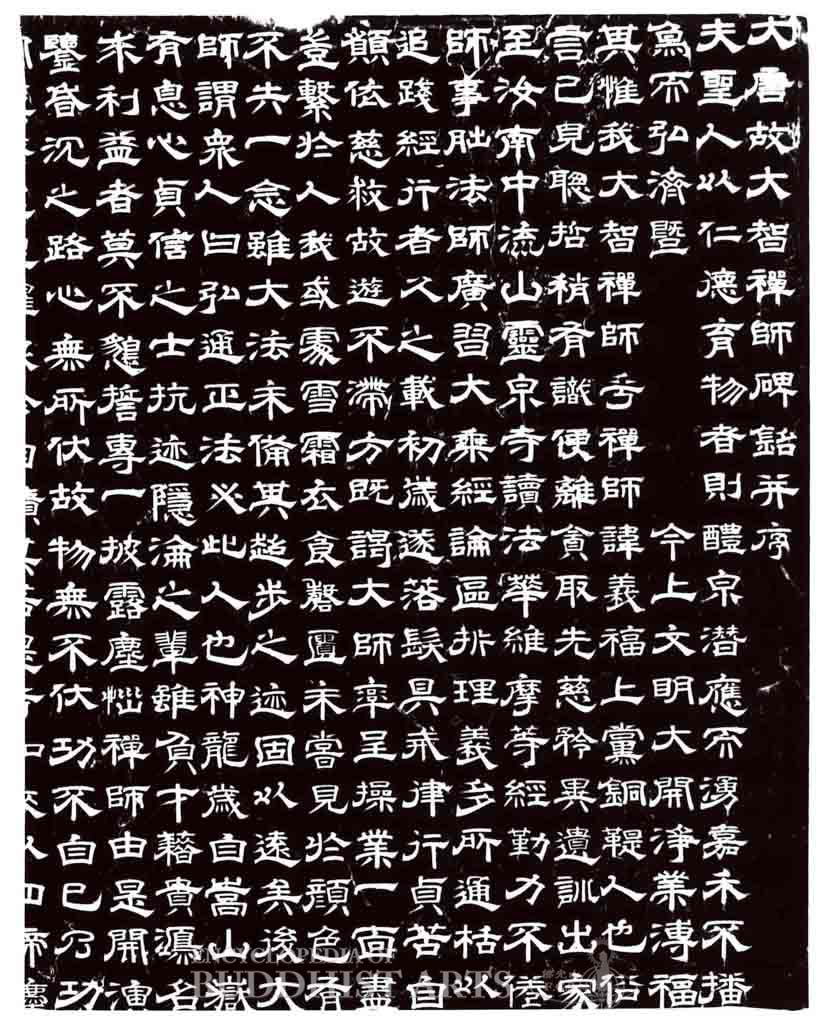
Stele of Master Dazhi (detail)
Rubbing
Stele of Master Dazhi
CHINA; Tang dynasty
This stele is also known as the Stele of Master Yifu. The text was composed by Yan Tingzhi, transcribed by Shi Weize in clerical script, and engraved by Shi Zihua. It has 32 lines with 61 characters each, while the top of the stele carries a caption containing 3 lines of 9 characters. Master Yifu was an outstanding member and role model of the Shenxiu lineage of Buddhism. He passed away in 736, and was given the posthumous name of Master Dazhi (Great Wisdom) by Emperor Xuanzong (reigned 712–756) of the Tang dynasty. Master Yifu’s disciples erected this stele in his memory.
The round and bold Tang clerical script differs from its Han period counterpart, which is typified by the “silkworm head” and “goose tail” articulations. This stele, however, preserves most of Han clerical characteristics. It was written skilfully with strong and refined characters. Qing dynasty (1644–1911) art collector Sun Chengze regarded this stele as the best work of the time period.
Shi Weize, or Shi Hao, was a Tang dynasty (618–907) calligrapher from Suzhou, Jiangsu. He was one of the Four Great Tang Masters of clerical script. Although Shi mastered clerical script from Han steles, his calligraphy shows glimpses of regular script, especially in its disciplined execution.
For more details, go to the Encyclopedia of Buddhist Arts: Calligraphy, page 237.
Cite this article:
author = Hsingyun and Youheng and Youlu and Pokorski, Stefanie and Mankuang and Edson, Gary,
booktitle = {Encyclopedia of Buddhist Arts: Calligraphy },
pages = 237,
title = {{Stele of Master Dazhi}},
volume = 17,
year = {2016}}