
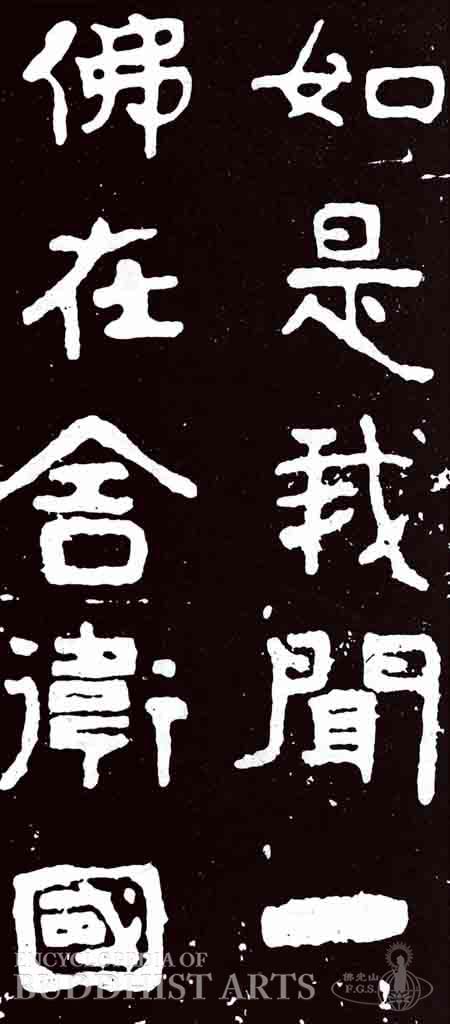
Taishan Cliff Carvings: Diamond Sutra (detail)
Rubbing
Taishan Cliff Carvings: Diamond Sutra
CHINA, Shandong, Tai’an; Northern Qi dynasty
This inscription is located on a rock plateau in Longquan Valley at the southeast foot of Taishan (Peaceful Mountain) in Tai’an, Shandong. It is presently the largest cliff sutra inscription in China. The inscription is regarded as the “originator of large characters” and “founder of signboard manuscript.” The Qing dynasty (1644–1911) scholar official Ruan Yuan estimated that the work was carried out during the rule of Emperor Tianbao (reigned 550–559) of the Northern Qi dynasty. While the number of characters cannot be clearly determined, Preface and Postscript on Epigraphy for the Stone Spring Bookstore, written by Li Zuoxian of the Qing dynasty, records that there are 901 characters extant, and each measure 50 cm in height. The text spreads across the granite rock bed with a grand expanse of nearly 6,000 sq ft.
Inscribed predominantly in regular script, the sutra shows signs of “bafen” (eight parts) and clerical script, as well as occasional traces of seal script. The character form is spaciously configured with strong, bold strokes. They appear to be slowly executed in rounded brushwork, exuding a sense of tranquility. Its staunch outlook is balanced by a restrained, dignified style which is speculated to be an effect of the calligrapher’s reverence to the teachings. The inscribed manuscript contrasts sharply with the famous Northern Wei steles, where the characters are defined by robust and forceful strokes. It differs also from the well-regulated and refined style of epitaph inscriptions. Nor is it close to the eccentric and unrestrained spectacle of other cliff inscriptions. In short, this particular Diamond Sutra inscription can be considered a unique work from the Six Dynasties (220–589).
For more details, go to the Encyclopedia of Buddhist Arts: Calligraphy, page 251.
Cite this article:
author = Hsingyun and Youheng and Youlu and Pokorski, Stefanie and Mankuang and Edson, Gary,
booktitle = {Encyclopedia of Buddhist Arts: Calligraphy },
pages = 251,
title = {{Taishan Cliff Carvings: Diamond Sutra}},
volume = 17,
year = {2016}}