
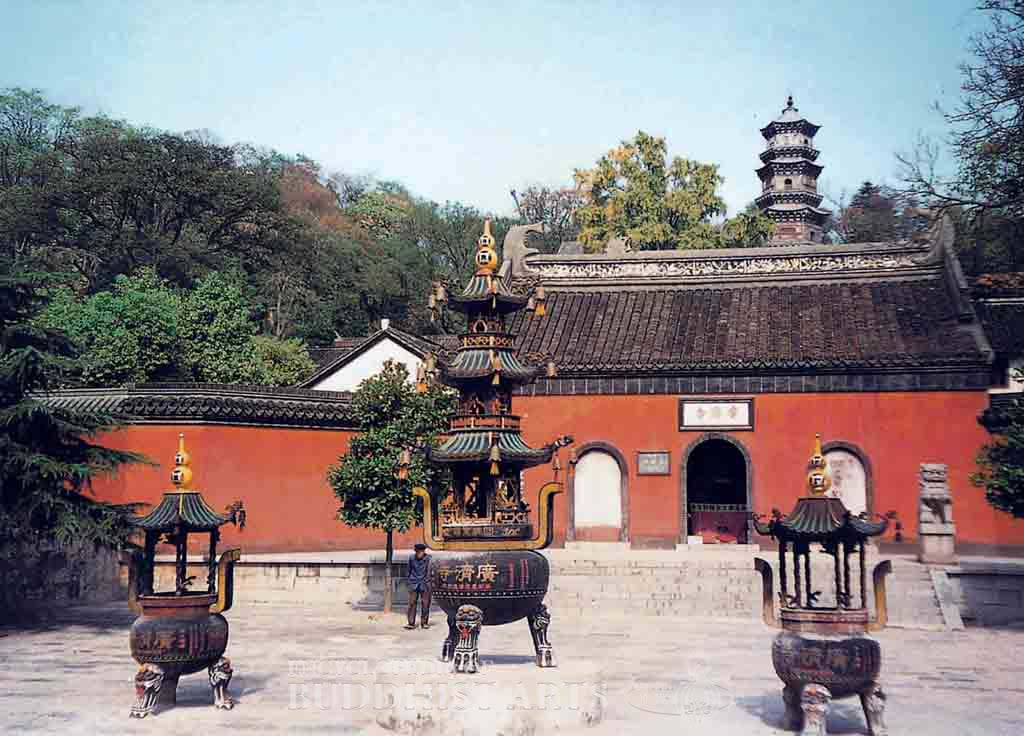
Guangji Temple: Main Temple Gate
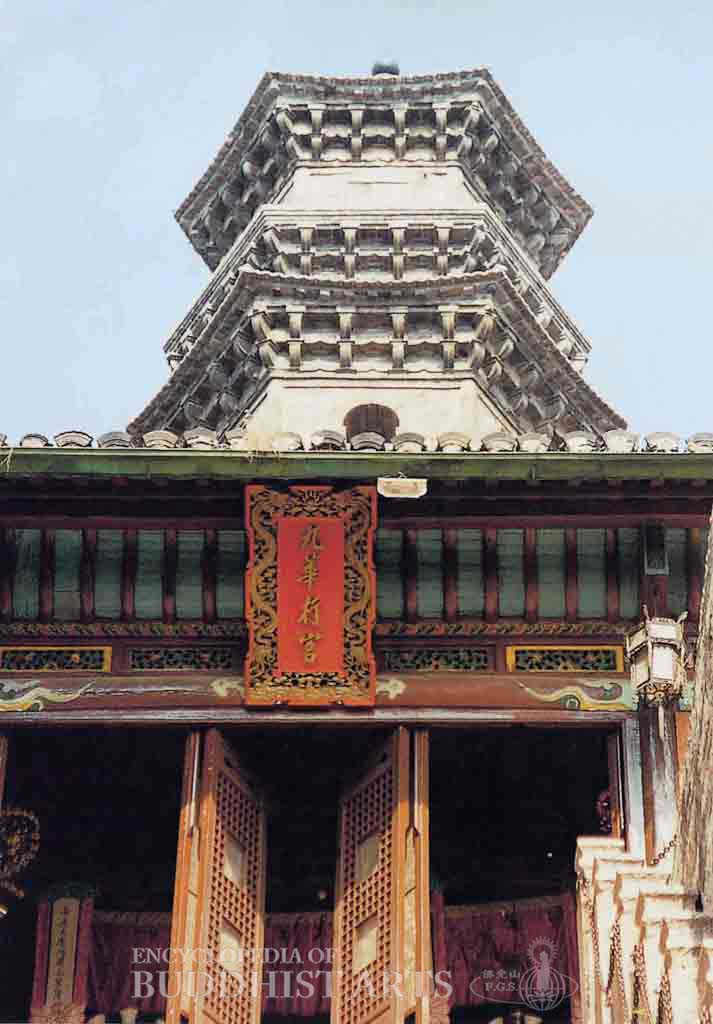
Guangji Temple: Zheshan Pagoda
Guangji Temple
CHINA, Anhui, Wuhu
The temple was established between 894 and 898 during the Tang dynasty. It was repaired during the Qing dynasty, and was reconstructed and expanded in 2000. According to the records, Korean Prince Kim Gyo Gak traveled to China during the Tang dynasty. He first built a hermitage on the site of Guangji Temple, and later went to Jiuhuashan (Nine Lotus Mountain). Pilgrims heading for Jiuhuashan usually visit Guangji Temple first, thus the temple is also known as Little Jiuhua or Jiuhua Palace. In 1983 it was listed as a key Buddhist temple in the Han region of China.
The temple was built to integrate with the mountainous terrain. Its buildings running from south to north include the main temple gate, Medicine Buddha Hall, Great Buddha Hall, Ksitigarbha Hall, and Zheshan Pagoda. The Ksitigarbha Hall is built in imitation of the Corporeal Relic Hall at Jiuhuashan. There are 88 stone steps leading up to the hall. The five-story, hexagonal, brick and stone Zheshan Pagoda is 26.8 m high. It was constructed in 1065 during the Northern Song dynasty. It has a number of features of a wooden pagoda, including the eaves, false windows, and reliefs of Buddhas and lotus flowers on the outer walls. The door leading to the pagoda chamber can be accessed from the back door of the Ksitigarbha Hall.
The most treasured object in the temple is the Ksitigarbha Golden Seal, which was made in 757 during the Tang dynasty to commemorate the incarnation of Ksitigarbha Bodhisattva at Jiuhuashan. The seal weighs 4 kg and is decorated with the Nine Dragons.
For more details, go to the Encyclopedia of Buddhist Arts: Architecture G-L, page 389.
Cite this article:
author = Hsingyun and Youheng and Johnson, Peter and Mankuang and Lancaster, Lewis,
booktitle = {Encyclopedia of Buddhist Arts: Architecture G-L},
pages = 389,
title = {{Guangji Temple}},
volume = 2,
year = {2016}}