
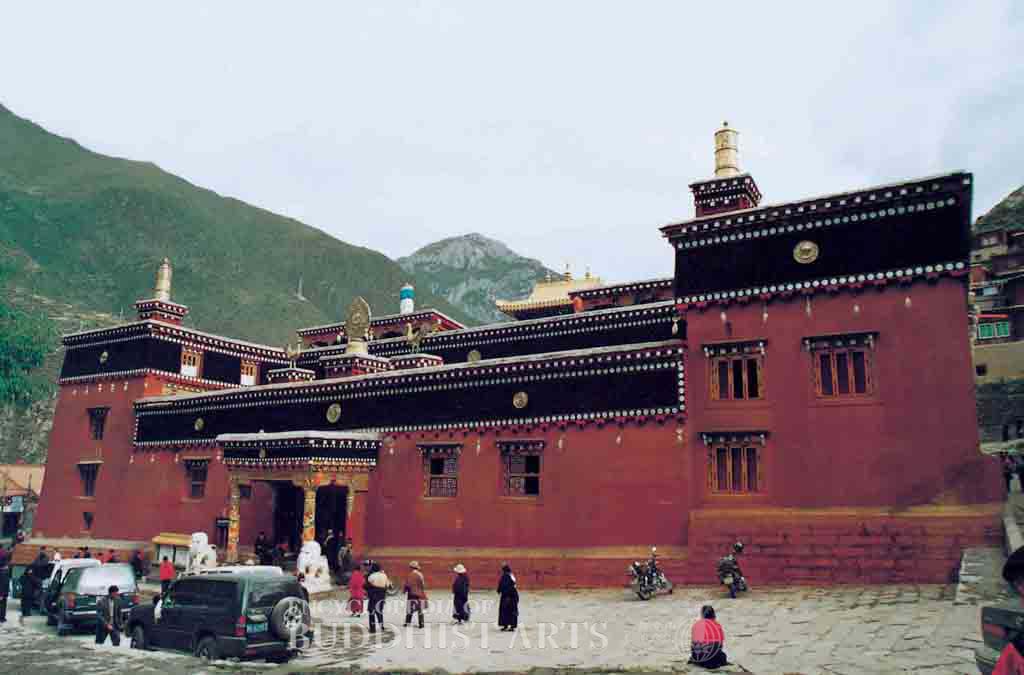
Derge Sutra Printing House
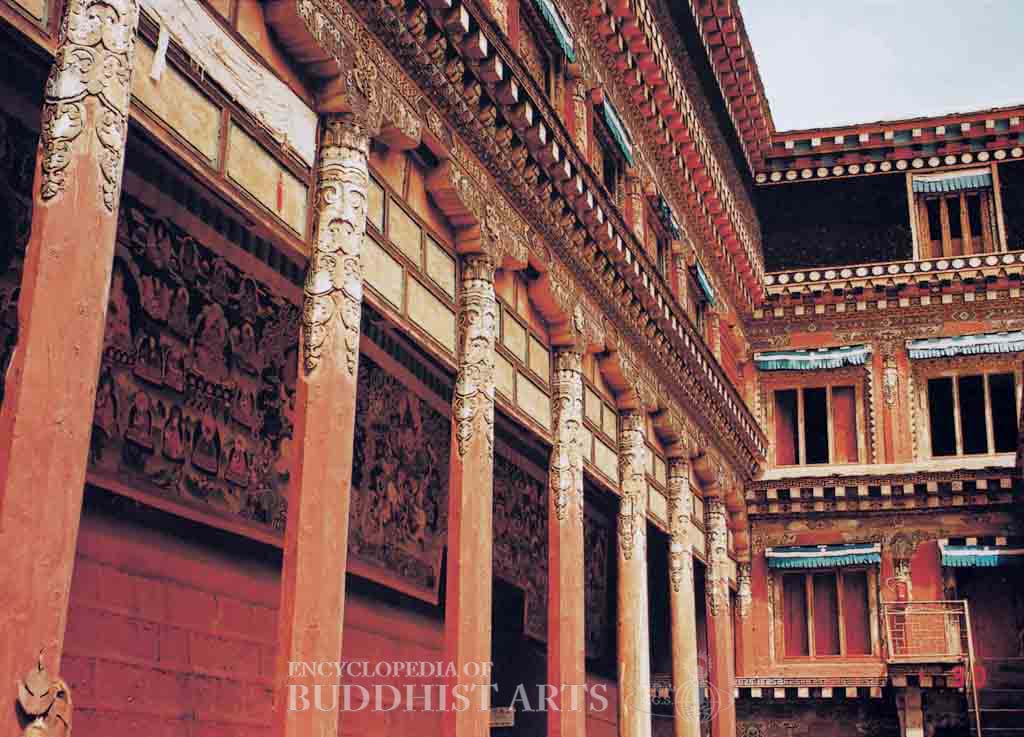
Derge Sutra Printing House
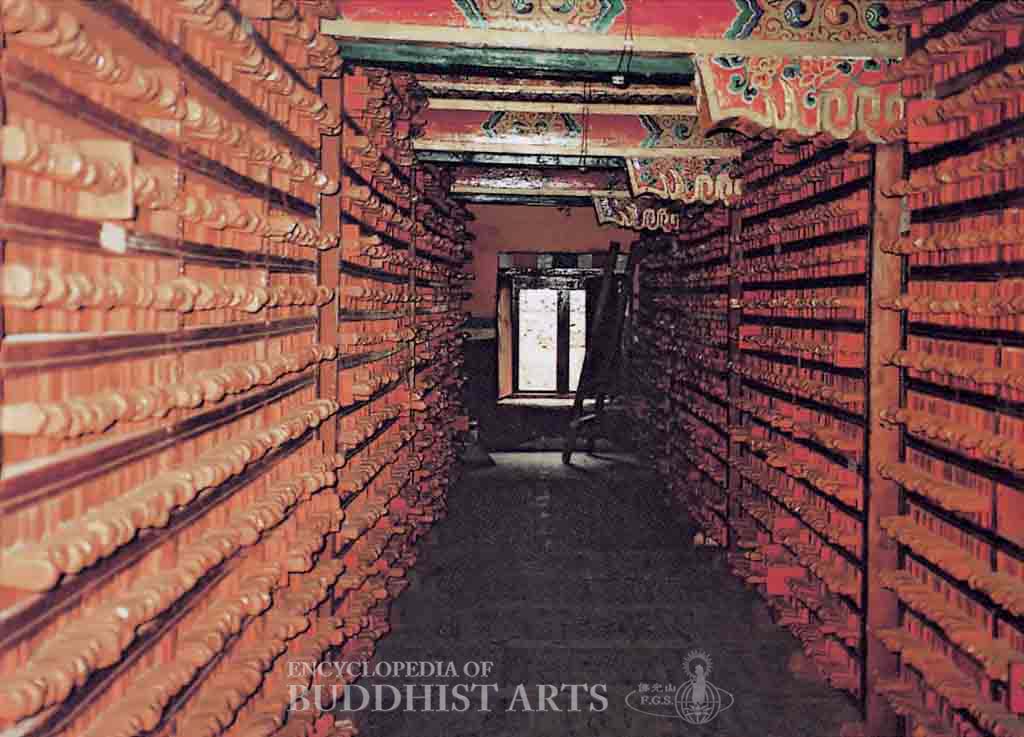
Derge Sutra Printing House: Woodblock Storage
Derge Sutra Printing House
CHINA, Sichuan, Garze
This is the largest of the three major Tibetan sutra printing houses. In 1729, the 12th chieftain, Choegyal Tenpa Tsering, ordered the construction of a building for the production of woodblocks for printing sutras and it took 16 years to complete. His successors renovated and expanded the building and, despite a number of renovations, it retains its original appearance. It was listed as a National Cultural Heritage Site in 1996.
Facing southwest, the compound occupies 1,640 sq m. It is a large rectangular building with a courtyard in the center. The red ocher building is constructed from rammed earth. A dark colored band runs along the top of the building, on which there are gold disks at intervals. On the flat roof at each corner of the building, there is a gilt copper prayer wheel. On the roof above the entrance in the south, there are a gilt bronze Dharma wheel and a pair of peacocks. On the northern part of the roof, there is a small structure with a gilded hip-and-gable roof. The interior beams, pillars, rafters, doors, and windows have either been delicately carved or colorfully painted. There are more than 100 rooms inside used for preserving woodblocks, storing paper, printing sutras, drying prints, and a platform for washing woodblocks. There is also an assembly hall and an inner shrine within the building. Apart from being a printing house, it also serves as a temple.
There are more than 270,000 birch printing blocks containing Tibetan text as well as illustrations. The subject matter includes Buddhist canons, biographies, medicine, astronomy, and linguistics. There are 82 different collections totaling 586 volumes. Of these, the Derge Tripitaka and the Four Medical Tantras are the best known. Due to the completeness of the collection, its diversity, accuracy, and superior quality, it is regarded as a Tibetan cultural treasury.
For more details, go to the Encyclopedia of Buddhist Arts: Architecture A-F, page 226.
Cite this article:
author = Hsingyun and Youheng and Johnson, Peter and Mankuang and Lancaster, Lewis,
booktitle = {Encyclopedia of Buddhist Arts: Architecture A-F},
pages = 226,
title = {{Derge Sutra Printing House}},
volume = 1,
year = {2016}}