
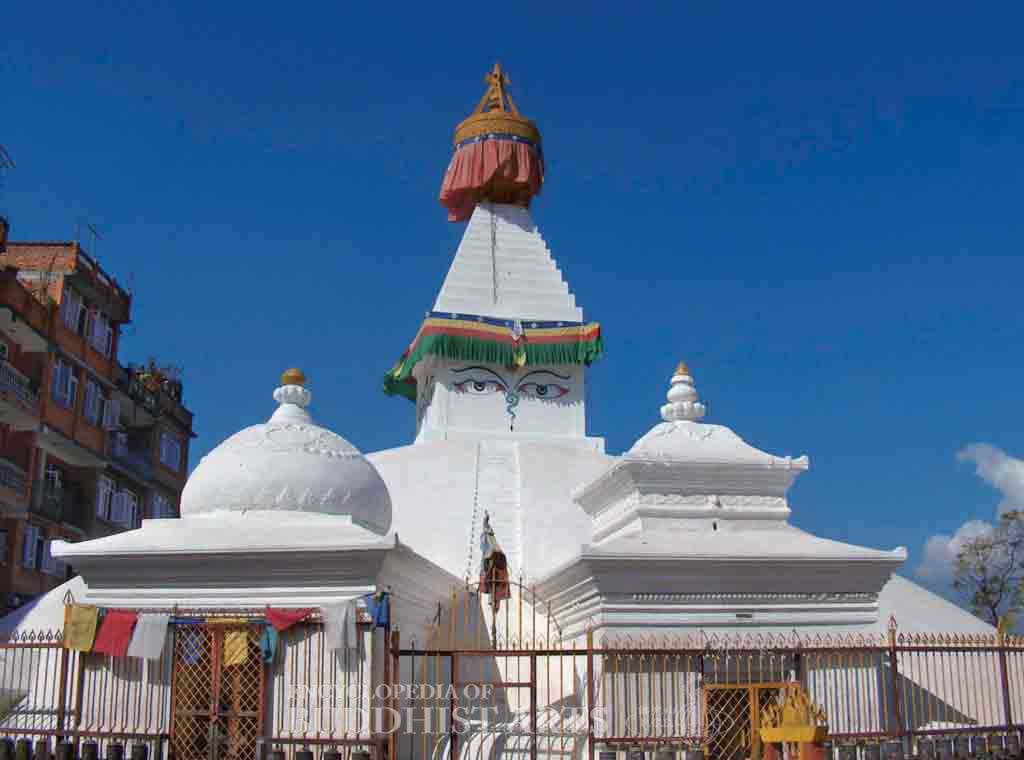
Asoka Stupas: Northern Stupa
Asoka Stupas
NEPAL, Patan
The stupas were constructed on the perimeter of Patan and mark the four cardinal points. They are collectively known as the Asoka Stupas because King Asoka (reigned circa 269–232 BCE) of Maurya is said to have visited Kathmandu in 250 BCE and erected the stupas. However, according to historians, the stupas were probably built much later, towards the end of the 4th century, when Patan was founded. Many features of these stupas have been modified over time and it is not possible to provide definite dates for such changes.
The four stupas look similar, each with a body in the shape of an inverted bowl. Each of the stupas is surmounted by a square harmika with painted eyes, 13 stacked rings, a canopy, and finial.
The Southern Stupa is the largest with a height of 11.8 m. The Northern Stupa is the smallest and is painted entirely in white. The brick and plaster dome is 5.5 m high with stairs that reach to the top. The Five Dhyani Buddhas are enshrined around the base of that stupa.
For more details, go to the Encyclopedia of Buddhist Arts: Architecture A-F, page 23.
Cite this article:
author = Hsingyun and Youheng and Johnson, Peter and Mankuang and Lancaster, Lewis,
booktitle = {Encyclopedia of Buddhist Arts: Architecture A-F},
pages = 23,
title = {{Asoka Stupas}},
volume = 1,
year = {2016}}