
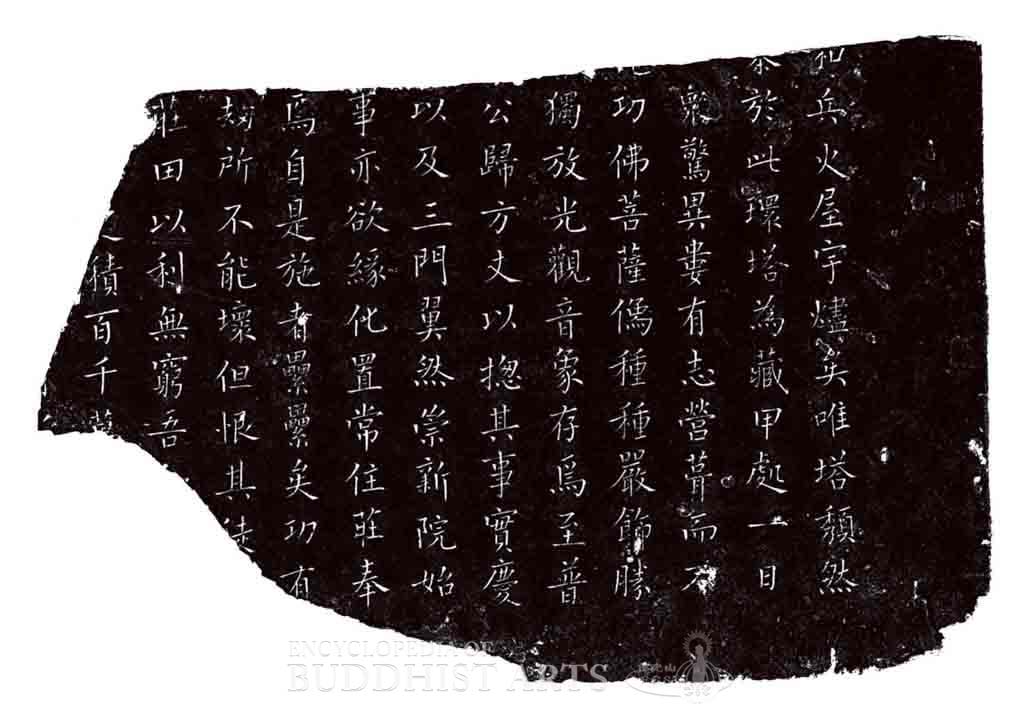
Leifeng Pagoda: Renovation Stele (fragment)
Rubbing
Leifeng Pagoda: Renovation Stele
CHINA, Zhejiang, Hangzhou; Southern Song dynasty
Unearthed from Leifeng Pagoda in Zhejiang in 2000, this stele was inscribed in 1199 during the Southern Song dynasty (1127–1279)and provides a detailed account of the construction of the pagoda. The stele is inscribed in 14 lines, with each line consisting of between 37 to 40 characters, forming a total of 556 characters. During excavation however, it was partially damaged, leaving only 150 characters.
Southern Song calligraphy was influenced by the Northern Song (960–1127) style that primarily used running script. As a result, regular script was often written with elements of running script style. This stele is no exception. Short brushstrokes indicate hastened writing in running script. Nevertheless, the quickened rhythm is balanced by a calming slowness portrayed by certain aspects of the inscription, which was written with a semblance to the Tang regular script. This interspersion balances the two styles, and results in an ambiance enlivened by running script brushwork.
For more details, go to the Encyclopedia of Buddhist Arts: Calligraphy, page 116.
Cite this article:
author = Hsingyun and Youheng and Youlu and Pokorski, Stefanie and Mankuang and Edson, Gary,
booktitle = {Encyclopedia of Buddhist Arts: Calligraphy },
pages = 116,
title = {{Leifeng Pagoda: Renovation Stele}},
volume = 17,
year = {2016}}