
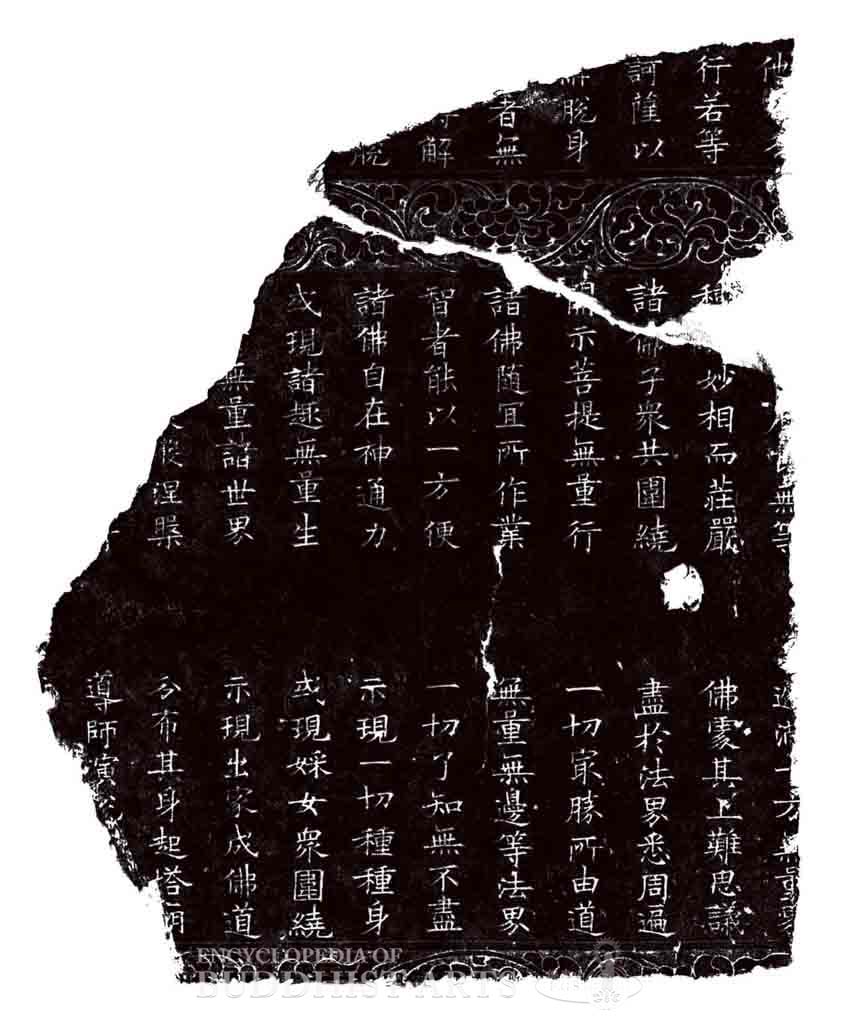
Leifeng Pagoda: Avatamsaka Sutra Stele (fragment)
Rubbing
Leifeng Pagoda: Avatamsaka Sutra Stele
CHINA, Zhejiang, Hangzhou; Wuyue Kingdom
This stele was broken when it was recovered from Leifeng Pagoda in Hangzhou in 2000. It was pieced back together by archaeologists and is currently located in the Zhejiang Provincial Museum. It was originally embedded within the pagoda and is inscribed with the Avatamsaka Sutra, which was translated from Sanskrit by Tripitaka Master Siksananda following the orders of Empress Wu Zetian (reigned 684–705) of the Tang dynasty. Empress Wu was actively involved in the translation project, even writing a preface for the sutra. The sutra contains 80 volumes and is regarded as an important sutra in the Huayan school.
Since the stele served as both a physical sutra and a symbol of reverence to the Buddhas and Bodhisattvas, it was engraved with characters in regular script so that the text could be read unambiguously while attaining a ceremonious appearance. The characters on this stele tend to have longer widths than heights, and elongated horizontal strokes appear as visual foci that organize and stabilize the rest of the composition. The inscription also showcases the diligence and intense concentration of the engraver, who maintained the sharp strokes and orderly composition of the calligrapher through a consistently rigorous effort from start to end despite the great length of the text.
For more details, go to the Encyclopedia of Buddhist Arts: Calligraphy, page 115.
Cite this article:
author = Hsingyun and Youheng and Youlu and Pokorski, Stefanie and Mankuang and Edson, Gary,
booktitle = {Encyclopedia of Buddhist Arts: Calligraphy },
pages = 115,
title = {{Leifeng Pagoda: Avatamsaka Sutra Stele}},
volume = 17,
year = {2016}}