
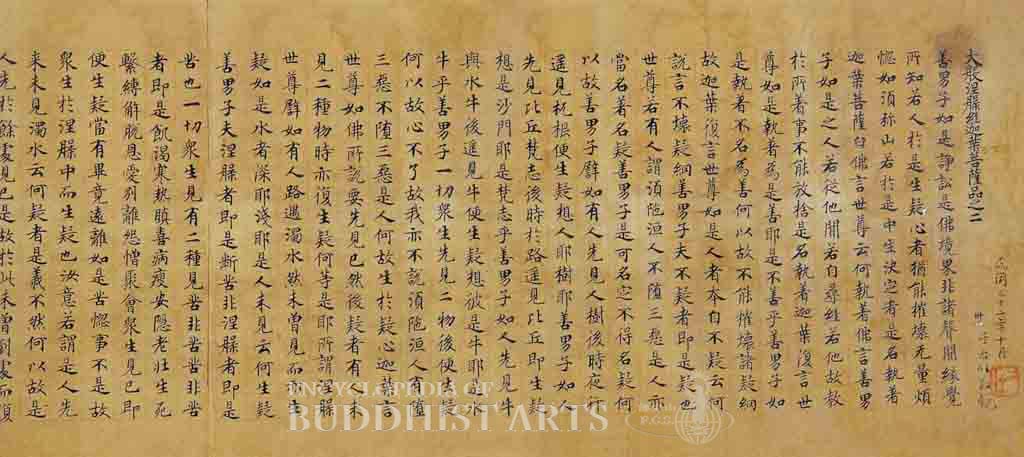
Mogao Cave 17: Mahaparinirvana Sutra - Chapter on Kasyapa Bodhisattva
Ink on paper

Mogao Cave 17: Mahaparinirvana Sutra - Chapter on Kasyapa Bodhisattva (right end section)
Mogao Cave 17: Mahaparinirvana Sutra - Chapter on Kasyapa Bodhisattva
CHINA, Gansu, Dunhuang; Tang dynasty
This sutra manuscript was discovered in Mogao Cave 17 in Dunhuang. It is transcribed with the text of Mahaparinirvana Sutra which expounds tenets such as the omnipresence of thusness or Buddha nature, the four characteristics of nirvana–eternity, bliss, self, and purity–and Buddha nature as being innate in all sentient beings.
Each line contains 17 characters, which is a typical feature of sutra manuscripts dating from the Tang dynasty (618–907). The missing characters for “shi” and “min” suggests that the text was likely transcribed shortly after the rule of Emperor Taizong (reigned 626–649) of the Tang dynasty, as it was prohibited to use the name of the prevailing emperor at the time. Characters are composed spaciously, and strokes tend to arc outwards, rendering a refined outlook. There is a hint of running script in the execution of each stroke with a rich, intense quality in the line work. Horizontal strokes appear thinner than vertical strokes, as can be seen in the bold, sharp returns and long vertical lines. The varied stroke thicknesses create a dynamic contrast within each character and generate a composition of bold strokes across the scroll, resulting in visual complexity.
For more details, go to the Encyclopedia of Buddhist Arts: Calligraphy, page 160.
Cite this article:
author = Hsingyun and Youheng and Youlu and Pokorski, Stefanie and Mankuang and Edson, Gary,
booktitle = {Encyclopedia of Buddhist Arts: Calligraphy },
pages = 160,
title = {{Mogao Cave 17: Mahaparinirvana Sutra - Chapter on Kasyapa Bodhisattva}},
volume = 17,
year = {2016}}