
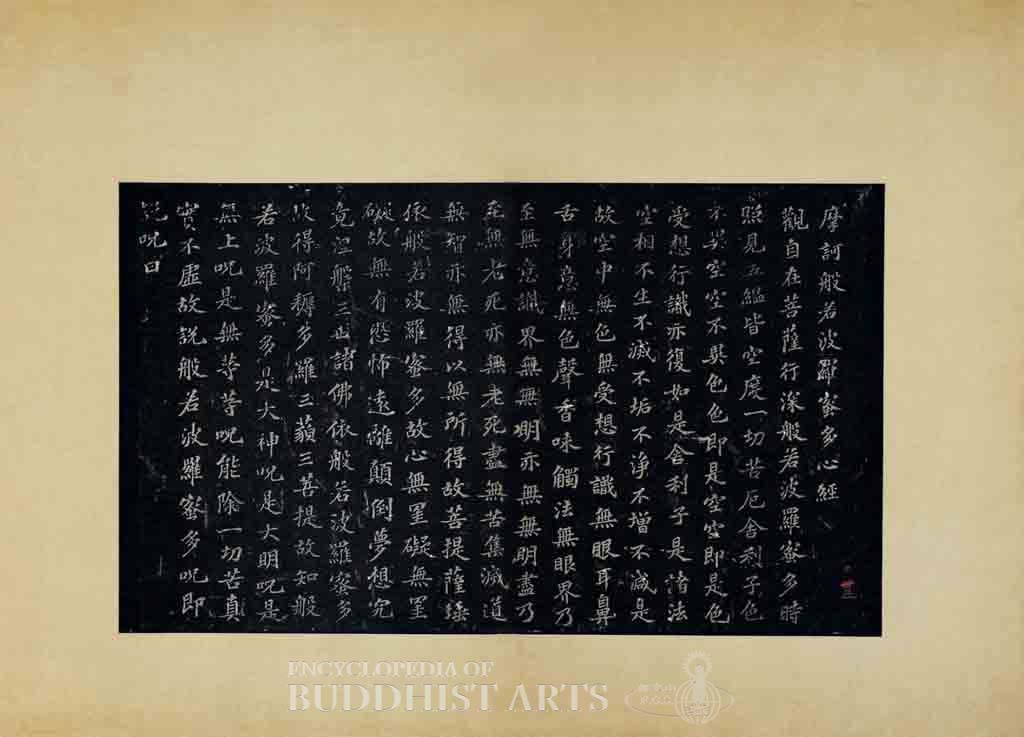
Heart Sutra (right end section)
Rubbing
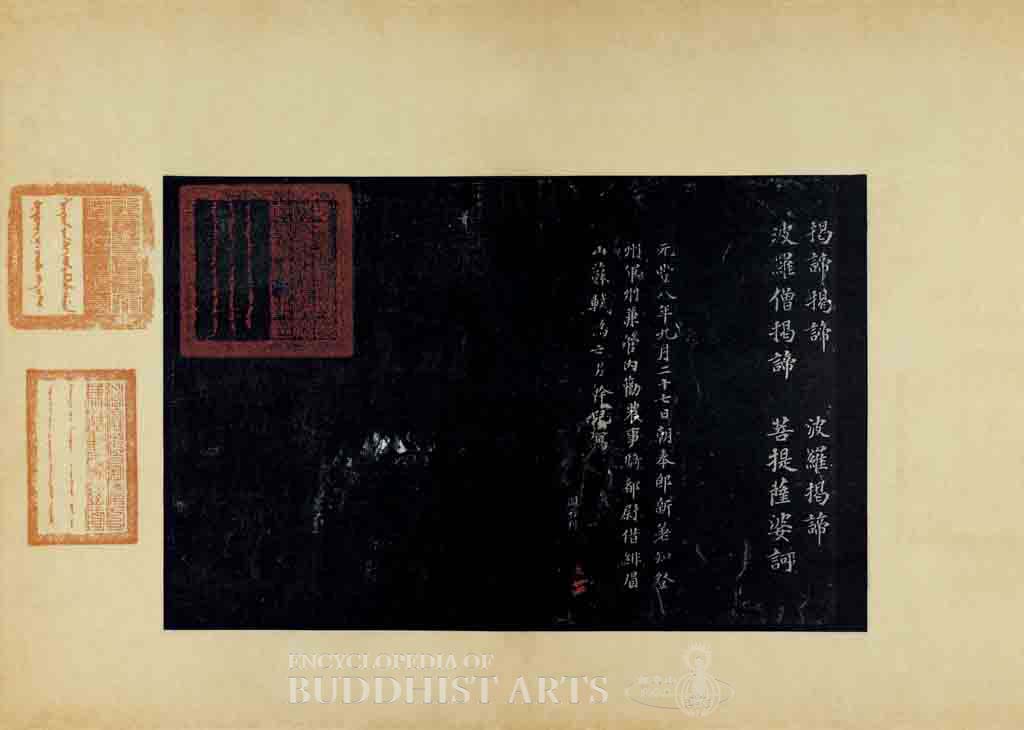
Heart Sutra (left end section)
Heart Sutra
CHINA; Northern Song dynasty
The postscript at the end of this 21-line sutra transcription indicates that it was written by Song dynasty (960–1279) calligrapher Su Shi to accrue blessings for his deceased son. A rubbing is currently kept at the National Museum of China in Beijing. The Heart Sutra became a popular piece for calligraphic practice following its translation by Master Xuanzang during the Tang dynasty (618–907). It was transcribed for various reasons including personal requests or for Buddhist services. The Heart Sutra is thus commonly seen in Buddhist calligraphy.
Su Shi’s calligraphic style is widely acclaimed for its flawless combination of grace and vigor; this is evident in his regular script, where strokes are flexibly executed in round and thick lines, giving a powerful yet refined effect that balances their austerity and ornamentation. This piece is quintessentially Su Shi’s style, but the characters are more sparse and less varied. This is likely due to the fact that it is a stone inscription, in which an over-emphasis on order and neatness perhaps diminished the intent and inhibited the freer flow of strokes.
For more details, go to the Encyclopedia of Buddhist Arts: Calligraphy, page 88.
Cite this article:
author = Hsingyun and Youheng and Youlu and Pokorski, Stefanie and Mankuang and Edson, Gary,
booktitle = {Encyclopedia of Buddhist Arts: Calligraphy },
pages = 88,
title = {{Heart Sutra}},
volume = 17,
year = {2016}}