
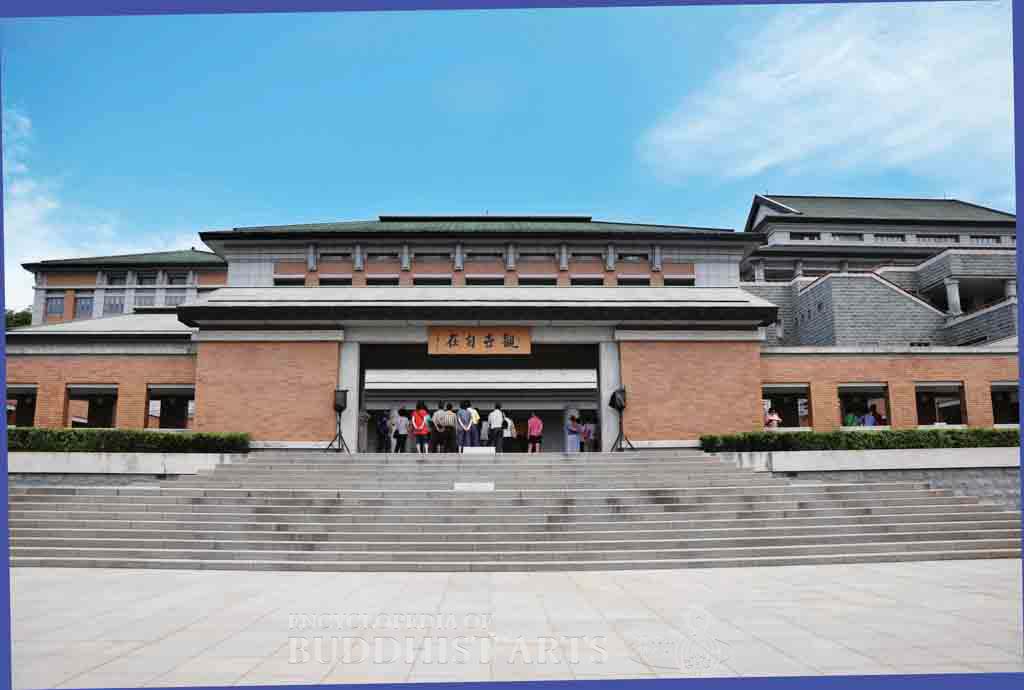
Dharma Drum Mountain: Avalokitesvara Hall
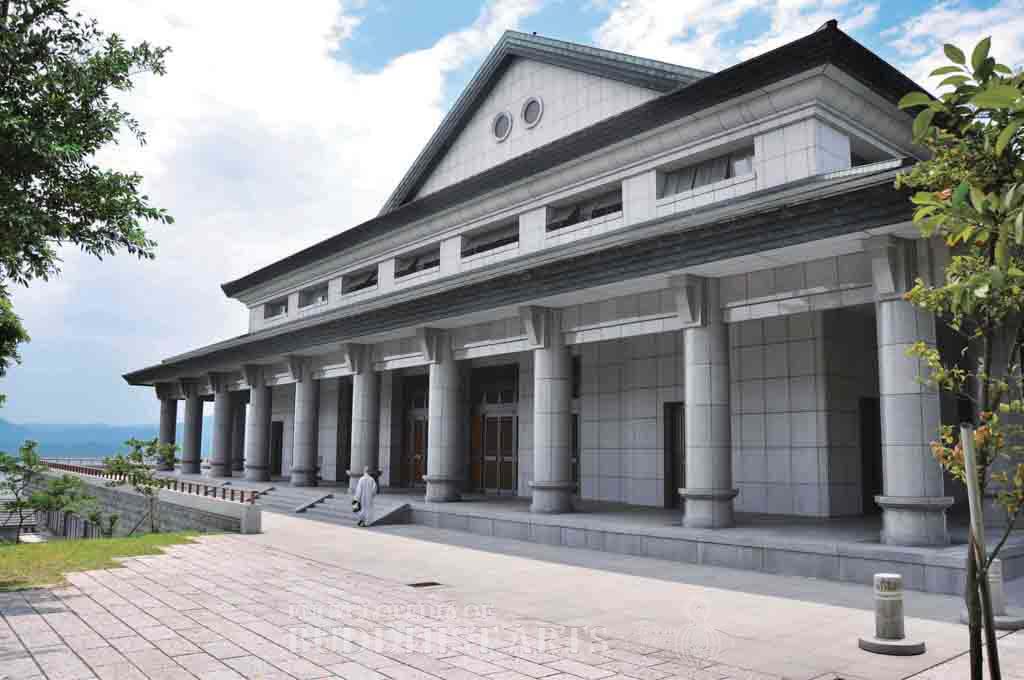
Dharma Drum Mountain: Grand Buddha Hall
Dharma Drum Mountain
TAIWAN, New Taipei City
In 1955, elder monk Dongchu established the Chung-Hwa Institute of Buddhist Culture in Taipei. It was expanded in 1975 to form Nung Chan Temple. In 1977, Dongchu passed away and Master Sheng Yen assumed the abbotship of the temple. Due to the growth in the number of devotees, there was an urgent need for new premises. In 1989 construction began at the new location and was completed in 2005. The temple was named Dharma Drum Mountain, which is a reference to the Lotus Sutra.
The temple blends harmoniously with its natural environment. It is finished in earth tones of beige, gray, and white. The principal structures include the main temple gate, Buildings I, II and III, and the meditation hall.
Building I is located in the center of the complex. It is six stories high with a double-eave hip-and-gable roof. It has sharp lines with a blue-gray finish. The building contains the Grand Buddha Hall, a museum on the founding of the temple, a reception lobby, as well as multi-purpose rooms. A large rectangular niche in the Grand Buddha Hall is filled with the statues of Sakyamuni Buddha, Amitabha Buddha, and Medicine Buddha. An underground palace is situated directly below the statues. On either side the walls are covered with thousands of illuminated miniature Buddhas. The Buddha walls and niche are designed on the basis of Buddhist caves.
Building II is seven stories high and contains an introduction zone and the Avalokitesvara Hall, which is located on the third story. It is fronted by an entrance hall and the Avalokitesvara pond. The water is mirrored by the screen of falling water forming the backdrop within the Avalokitesvara Hall. It represents the ability of Avalokitesvara Bodhisattva to deliver sentient beings to the opposite shore.
Building III is an education and administration center consisting of the Chung-Hwa Institute of Buddhist Studies, Dharma Drum Mountain Buddhist College, Dharma Drum Mountain Sangha University, as well as the library and information center. The meditation hall is a four-story building, which has floors, beams, and columns finished in wood and bamboo. The hall is surrounded by walkways, which can be used for walking meditation. A seated Sakyamuni Buddha is enshrined within the hall.
For more details, go to the Encyclopedia of Buddhist Arts: Architecture A-F, page 234.
Cite this article:
author = Hsingyun and Youheng and Johnson, Peter and Mankuang and Lancaster, Lewis,
booktitle = {Encyclopedia of Buddhist Arts: Architecture A-F},
pages = 234,
title = {{Dharma Drum Mountain}},
volume = 1,
year = {2016}}