
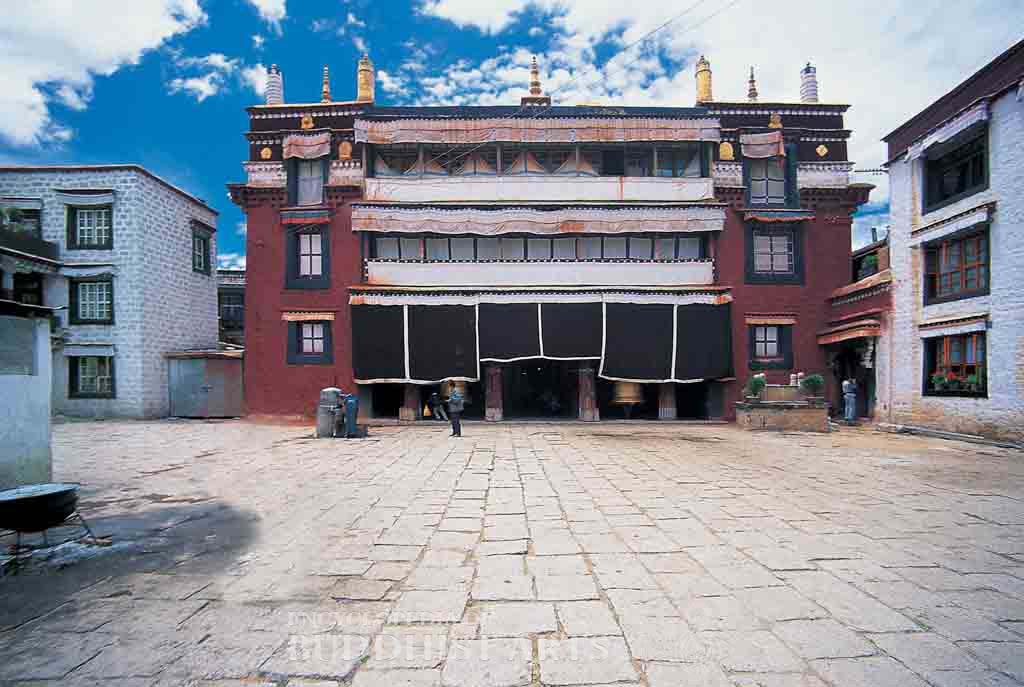
Ramoche Monastery
Ramoche Monastery
CHINA, Tibet, Lhasa
Ramoche means Treasury. The temple was founded by Princess Wencheng of the Tang dynasty (618–907). It is located approximately 1 km north of the Jokhang Temple in Lhasa. It was a renowned Buddhist temple during the early period of the Tibetan Empire (circa 7th–9th century). It later became the Upper Vajrayana College, one of the Vajrayana Colleges of the Gelug school.
The location and layout were determined by Princess Wencheng during the middle of the 7th century, and it was constructed by Chinese craftsmen from Chang’an (present day Xi’an). The building was completed in 641, at around the same time as the Jokhang Temple. It was destroyed by fire on a number of occasions and had been renovated many times. The original Chinese temple was replaced by the present three-story building in 1474. After 1986 the temple underwent large-scale renovation. It was listed as a National Cultural Heritage Site in 2001.
The temple originally housed the Jowo Rinpoche, a gilt copper statue of Sakyamuni Buddha with the height of a 12-year-old brought to Lhasa by Princess Wencheng. The Jowo Rinpoche was moved to the Jokhang Temple and replaced by a statue of Sakyamuni Buddha with the height of an eight-year-old, known as Jowo Mikyo Dorje, brought by Nepalese Princess Bhrkuti.
The temple faces east and occupies 4,000 sq m. At the front there is a courtyard with a gatehouse, which leads to the central hall and circumambulation passage. The gatehouse is three stories high with a spacious hallway on the first story. On the second and third stories there are monastic quarters and shrines.
The three-story central hall is the main building of the temple. The first story consists of an entrance hall, assembly hall, and inner shrine. The three-by-seven bay assembly hall is supported by 30 columns. Four of those in the center are large and rise to the second story, going on to support the third story. The inner shrine houses the copper gilt statue of Jowo Mikyo Dorje. There is a narrow circumambulation passage at the rear and sides of the inner shrine. The center of the second story of the central hall is an open space with the skylight of the assembly hall below. To the rear of the third story there is a Chinese-style shrine with a golden hip-and-gable roof supported by bracket sets; however, the doors, windows, murals, columns, and decorative features are all in Tibetan style. This is an example of the integration of Tibetan and Chinese architectural features.
For more details, go to the Encyclopedia of Buddhist Arts: Architecture M-S, page 893.
Cite this article:
author = Hsingyun and Youheng and Johnson, Peter and Mankuang and Lancaster, Lewis,
booktitle = {Encyclopedia of Buddhist Arts: Architecture M-S},
pages = 893,
title = {{Ramoche Monastery}},
volume = 3,
year = {2016}}