
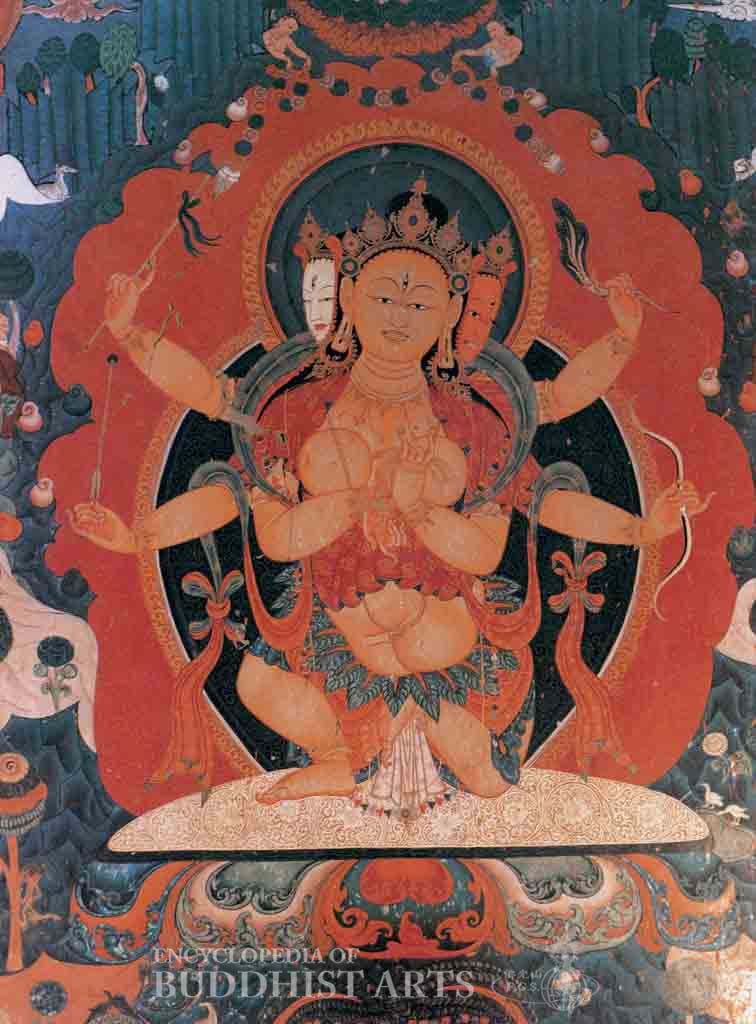
Toling Monastery White Hall: Parnasavari
Toling Monastery White Hall: Parnasavari
CHINA, Tibet, Ngari; Guge Kingdom
Parnasavari appears in a variety of colors and manifestations, and is said to possesses the power to prevent plagues and disasters. In this mural on the east wall of the White Hall, Parnasavari is portrayed with three heads and six arms, half-kneeling on a lotus pedestal with large inverted petals. All three heads are topped with golden crowns and have a third eye in the middle of the forehead. Two of the faces appear wrathful; their teeth are bared in a snarl. The white face on the left seems peaceful. On the central head, ornate earrings stretch the lobes of the ears. The robust lower body is partially covered by a skirt of leaves. The tight upper garment leaves the chest bare. A flowing stole encircles the four arms. Two of the hands hold a vajra and a noose in front of the chest. The other hands carry an axe, an arrow, a branch, and a bow. A red mandorla surrounds the light blue nimbus and dark blue aureole.
For more details, go to the Encyclopedia of Buddhist Arts: Painting P-Z, page 931.
Cite this article:
author = Hsingyun and Youheng and Youlu and Wilson, Graham and Manho and Mankuang and Huntington, Susan,
booktitle = {Encyclopedia of Buddhist Arts: Painting P-Z},
pages = 931,
title = {{Toling Monastery White Hall: Parnasavari}},
volume = 16,
year = {2016}}