
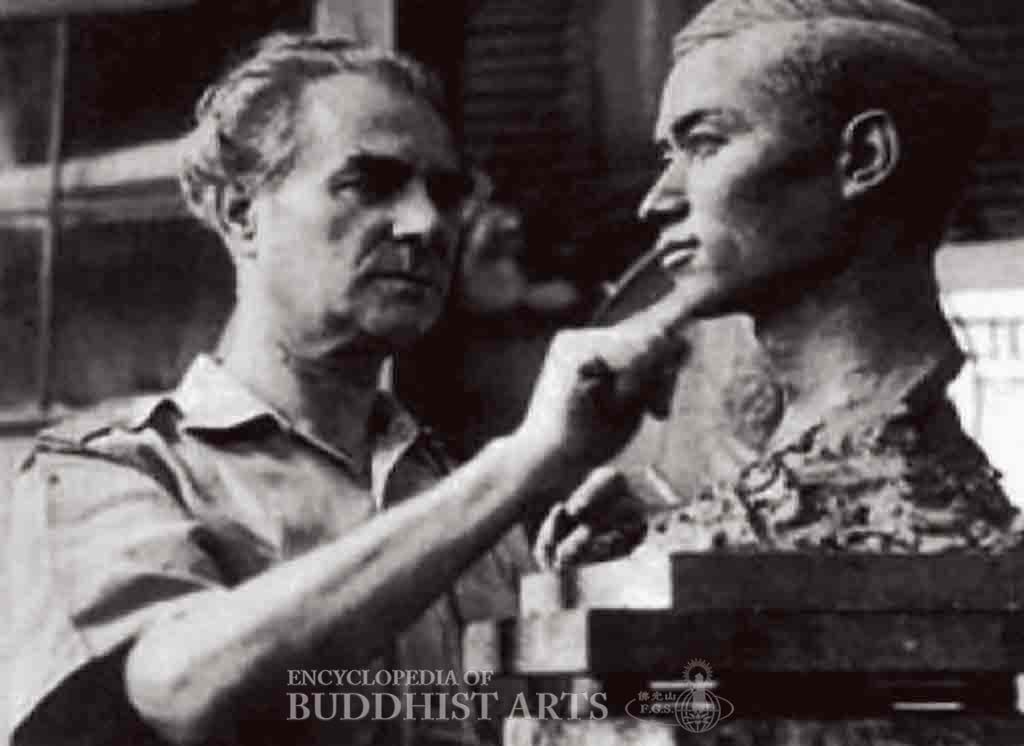
Silpa Bhirasri
Bhirasri, Silpa
ITALY, Florence
Originally named Corrado Feroci, Silpa Bhirasri was a sculptor, painter, and arts educator from Florence, Italy. In the early 20th century, Thai arts were becoming increasingly westernized and Thai royalties hired many European artists. Bhirasri went to Thailand in 1923 when he was hired as a sculptor for the Fine Arts Department of Thailand. His outstanding works led the Thai government to commission him in designing and sculpting monuments of important figures to be placed in each city. Bhirasri continued his post through Thailand’s political reform in 1932. In 1944, to avoid becoming a prisoner of war of the Japanese army, Bhirasri became naturalized as a Thai citizen. He was given the name Silpa Bhirasri.
In 1957, Bhirasri completed the blueprint and clay model for the Phra Si Sakkaya Thotsaphonlayan, a statue of Sakyamuni Buddha in walking posture, of Phutthamonthon in Nakhon Pathom. The flame pattern above the Buddha’s usnisa, the elongated earlobes, and the walking posture all delineate the classic style of Buddha statues in Sukhothai. The facial features, the forward-leaning body that puts pressure on one foot, and the throne behind the body, however, hint at the style of ancient Greek statues of gods. The Phra Si Sakkaya Thotsaphonlayan exemplifies Thailand’s new style of Buddha statues.
Bhirasri spent his life developing his personal artistic career and educating others about the local arts. In 1934, Bhirasri founded the National Academy of Fine Art (present day Silpakorn University); in 1943, he escalated the academy to university status while he served as professor and dean of the Schools of Drawing and Sculpting. Bhirasri’s teaching philosophy emphasizes both theory and practice. Using Thai traditional artistic culture and the Western style of realism as bases, in addition to the contemporary artistic school of thought as theoretical foundation, Bhirasri pushed for the creation of local arts, promoted modern art, and advocated artistic activities.
Bhirasri was also a prolific writer. His written works include Thai Buddhist Sculptures, The Origin and Evolution of Thai Murals, Thai Paintings, and Sukhothai Art Appreciation. Reputed as the Father of Modern Thai Art, Bhirasri made many contributions to the creation and education of art in Thailand. The National Silpa Bhirasri Memorial Center at Silpakorn University was established in 1987 in his honor. It now belongs to the Fine Arts Department of Thailand’s National Museum Agency. In honor of Bhirasri’s accomplishments, the local government commemorates his date of birth, September 15, as National Fine Arts Day.
For more details, go to the Encyclopedia of Buddhist Arts: People, page 6.
Cite this article:
author = Hsingyun and Youheng and Youlu and Pokorski, Stefanie and Yichao and Mankuang and Miaohsi,
booktitle = {Encyclopedia of Buddhist Arts: People },
pages = 6,
title = {{Bhirasri, Silpa}},
volume = 19,
year = {2016}}