
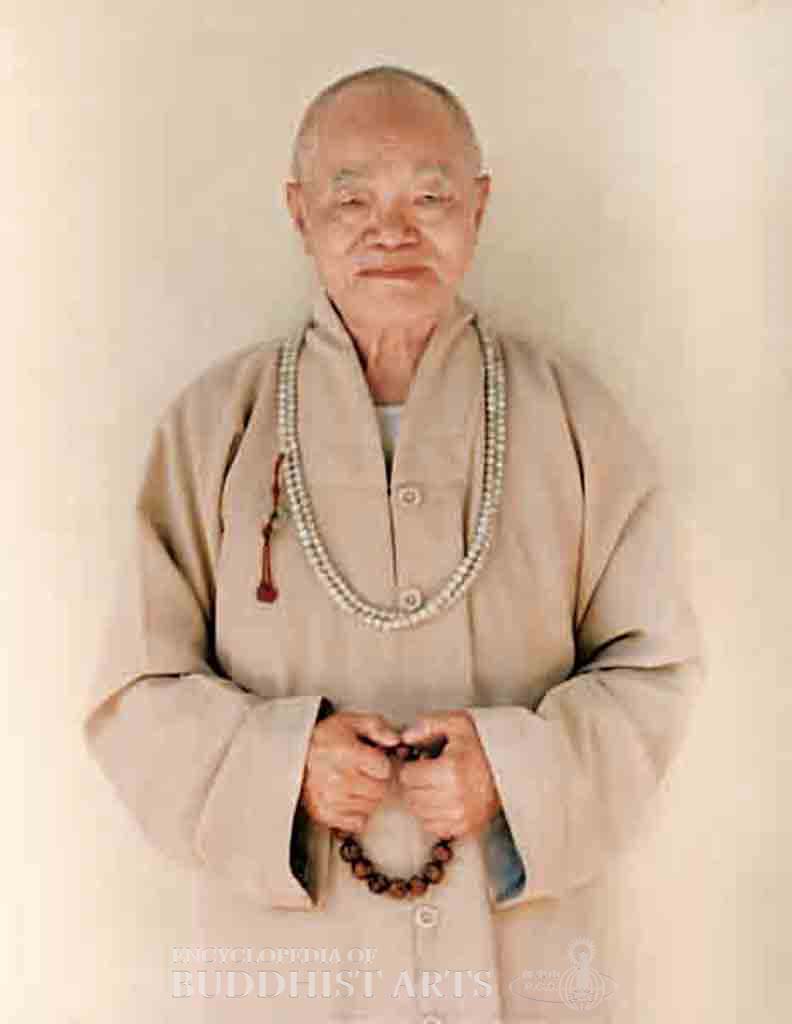
Songnian
Songnian
CHINA, Jiangsu, Taizhou
A monk, calligrapher and painter, Songnian was born in Hailing, Taizhou. He was also known as Luoyun Toutuo or Yuezhai Laoren. Coming from an influential scholarly family, Songnian began studying the various arts at the age of 8. He was guided by the calligrapher Xiao Tuiai, who held him in great esteem. At the age of 16, he renounced under Master Miaoyi at Guangfu Temple, and when he was 20 years old, he took the full monastic precepts at Longchang Temple. Subsequently, he studied at Jiaosan Buddhist Collage and Institute of Dharma Realm in Changshu. He later moved to Lingyanshan where he continued studies under Master Yinguang. To seek refuge during wartime, Songnian moved to Hong Kong in 1949, and then went to Penang, Malaysia in 1952 to stay a monastery for retreat. In 1960, he finally settled in Singapore and lived at Leng Foong Prajna Temple, and four years later he became the abbot for Mahabodhi Temple.
In his younger years, Songnian studied the calligraphy of many famous artists and practiced diligently by modeling his calligraphy after that seen on ancient stone inscriptions. His matured and distinctive writing style could be described as being full of vigor and agility. He specialized in seal, bronze, and oracle bone script, and excelled in wild cursive script. In his calligraphy, some strokes were flat and others were pointed, a result of which was the creation of contrasting light and dark tones.
In 1986, the prime minister of Singapore, Lee Kwan Yew, visited Japan and presented the calligraphic works of Songnian as a gift to Emperor Showa (1926–1989) and Japanese prime minister Yasuhiro Nakasone; these pieces are listed as National Treasures. Both the National Museum of Singapore and the National Palace Museum in Taiwan keep collections of Songnian’s works.
Often using calligraphy as a form of education and propagation, Songnian held art exhibitions for charity and also donated his works to schools and other organizations to raise funds. In doing so, many of his calligraphic works became widely circulated.
For more details, go to the Encyclopedia of Buddhist Arts: People, page 244.
Cite this article:
author = Hsingyun and Youheng and Youlu and Pokorski, Stefanie and Yichao and Mankuang and Miaohsi,
booktitle = {Encyclopedia of Buddhist Arts: People },
pages = 244,
title = {{Songnian}},
volume = 19,
year = {2016}}