
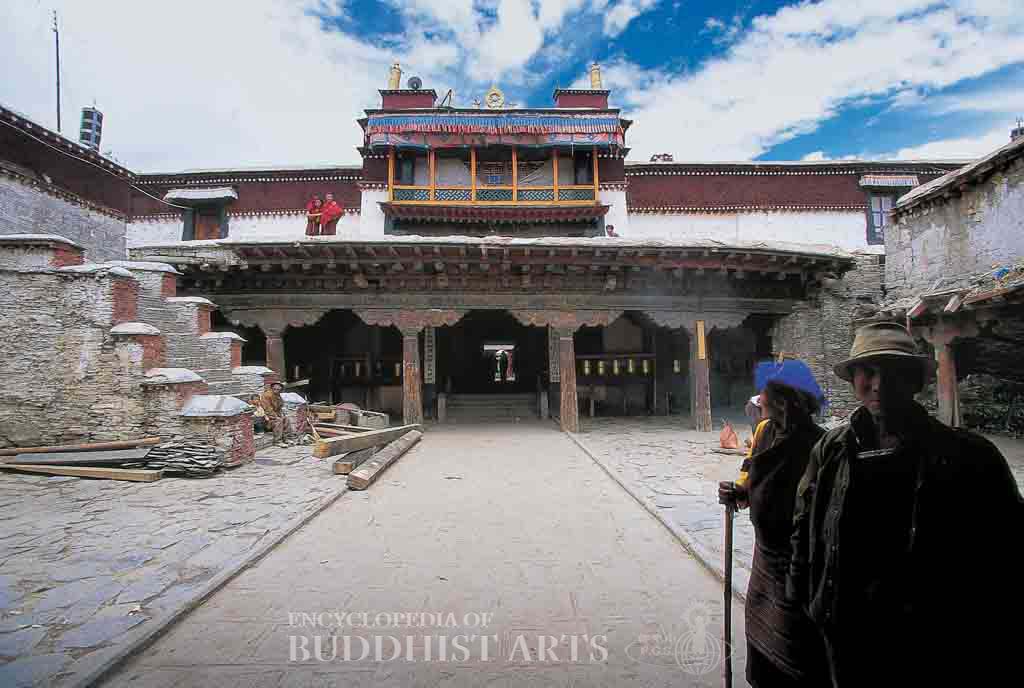
Tradruk Monastery
Tradruk Monastery
CHINA, Tibet, Lhoka
Tradruk means Falcon and Dragon. The temple is also known as Changzhug Monastery. It was built during the rule of Songtsan Gampo (reigned ?–650) of the Yarlung dynasty and is one of the oldest temples in Tibet. It is said that there used to be an evil dragon inhabiting the place and bringing harm to the local people. The dragon was subdued when a Bodhisattva appeared in the form of a falcon and defeated the dragon, which explains the origin of the name Tradruk. The monastery has undergone a number of renovations and expansions throughout its history. It was listed as a National Cultural Heritage Site in 1961.
The temple occupies over 4,600 sq m. As a result of the structural changes to the courtyard and central hall, there are no traces of the original buildings. The central hall consists of an entrance hall, an assembly hall, and a circumambulation passage. The assembly hall in the center of the building is supported by 60 columns. An exquisite thangka embroidered with pearls depicting Tara sitting in the royal ease posture is one of the most treasured artifacts of the temple.
For more details, go to the Encyclopedia of Buddhist Arts: Architecture T-Z, page 1151.
Cite this article:
author = Hsingyun and Youheng and Johnson, Peter and Mankuang and Lancaster, Lewis,
booktitle = {Encyclopedia of Buddhist Arts: Architecture T-Z},
pages = 1151,
title = {{Tradruk Monastery}},
volume = 4,
year = {2016}}