
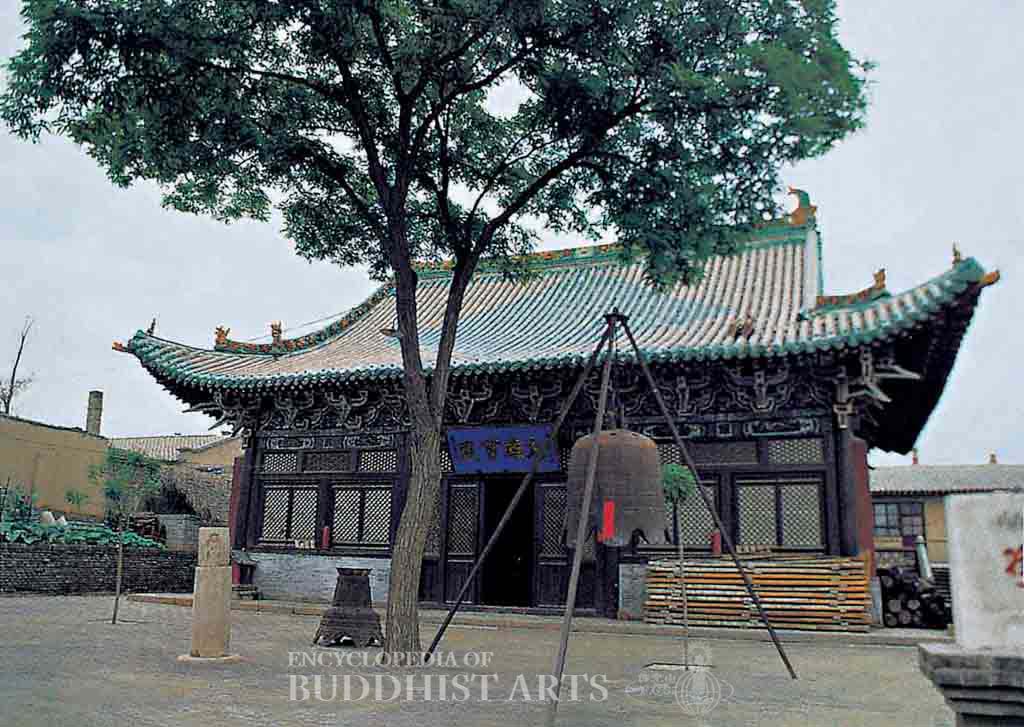
Jingtu Temple Great Hero Hall
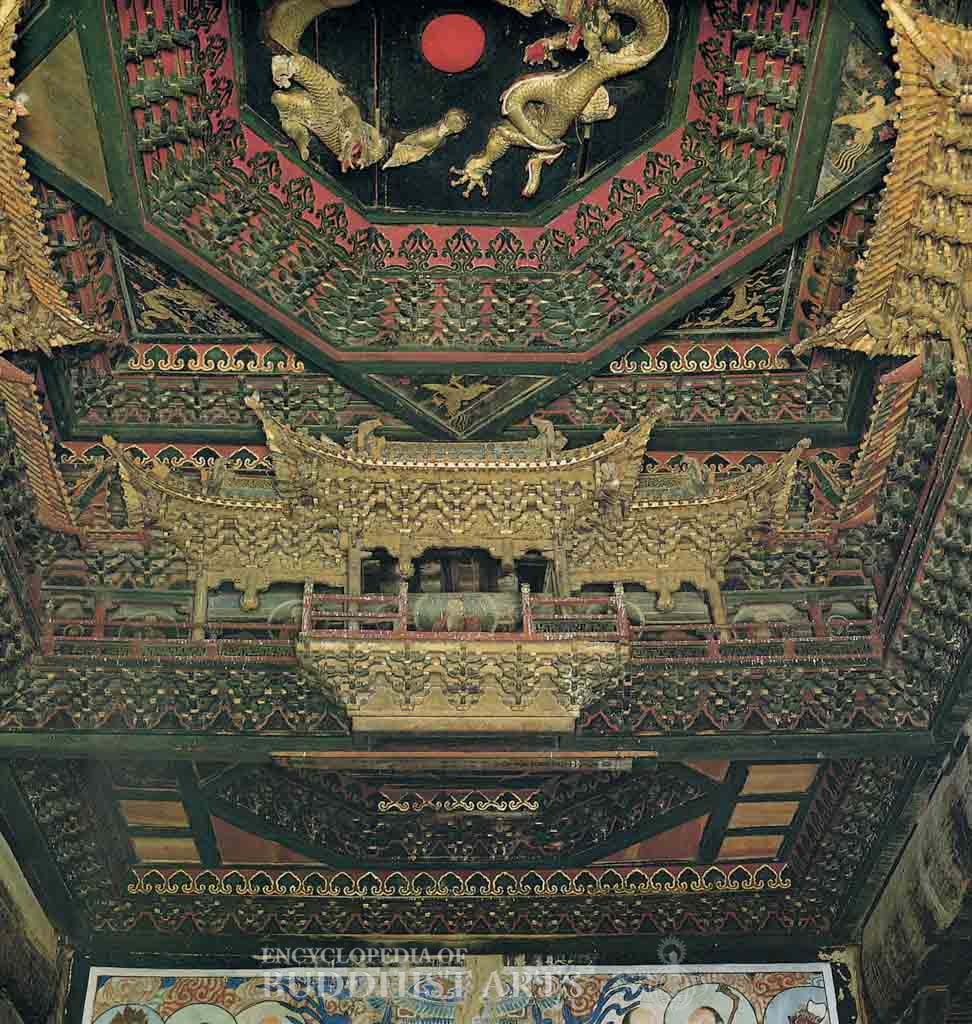
Jingtu Temple Great Hero Hall (interior)
Jingtu Temple Great Hero Hall
CHINA, Shanxi, Shuozhou
It was built in 1184 during the Jin dynasty. Even though repairs were carried out during the Ming (1368–1644) and Qing (1644–1911) dynasties, the hall still retains its original form. Jingtu Temple was listed as a National Cultural Heritage Site in 2006.
Facing south, the three-by-three bay hall has a single-eave hip-and-gable roof covered in yellow glazed cylindrical tiles, which are green at the edges. Doors are located in the central bay at the front, while the side bays are covered in lattice windows. The Amitabha Buddha Triad is enshrined inside, with Amitabha Buddha in the center and Avalokitesvara and Mahasthamaprapta Bodhisattvas on either side. Each statue occupies a bay directly beneath an octagonal caisson. Shallower supplementary caissons in diamond or hexagonal shapes can be found in front of or behind each octagonal caisson. There are intricately carved miniature timber buildings surrounding the central caisson and located on the north, east and west walls signifying Heavenly Palaces. Two carved and completely gilded dragons are located within the central caisson. Gold is used entirely for the Heavenly Palace surrounding the central caisson, while the remaining caissons do not use gold at all, thus highlighting the importance of the main statue. The details within the caissons and miniature buildings are an important source for understanding Jin dynasty (1115–1234) architecture. The murals within the hall were painted during the Qing dynasty and convey a strong folk flavor.
For more details, go to the Encyclopedia of Buddhist Arts: Architecture G-L, page 527.
Cite this article:
author = Hsingyun and Youheng and Johnson, Peter and Mankuang and Lancaster, Lewis,
booktitle = {Encyclopedia of Buddhist Arts: Architecture G-L},
pages = 527,
title = {{Jingtu Temple Great Hero Hall}},
volume = 2,
year = {2016}}