
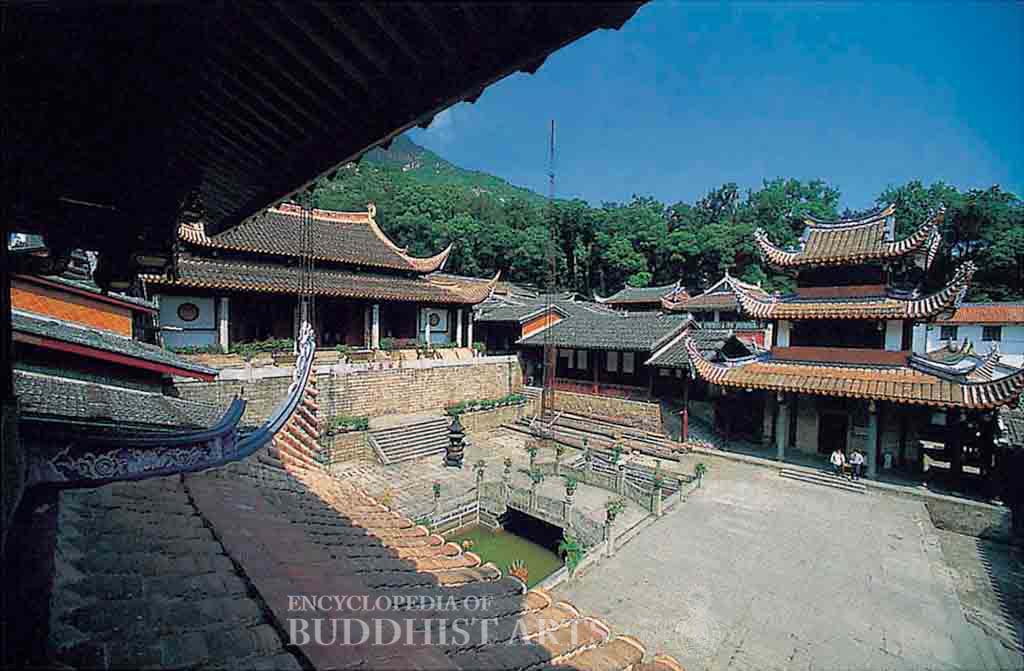
Yongquan Temple
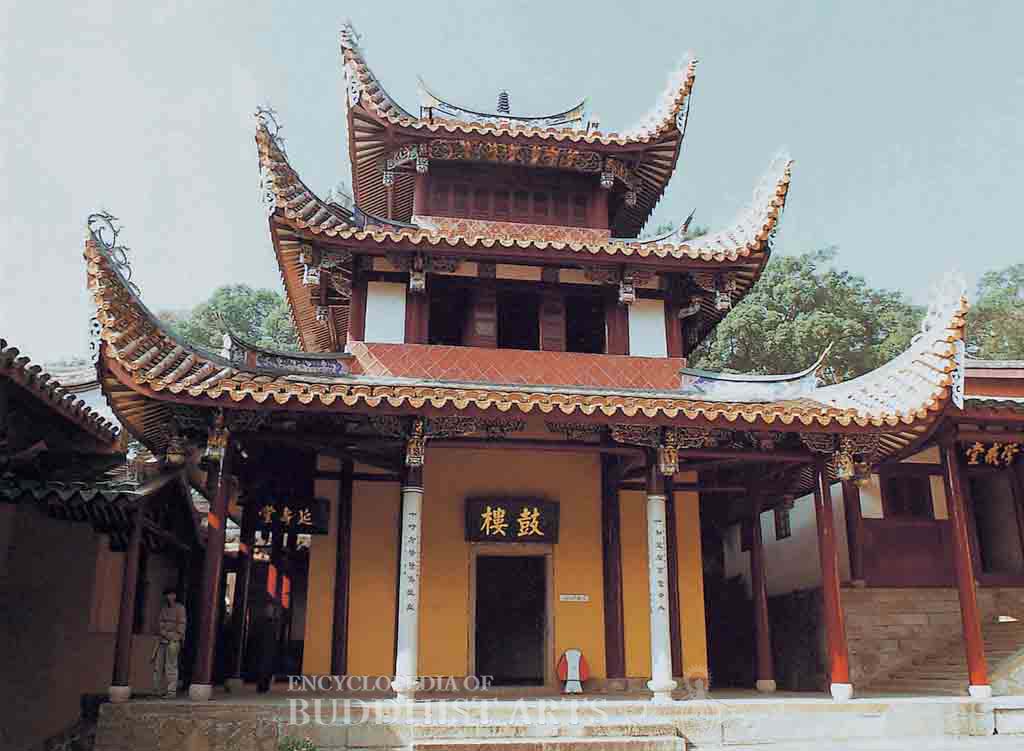
Yongquan Temple: Drum Tower
Yongquan Temple
CHINA, Fujian, Fuzhou
Located at the foot of Baiyun Peak of Gushan (Drum Mountain), it is one of the Five Major Temples of Chan Buddhism in Fuzhou. It was founded in 783 during the Tang dynasty. It has been destroyed and rebuilt a number of times and has undergone regular repairs. The existing layout dates back to the Ming (1368–1644) or Qing (1644–1911) dynasties. It was listed as a key Buddhist temple in the Han region of China in 1983.
The temple occupies around 1.6 ha and there are 25 buildings built along the contours of the mountain. The main buildings along the central axis are the Heavenly King Hall, Great Hero Hall, and Dharma Hall. Side buildings include the bell and drum towers and the sutra repository. A Thousand Buddha Pagoda is located on each side of the Heavenly King Hall. The three-bay wide bell and drum towers are three stories high with hip-and-gable roofs. On all three stories there are eaves that turn steeply upwards at the corners. In the center of the main ridge is a miniature pagoda.
The five-bay wide Great Hero Hall has a double-eave hip-and-gable roof. The Three Buddhas are enshrined within the hall. The statues were cast during the Ming dynasty and are 5 m high. A courtyard is located in front of the sutra respository, with covered walkways on three sides. Inside the sutra repository there is a white jade Reclining Buddha from Myanmar. Behind the statue there is a stupa which houses a relic of the Buddha. The repository contains more than 20,000 fascicles of sutras from various versions of the Buddhist Canon, such as the Qisha Tripitaka, Yongle Northern Tripitaka, Yongle Southern Tripitaka, and Qing Tripitaka, as well as 657 fascicles of scriptures written in blood by eminent monks from the Ming and Qing dynasties. The repository also has Theravadan palm leaf manuscripts. During the Song dynasty (960–1279), the temple became a sutra printing house and continued to play an important role in the printing of Buddhist scriptures until the Qing dynasty. It houses around ten thousand printing blocks from the Ming and Qing dynasties.
For more details, go to the Encyclopedia of Buddhist Arts: Architecture T-Z, page 1360.
Cite this article:
author = Hsingyun and Youheng and Johnson, Peter and Mankuang and Lancaster, Lewis,
booktitle = {Encyclopedia of Buddhist Arts: Architecture T-Z},
pages = 1360,
title = {{Yongquan Temple}},
volume = 4,
year = {2016}}