
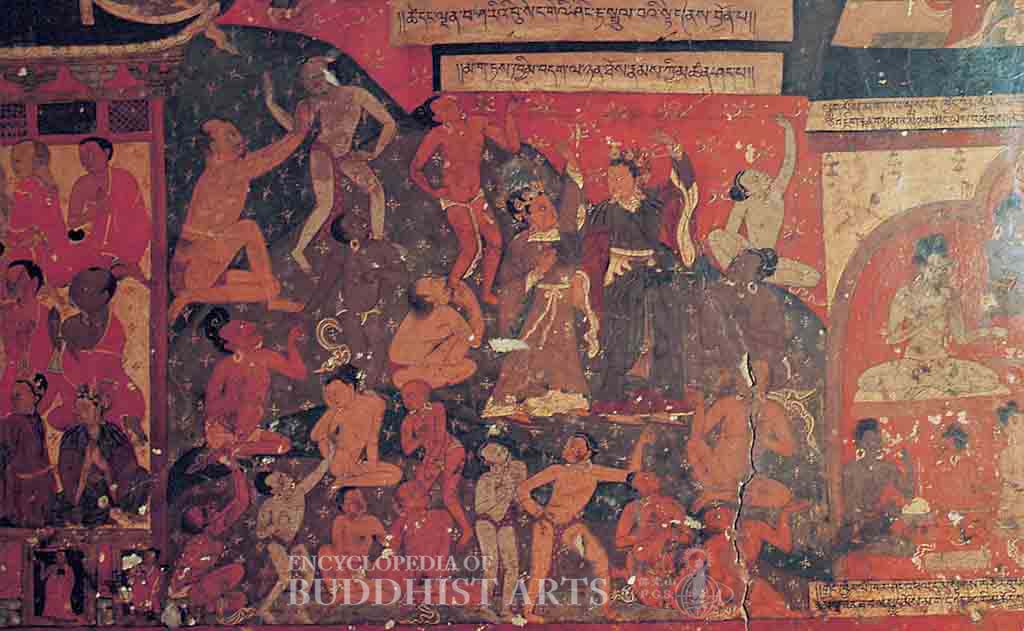
Shalu Monastery Central Hall Prajnaparamita Shrine: Sumagadha’s Invitation
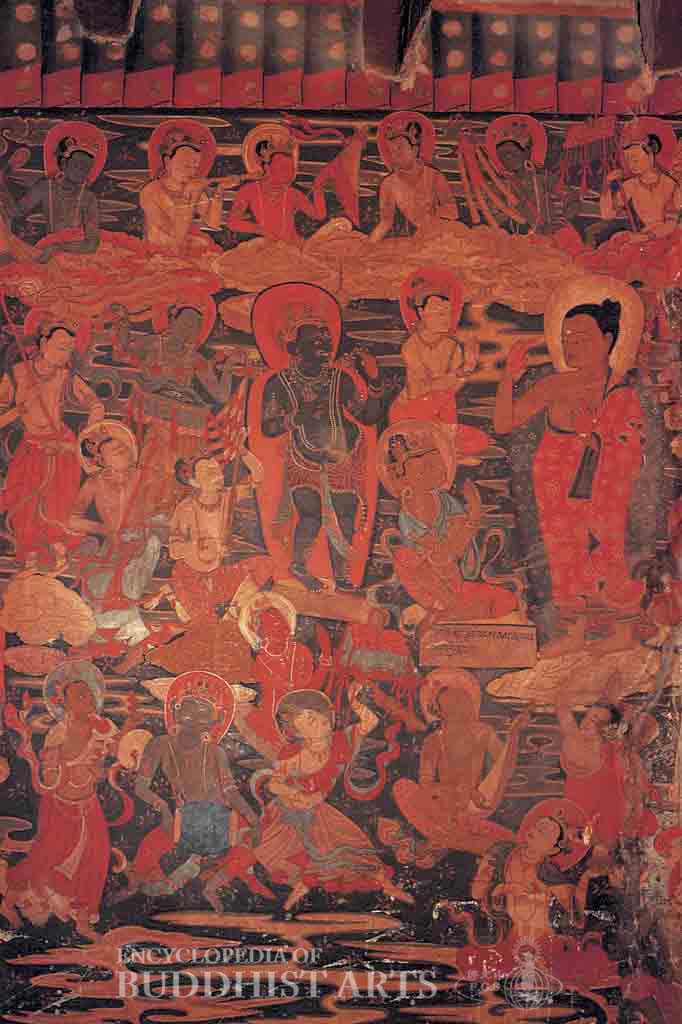
Shalu Monastery Central Hall Prajnaparamita Shrine: Sumagadha’s Invitation - Arrival of Sakyamuni Buddha
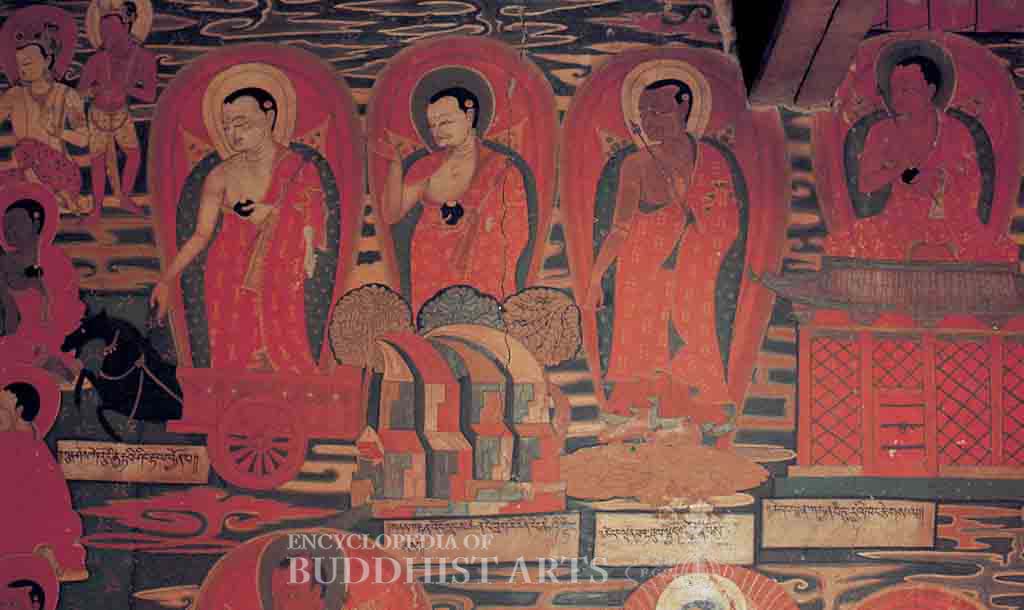
Shalu Monastery Central Hall Prajnaparamita Shrine: Sumagadha’s Invitation - Arrival of Disciples
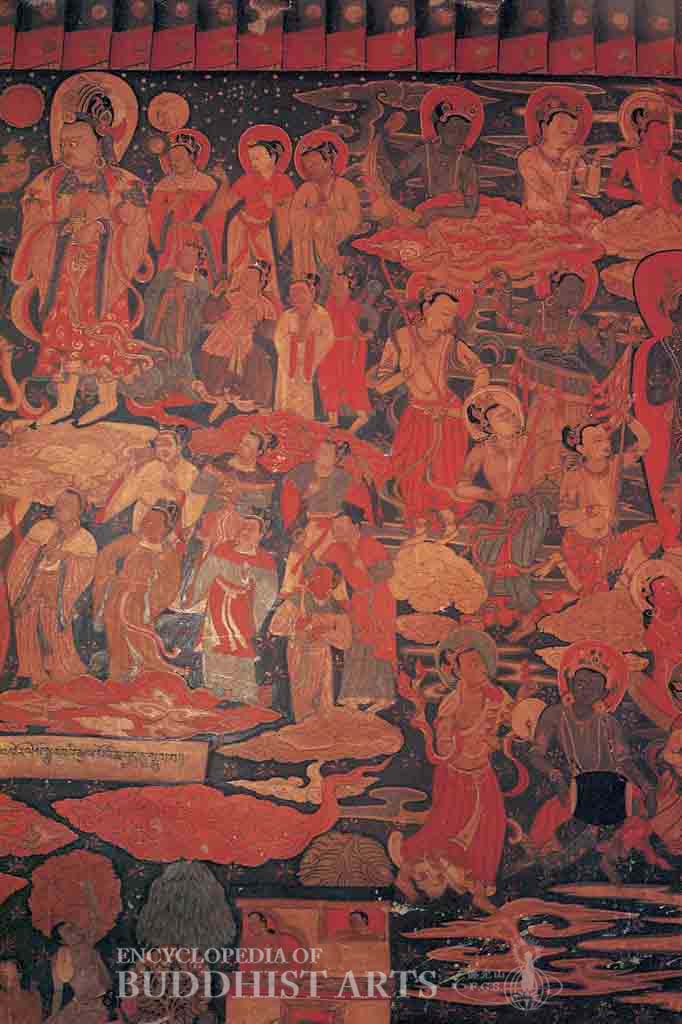
Shalu Monastery Central Hall Prajnaparamita Shrine: Sumagadha’s Invitation - Arrival of Rahula
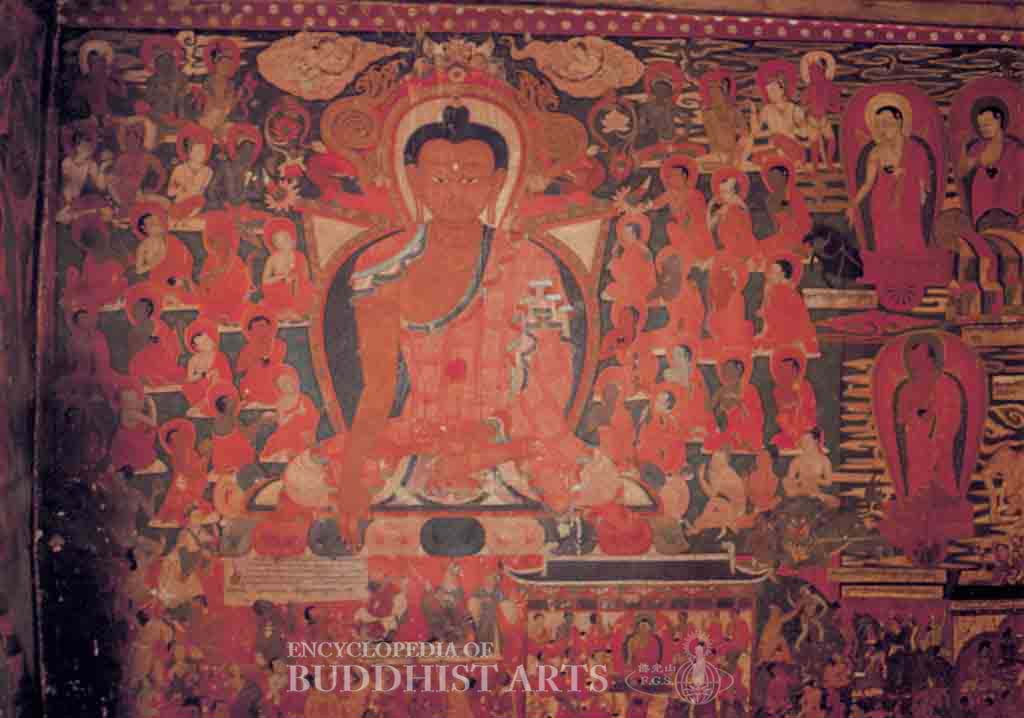
Shalu Monastery Central Hall Prajnaparamita Shrine: Sumagadha’s Invitation - Teaching by the Buddha
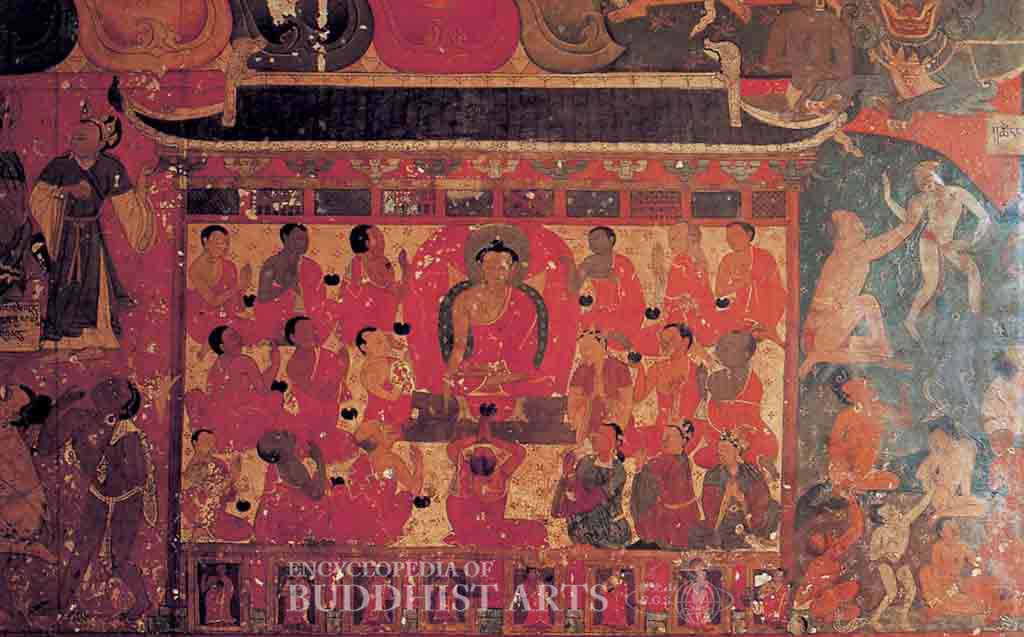
Shalu Monastery Central Hall Prajnaparamita Shrine: Sumagadha’s Invitation - Refuge in the Buddha
Shalu Monastery Central Hall Prajnaparamita Shrine: Sumagadha’s Invitation
CHINA, Tibet, Shigatse
This mural is painted on the outer wall of the south corridor of the Prajnaparamita Shrine on the second story of the central hall. Measuring 200 cm high and 1,100 cm long, this mural dates from the 14th century and consists of two registers. It illustrates the Sumagadha Avadana, a karma story that tells of a Buddhist woman named Sumagadha who married a rich man from a non-Buddhist family and became ashamed by their devotion to a dubious group of brahmins. On the roof of her home in Sravasti, Sumagadha made an incense offering and prayed that the Buddha might come to her house for a meal so he could teach her husband’s family the Dharma. The Buddha was instantly aware of Sumagadha’s heartfelt request and rapidly traveled to her house, accompanied by his disciples. After the meal, the Buddha gave a teaching that inspired Sumagadha’s husband, his family, as well as many other people of Sravasti to take refuge.
In the first scene, the group of half-naked brahmins look up at Sumagadha as she makes an incense offering on the roof of her house. Next, the disciples of the Buddha are shown traveling to Sumagadha’s home. They have serious expressions and employ several means of transportation; some stand in chariots and others ride on animals. The Buddha’s son Rahula is particularly majestic, wearing a tall headdress and floating on a cloud. In the third scene, Sakyamuni Buddha, depicted with an urna and a bright nimbus, stands on a cloud that moves towards a group of figures wearing crowns who dance or join their palms in reverence. The Buddha is then shown sitting in lotus position, flanked by disciples in red robes, he teaches the Dharma to the people of Sravasti. In the final scene, the Buddha sits within a large building, surrounded by a group of new disciples who join their palms in reverence.
There are Tibetan inscriptions beside each scene. Flowers, trees, and lines of cloud are painted in the background. The murals are brightly colored and filled with details, vividly illustrating the story.
For more details, go to the Encyclopedia of Buddhist Arts: Painting P-Z, page 817.
Cite this article:
author = Hsingyun and Youheng and Youlu and Wilson, Graham and Manho and Mankuang and Huntington, Susan,
booktitle = {Encyclopedia of Buddhist Arts: Painting P-Z},
pages = 817,
title = {{Shalu Monastery Central Hall Prajnaparamita Shrine: Sumagadha’s Invitation}},
volume = 16,
year = {2016}}