
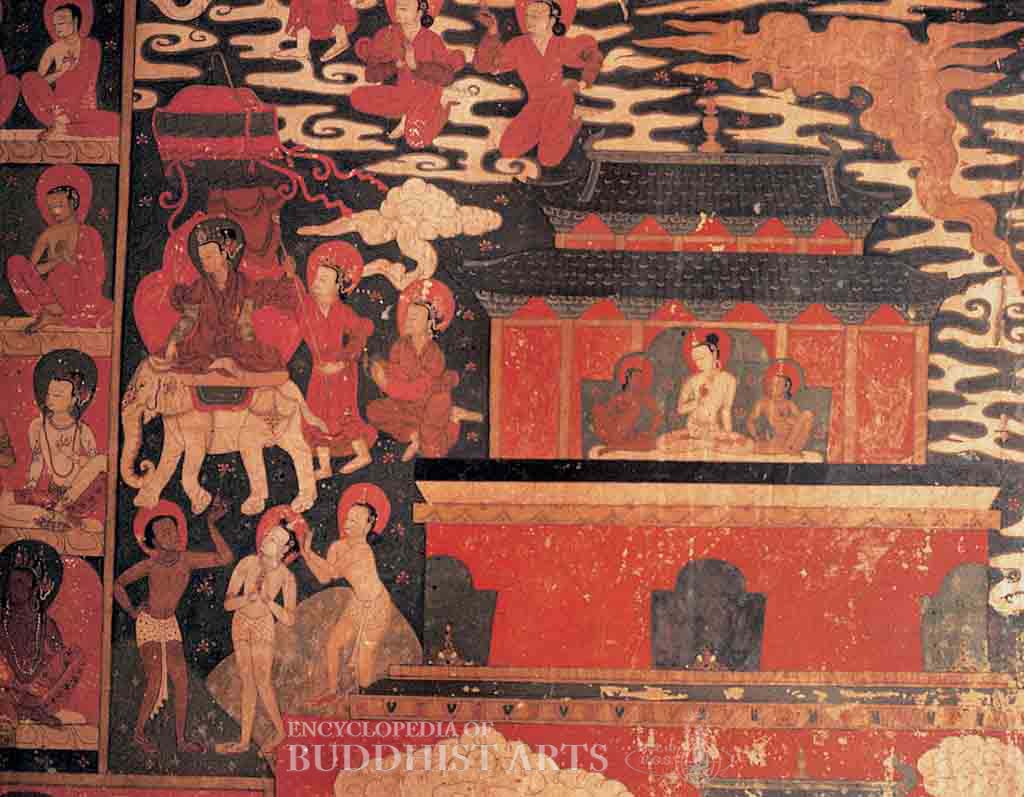
Shalu Monastery Central Hall Prajnaparamita Shrine: Miracle at Sravasti (east passage, east wall, left side)

Shalu Monastery Central Hall Prajnaparamita Shrine: Manjusri Bodhisattva (north passage, south wall)
Shalu Monastery Central Hall Prajnaparamita Shrine Murals
CHINA, Tibet, Shigatse
These murals are painted in the Prajnaparamita Shrine on the second story of the central hall. The shrine was consecrated by the eminent Indian monk Atisa after it was constructed in the 11th century. Murals within the shrine date from both this time and from the 14th century, when the monastery was expanded.
On the exterior walls of the circumambulation passage around the shrine, there are illustrations of scenes from the Life of the Buddha and karma stories, including a 1,100 cm long depiction of Sumagadha’s Invitation. All of the images are 200 cm high and are labeled with inscriptions. Within a portrayal of the Miracle at Sravasti, a crowned Bodhisattva sits gracefully in full lotus position. Long hair flows down to the bare upper body, which is covered only with a sacred thread. The murals are painted in a combination of Chinese, Tibetan, Nepalese, and Indian styles, reflecting Shalu Monastery’s location in a region permeated by diverse cultural influences.
For more details, go to the Encyclopedia of Buddhist Arts: Painting P-Z, page 816.
Cite this article:
author = Hsingyun and Youheng and Youlu and Wilson, Graham and Manho and Mankuang and Huntington, Susan,
booktitle = {Encyclopedia of Buddhist Arts: Painting P-Z},
pages = 816,
title = {{Shalu Monastery Central Hall Prajnaparamita Shrine Murals}},
volume = 16,
year = {2016}}