
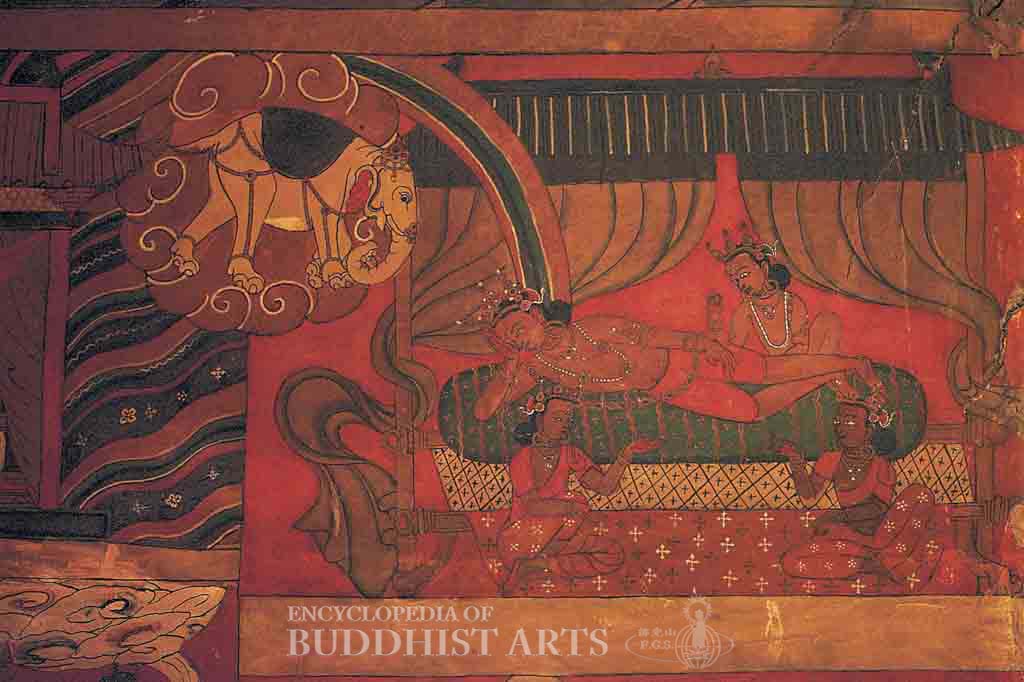
Shalu Monastery Central Hall Circumambulation Passage Murals: Life of the Buddha - Queen Maya
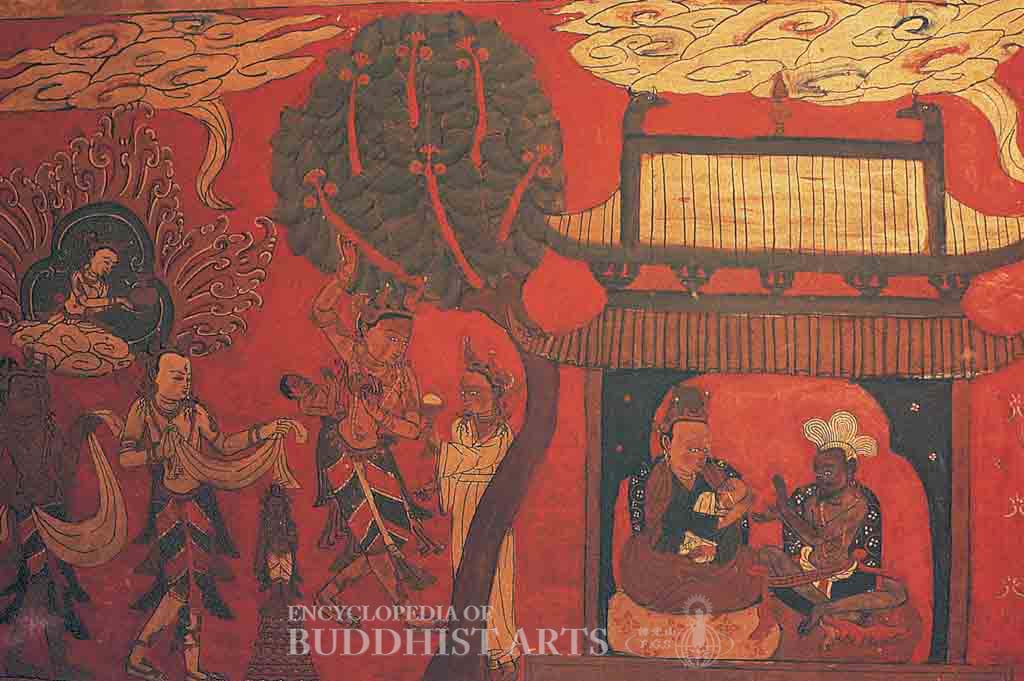
Shalu Monastery Central Hall Circumambulation Passage Murals: Life of the Buddha - Birth of Prince Siddhartha
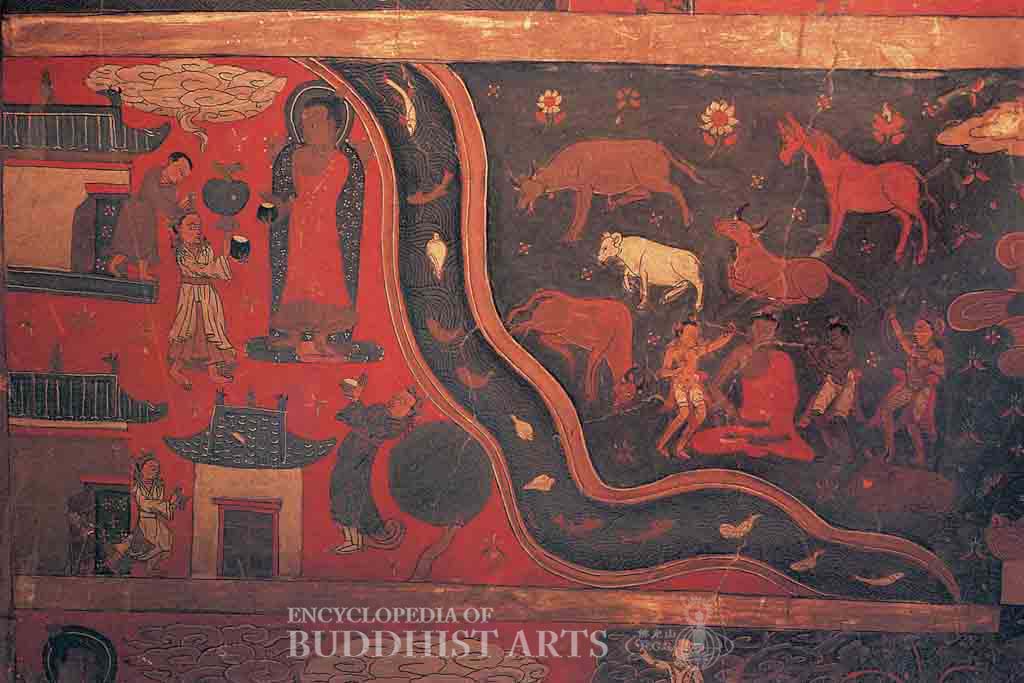
Shalu Monastery Central Hall Circumambulation Passage Murals: Life of the Buddha - Alms Round
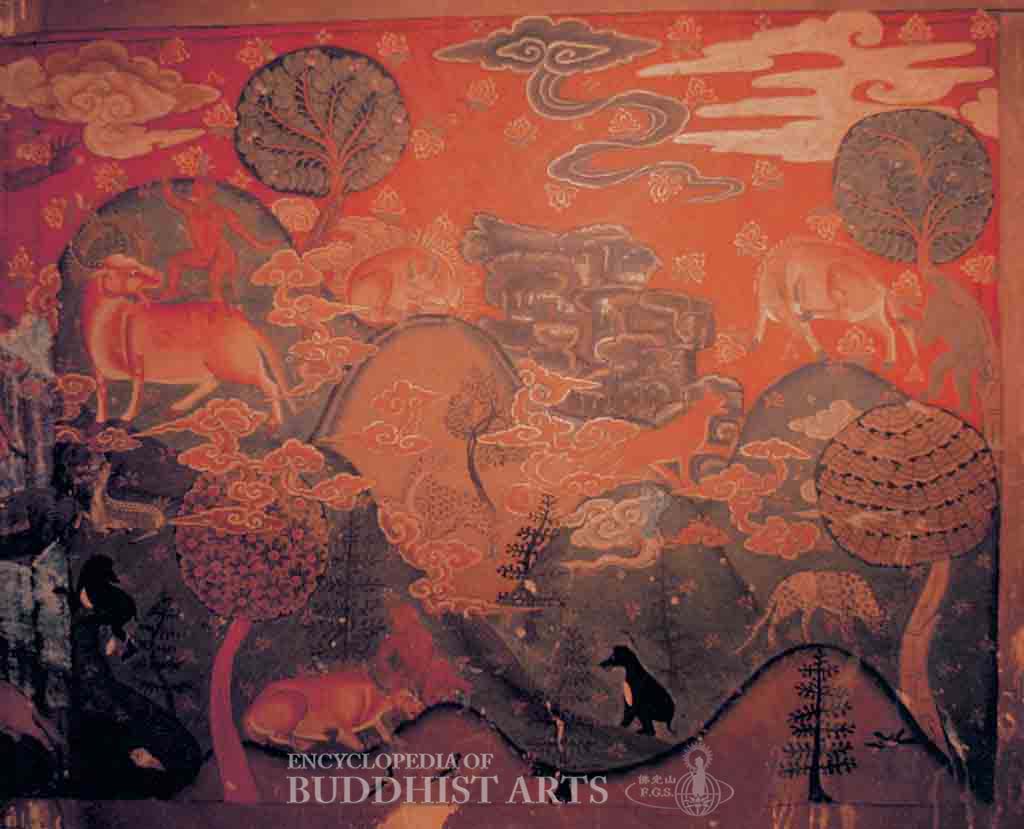
Shalu Monastery Central Hall Circumambulation Passage Murals: Jataka of the Forbearance of the Buffalo
Shalu Monastery Central Hall Circumambulation Passage Murals
CHINA, Tibet, Shigatse
These 14th century murals are located along the walls of the circumambulation passage around the assembly hall on the first story of the central hall. The seven treasures of the cakravartin and the eight auspicious symbols are painted on the inner wall; the outer wall is covered with scenes from Jataka tales, stories from the Life of the Buddha, and karma stories.
In the illustration of Queen Maya’s Dream, the queen lies on her right side, wearing a headdress, jewelry, and a tight lower garment. Three palace maids sit beside the bed. A rainbow extends from the left side of the picture to the queen’s head. Standing on clouds, an elephant symbolizing the Buddha moves towards the queen. In the illustration of the Birth of Prince Siddhartha, Queen Maya holds the branch of an asoka tree as the prince emerges from her right side. Another mural portrays the prince on an alms round, holding a black bowl while three figures approach bearing offerings. On the right, there is a unique, lighthearted depiction of the prince sitting in meditation beside a stream, unperturbed by two young shepherds who try to distract him.
Other scenes include the Jataka tales of Prince Mahasattva and the Forbearance of the Buffalo. In one of his past lives, the Buddha was a noble, patient water buffalo. A foolish monkey torments him by jumping on his back and swinging from his horns, but the patient buffalo pays the monkey no mind. Painted against a deep red background, the scenes are vivid and detailed. The buildings in the murals appear Chinese, while the figures have Tibetan features.
For more details, go to the Encyclopedia of Buddhist Arts: Painting P-Z, page 813.
Cite this article:
author = Hsingyun and Youheng and Youlu and Wilson, Graham and Manho and Mankuang and Huntington, Susan,
booktitle = {Encyclopedia of Buddhist Arts: Painting P-Z},
pages = 813,
title = {{Shalu Monastery Central Hall Circumambulation Passage Murals}},
volume = 16,
year = {2016}}