
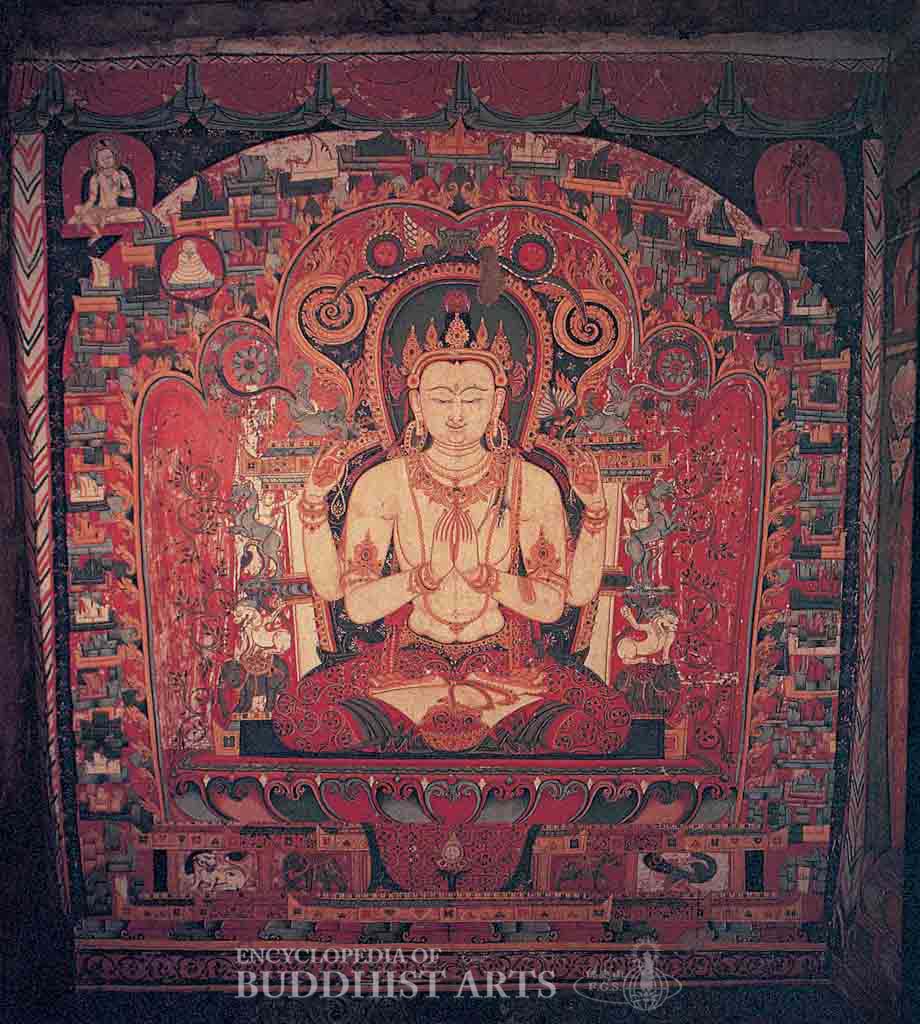
Shalu Monastery Central Hall Avalokitesvara Shrine: Four-Armed Avalokitesvara
Shalu Monastery Central Hall Avalokitesvara Shrine: Four-Armed Avalokitesvara
CHINA, Tibet, Shigatse
This 14th century mural is painted in the Avalokitesvara Shrine in the circumambulation passage on the first story of the central hall in Shalu Monastery. According to the Karandavyuha Sutra, this manifestation, also known as the Six-Syllable Wisdom King, is the embodiment of the Six-Syllable Mantra. In Tibet, this figure is popularly known as the protective deity of snow-covered lands.
Four-Armed Avalokitesvara has white skin, wears a five-leaf golden crown, and sits in full lotus position on a lotus throne. The crown is decorated with fan-like ornaments on the sides and ribbons that hang down to the shoulders. There is a small Buddha image on top of the usnisa. The Bodhisattva wears earrings, necklaces, armlets, and bracelets. A small antelope skin, a symbol of Avalokitesvara, is draped over the left shoulder. One set of hands join palms in front of the chest. The other two hands are raised beside the shoulders; the left hand holds a lotus and the right hand holds prayer beads.
The base of the throne is decorated with images of a snow lion, an elephant, a horse, and a peacock. The ornate backrest is decorated with the Six Dharma Symbolic Features. At the top, the head of a garuda is shown biting onto the body of a naga that it holds in its claws. The head and tail of the snake disappear into two golden spirals beside the nimbus of the Bodhisattva. Makaras, lions, and elephants are arranged symmetrically down the sides. Golden scrolling patterns decorate the border of the red mandorla. Unique geometric patterns fill the rest of the space within the petal-shaped area around the central figure. Two small Bodhisattvas are painted in the upper corners.
For more details, go to the Encyclopedia of Buddhist Arts: Painting P-Z, page 811.
Cite this article:
author = Hsingyun and Youheng and Youlu and Wilson, Graham and Manho and Mankuang and Huntington, Susan,
booktitle = {Encyclopedia of Buddhist Arts: Painting P-Z},
pages = 811,
title = {{Shalu Monastery Central Hall Avalokitesvara Shrine: Four-Armed Avalokitesvara}},
volume = 16,
year = {2016}}