
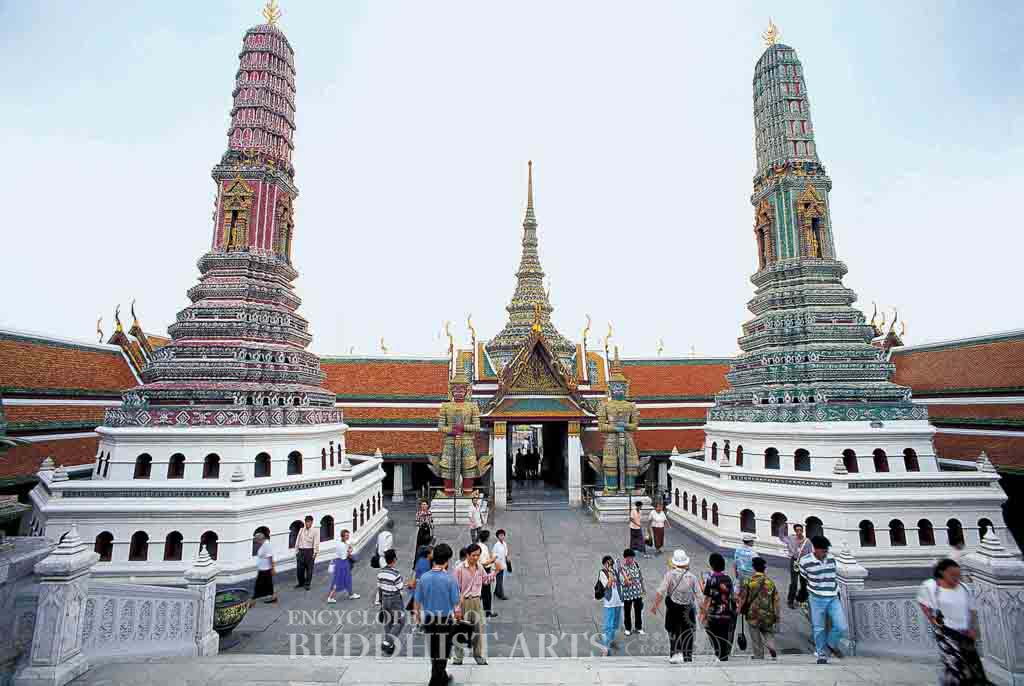
Wat Phra Kaeo
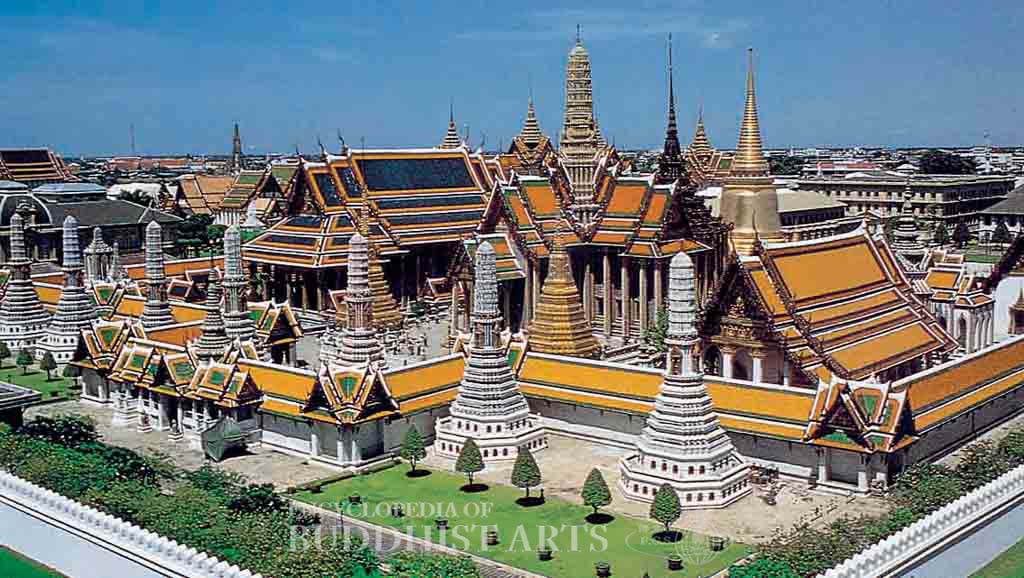
Wat Phra Kaeo
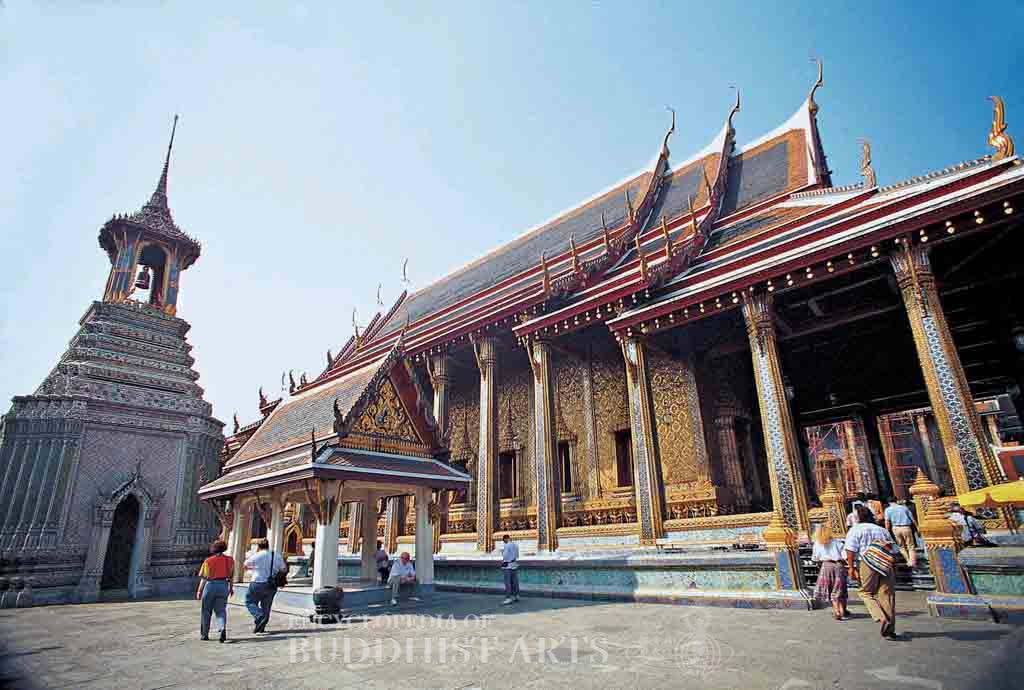
Wat Phra Kaeo: Ordination Hall
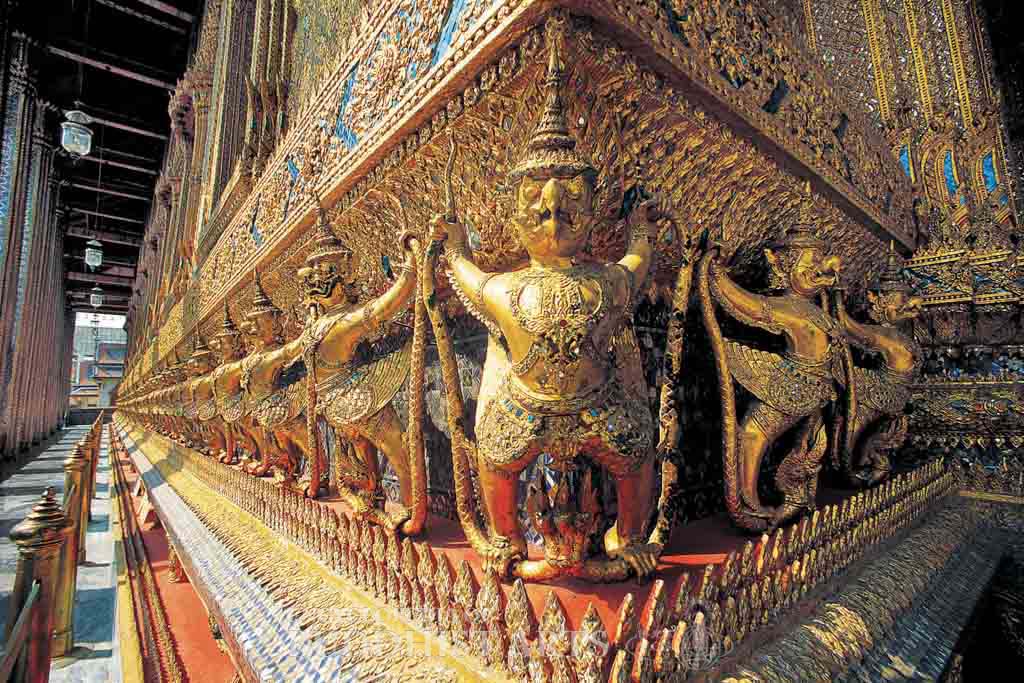
Wat Phra Kaeo: Ordination Hall (detail)
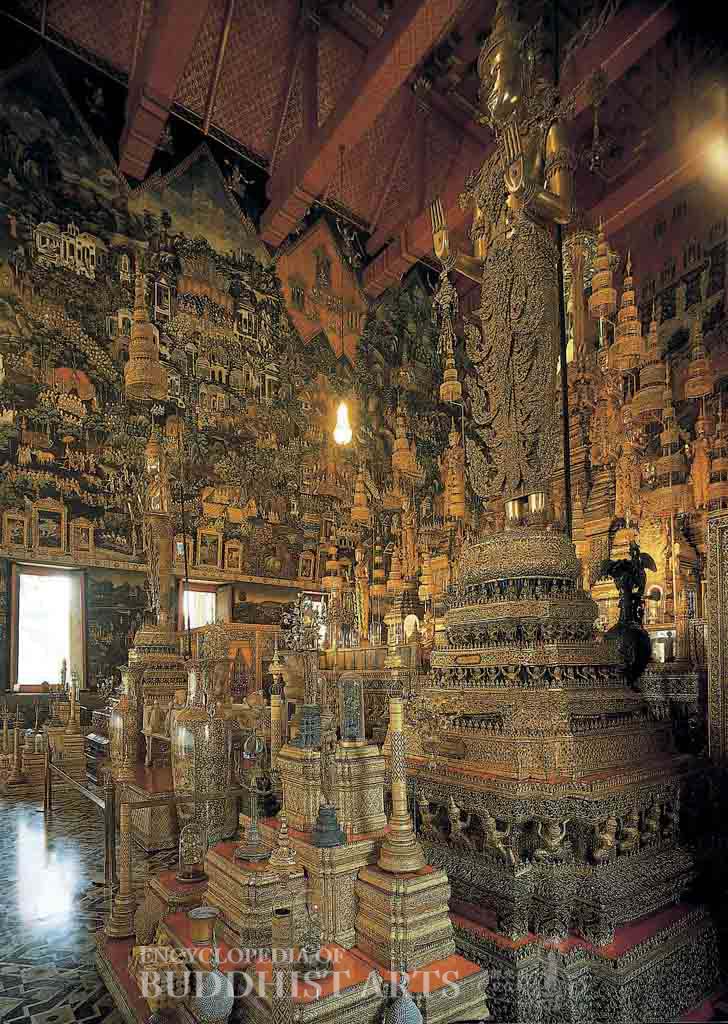
Wat Phra Kaeo: Ordination Hall (interior)
Wat Phra Kaeo
THAILAND, Bangkok
Wat Phra Kaeo means the Temple of the Emerald Buddha, and it is also spelled Wat Phra Kaew. It is officially named Wat Phra Sri Rattanasatsadaram. The temple complex is located inside the Grand Palace in Bangkok. It is named after the unique Emerald Buddha statue enshrined within the ordination hall. The temple was established in 1782 by Rama I (reigned 1782–1809), and was renovated and expanded by each successive sovereign of the Chakri dynasty (1782–present). The temple is reserved for coronation ceremonies for the Thai king, and for Buddhist ceremonies and worship for the royal family. It is the only royal temple holding the designation Special Class. Wat Phra Kaeo, Wat Traimit Witthayaram, and Wat Phra Chetuphon constitute Thailand’s Three National Treasures.
The temple has six gates and on the inside each of them is flanked by an imposing pair of 5 m high door guardians. It is unusual for such guardians to be placed on the inside and it is thought that they may have been placed there to watch over the Emerald Buddha. The east side of the temple is bordered by eight stupas: six outside the walls and two inside. The entire temple complex is enclosed by a covered walkway approximately 2 km long. The walls of the walkway are covered with 178 murals from the Ramakien, Thailand’s national epic derived from the Hindu Ramayana. There are over 100 structures within the temple, including the ordination hall, Royal Pantheon, sutra repository, main stupa, auxiliary library, Buddha image hall, royal mausoleum, stupas of various sizes, pavilions, a bell tower, shrines and a model of Angkor Wat. The buildings are mostly erected on white marble base platforms and are decorated in various ways, a common theme being floral and animal reliefs. Bronze chimes are hung from the eaves of a number of buildings.
The ordination hall is located in the center of the temple complex facing east. The ordination hall is 55 m long and 24 m wide. It has a hip and gable roof with five overlapping sections and triple-tier eaves. The roof is covered with blue glazed tiles bordered in orange and red. There are garuda on the ridge ends, and naga scales and naga tails on the hips and bargeboards. There are porticos projecting from the front and back of the hall. A series of 40 elegant columns, which are inlaid with glass and mother-of-pearl, support the lower eaves forming a veranda around the ordination hall, while the interior is column-free. Around the base of the exterior walls there are 112 distinctive golden garudas standing on a pair of nagas and holding their tails. The walls are covered with colored mirror tiles and gilt carving. The main statue inside the hall is the seated Emerald Buddha, named Phra Kaeo Morokot, and carved entirely in green jadeite, resting on an 11 m high gold altar. The back wall behind the statue has a painting of the Three Realms, indicative of the universe according to Buddhist cosmology. The front wall is painted with depictions of the main events leading to the Buddha’s enlightenment. The murals on the two side walls illustrate scenes from the Life of the Buddha and the Jataka tales. This arrangement is typical of mural compositions from the Chakri dynasty.
The imposing cruciform building next to the ordination hall is the Royal Pantheon. It was originally built to hold the Emerald Buddha but was then considered too small for ceremonies in veneration of the Buddha. It contains life-size statues of previous kings of the Chakri dynasty. The building behind the Royal Pantheon is the sutra repository. The lower part of the building is square with columns around it and the upper part is in the form of a stepped pyramid, which is surmounted by a spire consisting of stacked rings and a finial. It contains the fully revised version of the Buddhist Canon, known as the Royal Golden Edition. The main stupa has a round base upon which there are circular tiers. There are porticos projecting from the four cardinal points. The body is in the shape of a bell. The base of the spire consists of a circle of short columns standing on the square harmika. The spire consists of a number of stacked rings leading to the finial. The exterior of the stupa is covered in golden mosaic tiles.
Due to the wide variety of structures, sculptures, and paintings, as well as the external and internal decorative features on the buildings, Wat Phra Kaeo can be regarded as a magnificent repository of Buddhist art and architecture.
For more details, go to the Encyclopedia of Buddhist Arts: Architecture T-Z, page 1221.
Cite this article:
author = Hsingyun and Youheng and Johnson, Peter and Mankuang and Lancaster, Lewis,
booktitle = {Encyclopedia of Buddhist Arts: Architecture T-Z},
pages = 1221,
title = {{Wat Phra Kaeo}},
volume = 4,
year = {2016}}