
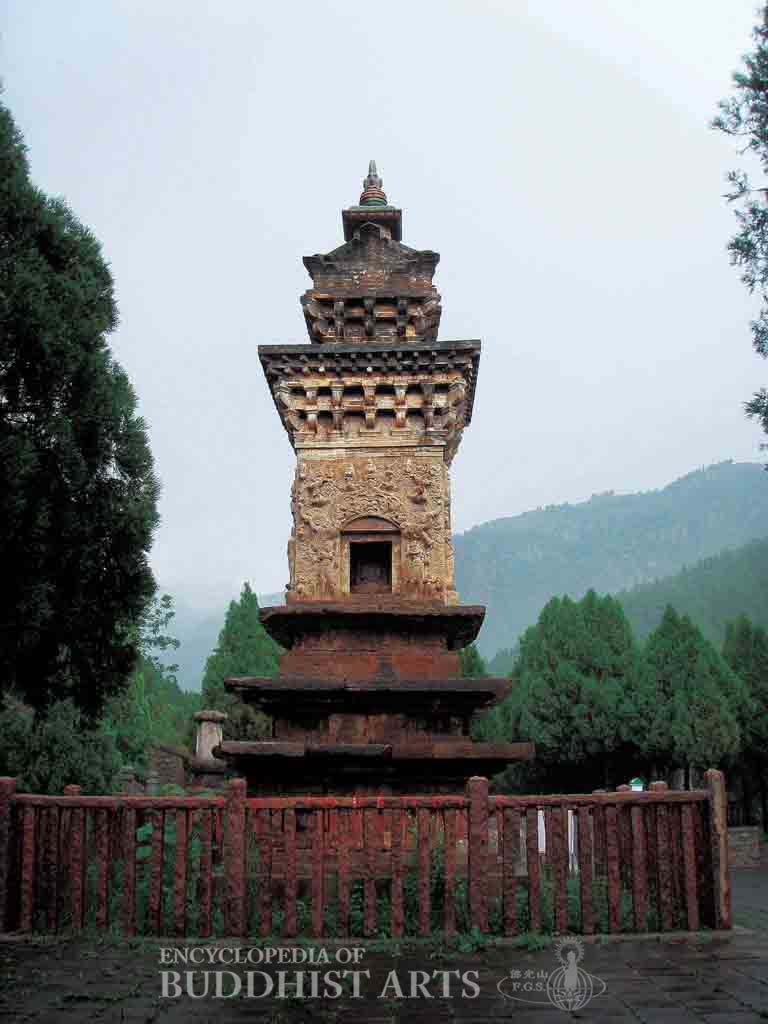
Shentong Temple Longhu Pagoda
Shentong Temple Longhu Pagoda
CHINA, Shandong, Jinan
Longhu means Dragon Tiger. The pagoda derives its name from the engravings of dragons and tigers found upon it. It is located south of the forest of pagodas and directly opposite the Four-Entry Pagoda on the other side of the valley. There are no records of its date of construction but based on its architectural style, it was most likely built during the late Tang dynasty (618–907). The imitation timber eaves and bracket sets indicate that it was probably repaired during the Song dynasty (960–1279). The spire was rebuilt recently.
The pagoda is square and 12.3 m high. The base and pagoda body are constructed from stone while the spire is made from bricks. The high Sumeru base has three layers. The cuboid body is made from four 4 m wide rectangular stone slabs. There is a doorway on each side. On both sides of the doorways and on the surrounding walls there are vivid reliefs of the Buddha, disciples, Bodhisattvas, warriors, dragons, tigers, apsaras, lotuses, and cloud patterns. Inside the chamber, the square central pillar has a Buddha statue carved on each side. The pagoda has double-eave roofs supported by imitation wooden bracket sets. Above the bracket sets there is a pyramidal roof, on top of which is the harmika. The spire consists of five stacked rings and a jewel.
The pagoda is highly decorated with a large number of reliefs, which shows the changing trend from the simple Sui dynasty (581–618) designs to the more complex late Tang dynasty designs.
For more details, go to the Encyclopedia of Buddhist Arts: Architecture M-S, page 988.
Cite this article:
author = Hsingyun and Youheng and Johnson, Peter and Mankuang and Lancaster, Lewis,
booktitle = {Encyclopedia of Buddhist Arts: Architecture M-S},
pages = 988,
title = {{Shentong Temple Longhu Pagoda}},
volume = 3,
year = {2016}}