
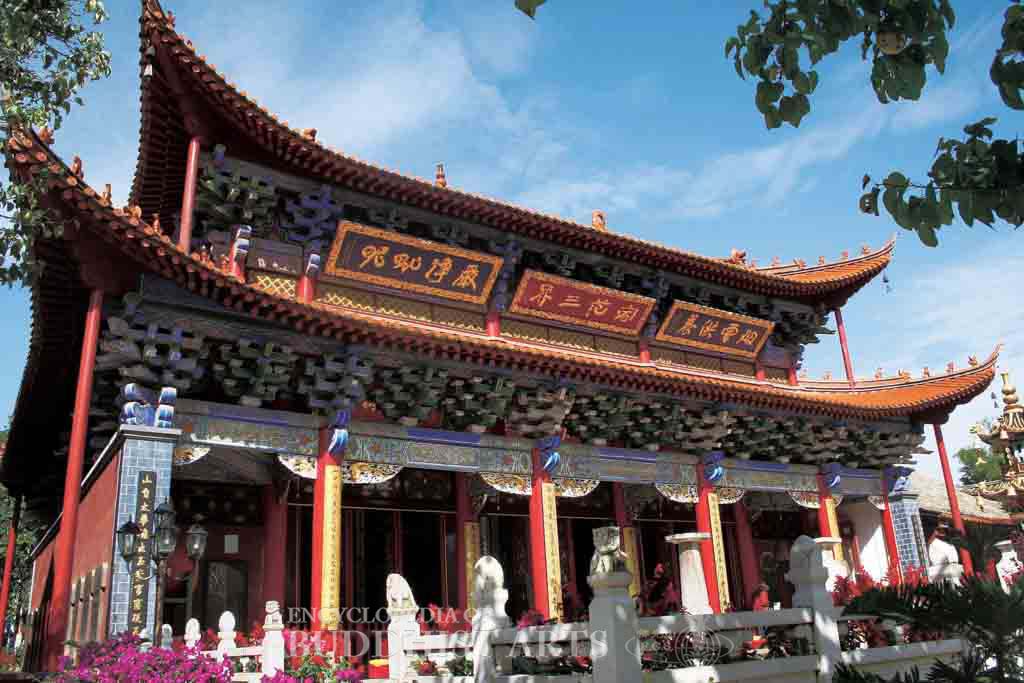
Qiongzhu Temple: Great Hero Hall
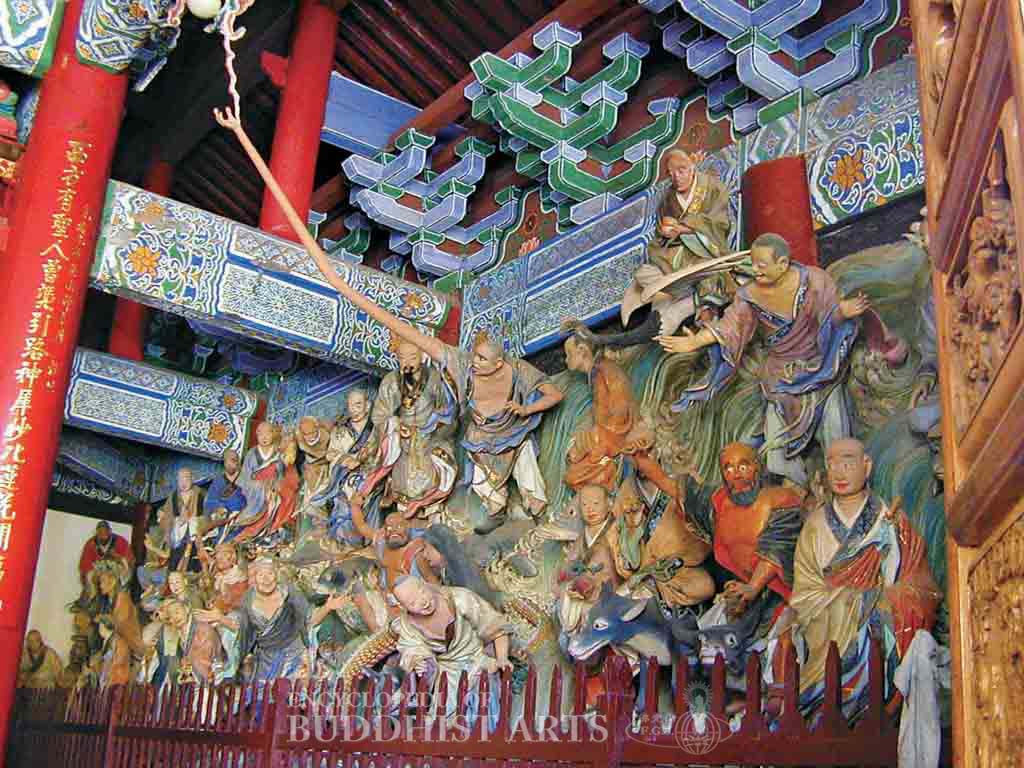
Qiongzhu Temple: Great Hero Hall (interior)
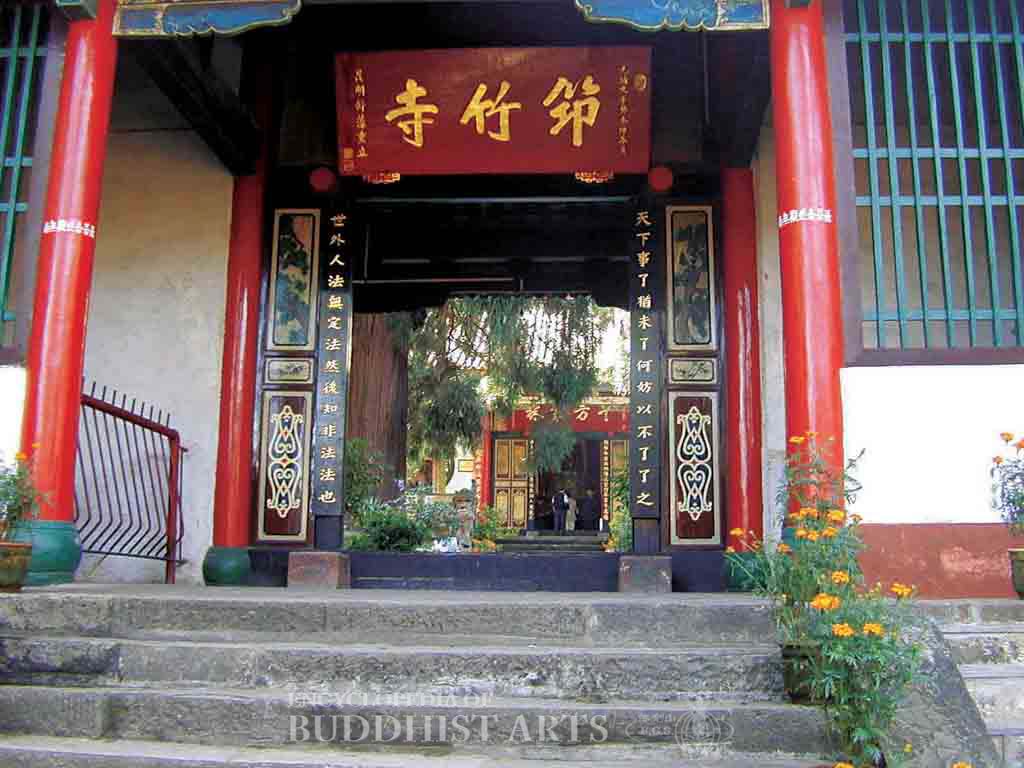
Qiongzhu Temple: Main Temple Gate
Qiongzhu Temple
CHINA, Yunnan, Kunming
Qiongzhu means Bamboo. Located on Yu’anshan (Jade Table Mountain), it was built in 1280 during the Yuan dynasty by Chan Master Xiongbian. It is one of the oldest Chan Buddhist temples in Kunming. Between 1403 and 1424 of the Ming dynasty it was destroyed by fire and later rebuilt. The temple was reconstructed several times during the Qing dynasty (1644–1911). It was listed as a National Cultural Heritage Site in 2001.
Facing east, the temple consists of three courtyards along the contours of the hill. On the central axis there are the main temple gate, Heavenly King Hall, Great Hero Hall, and Avatamsaka Pavilion. The five-by-three bay Great Hero Hall has a single-eave hip-and-gable roof. It stands on a high base with a platform built in front of it. The hall houses the Three Buddhas: Sakyamuni Buddha at the center, with the Medicine Buddha and Amitabha Buddha on either side.
A courtyard is located between the Heavenly King Hall and Great Hero Hall. To the north of the courtyard there is the Fanyin Pavilion, while the Tiantailai Pavilion is located to the south. Statues of the Five Hundred Arhats are distributed throughout the Great Hero Hall and the two pavilions. The statues were based on real people and were created in the 1880s by Li Guangxiu, a sculptor from Sichuan, and five of his disciples.
For more details, go to the Encyclopedia of Buddhist Arts: Architecture M-S, page 883.
Cite this article:
author = Hsingyun and Youheng and Johnson, Peter and Mankuang and Lancaster, Lewis,
booktitle = {Encyclopedia of Buddhist Arts: Architecture M-S},
pages = 883,
title = {{Qiongzhu Temple}},
volume = 3,
year = {2016}}