
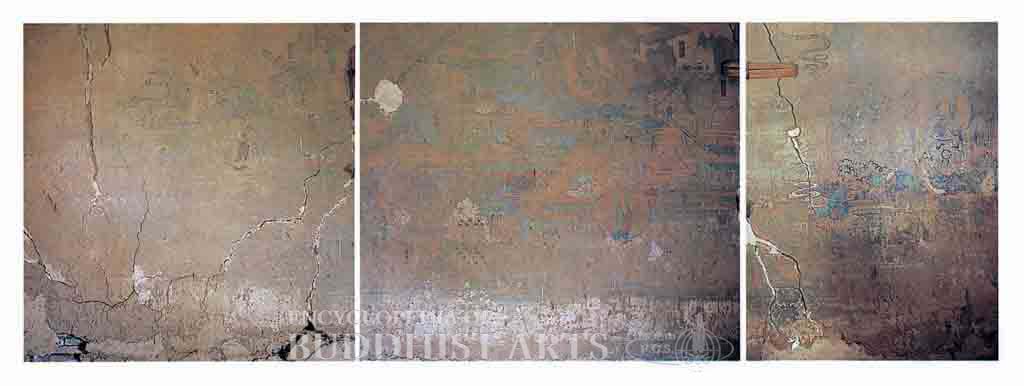
Wutaishan Yanshan Temple Manjusri Hall Murals (west wall)
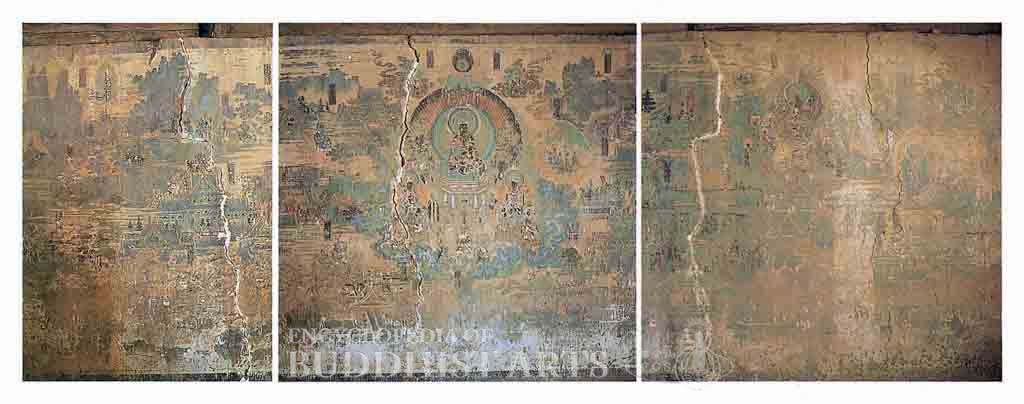
Wutaishan Yanshan Temple Manjusri Hall Murals (east wall)
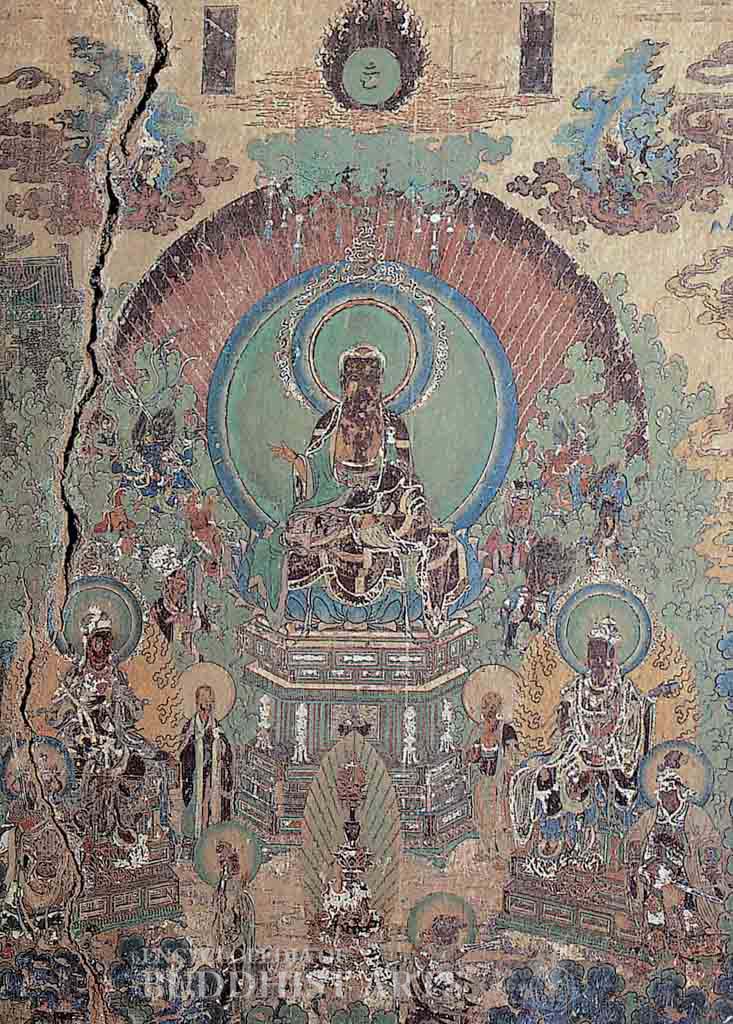
Wutaishan Yanshan Temple Manjusri Hall Murals: Buddha Teaching the Dharma (east wall)
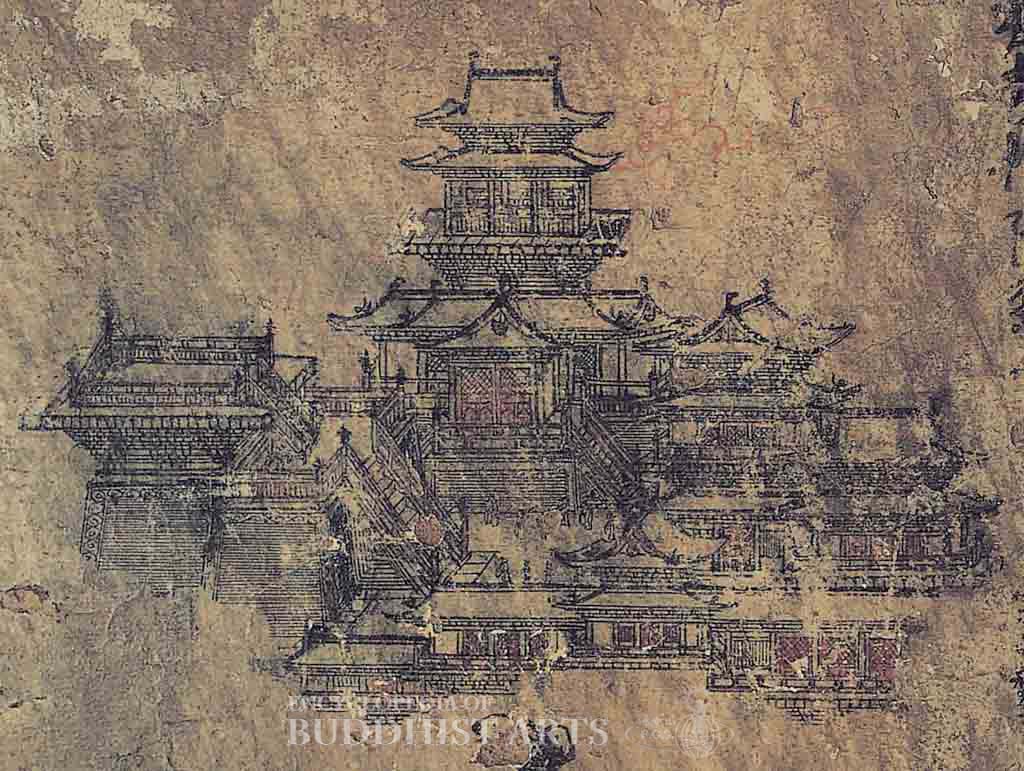
Wutaishan Yanshan Temple Manjusri Hall Murals: Pavilions and Towers
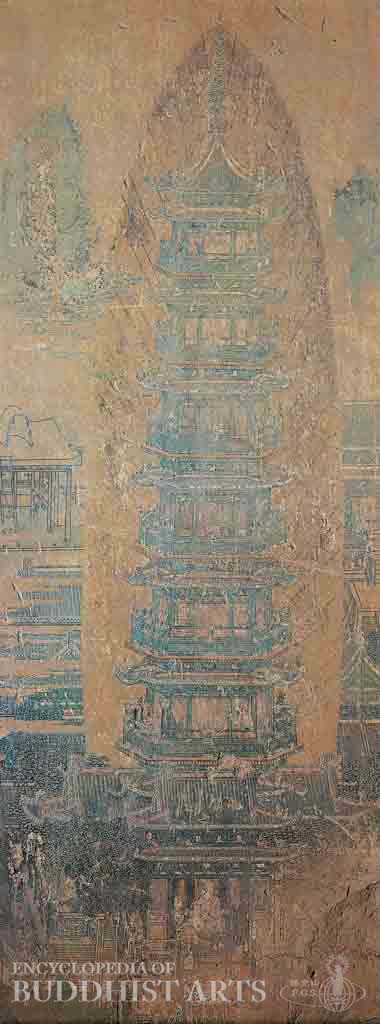
Wutaishan Yanshan Temple Manjusri Hall Murals: Pagoda (back wall, right side)
Wutaishan Yanshan Temple Manjusri Hall Murals
CHINA, Shanxi, Xinzhou; Jin dynasty
These murals cover 97.98 sq m of the four walls of the south-facing Manjusri Hall at Yanshan Temple. According to inscriptions on the temple stele and the west wall of the hall, they were painted in 1167 of the Jin dynasty by the artists Wang Kui and Wang Zun. Only a small number of murals in Buddhist and Daoist temples from the Song (960–1279) and Jin (1115–1234) dynasties have been preserved, and the historical information on the inscriptions make these finely painted artworks particularly valuable.
The west wall features scenes from the Life of the Buddha, each accompanied by an inscription within a cartouche. On the east wall, there are depictions of the Buddha teaching the Dharma, flanked by illustrations of Hariti and scenes from the “Chapter on Filial Piety” in the Returning Favors Sutra. Pavilions and towers are painted in the upper register on the left side of the front (south) wall. The Buddha, two disciples, and two Bodhisattvas occupy the middle register, and figures are shown making offerings in the lower register.
The left side of the back (north) wall features scenes from the “Universal Gateway Chapter” of the Lotus Sutra. Within these scenes there are line drawings of pavilions and towers appearing from out of clouds and mist. These meticulous drawings feature exact proportions and precise perspectives; it is almost as if they were based on architectural blueprints from the Song and Jin dynasties. On the right side of the back wall, a seven-story octagonal pagoda rises in the center of a compound with pavilions and corridors around the perimeter. The body of the pagoda is complete with balustrades, flat bases, bracket sets, and eaves. The murals also include fine depictions of more everyday structures including a water mill, a restaurant, and a town square.
The white color used in the murals was made with lead powder; it has turned to a steel blue due to aging. Embossed plaster and gold foil were used to ornament the ridges, eave tiles and drip tiles on the buildings, as well as the headdresses and belts worn by prominent figures, adding to the magnificence of the images.
For more details, go to the Encyclopedia of Buddhist Arts: Painting P-Z, page 1027.
Cite this article:
author = Hsingyun and Youheng and Youlu and Wilson, Graham and Manho and Mankuang and Huntington, Susan,
booktitle = {Encyclopedia of Buddhist Arts: Painting P-Z},
pages = 1027,
title = {{Wutaishan Yanshan Temple Manjusri Hall Murals}},
volume = 16,
year = {2016}}