
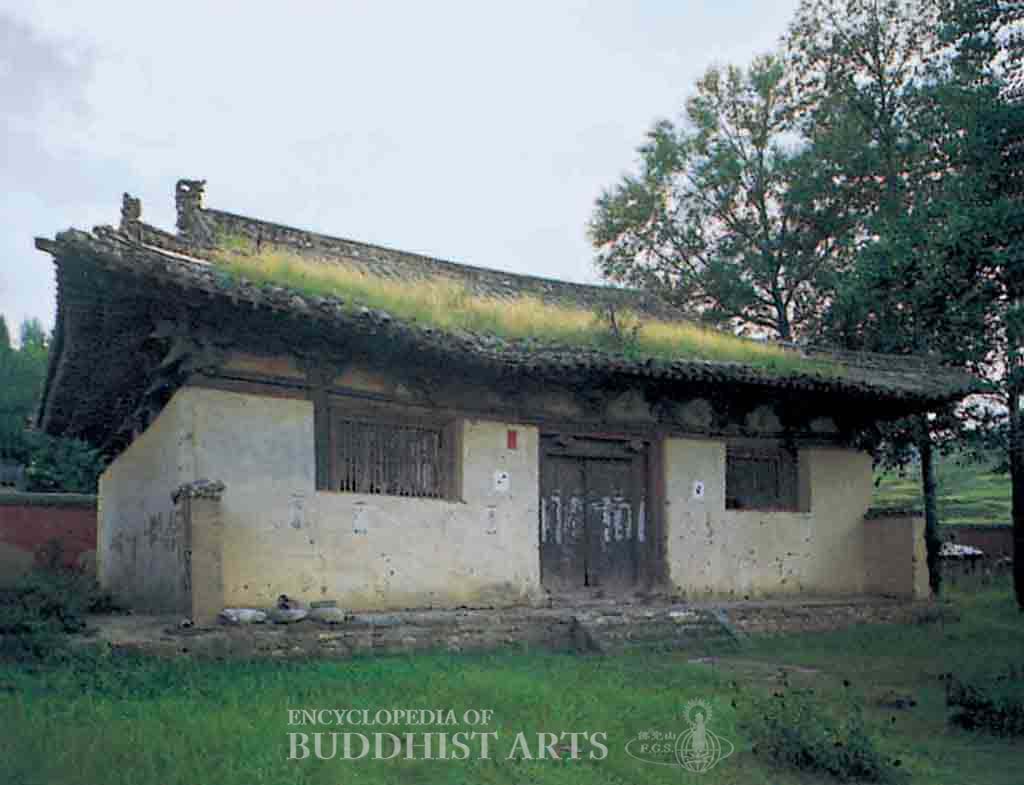
Wutaishan Yanshan Temple: Manjusri Hall
Wutaishan Yanshan Temple
CHINA, Shanxi, Xinzhou
Originally called Lingyan Temple, it is located in the northern foothill of Wutaishan. According to inscriptions, the main hall, also known as Water and Land Hall, was built in 1158 during the Jin dynasty and construction of the Manjusri Hall followed. The other buildings were constructed during the Ming (1368–1644) and Qing (1644–1911) dynasties. The temple underwent renovations at different times. It was listed as a National Cultural Heritage Site in 1982.
Facing south and covering an area of 8,000 sq m, the existing buildings include the main temple gate, bell tower, Manjusri Hall, Sangharama Hall, and the Ksitigarbha Hall. The five-by-three bay Manjusri Hall has a single-eave hip-and-gable roof. Wooden doors can be found on both the front and back central bays, while vertical bar windows are set in the side bays. The Buddha altar occupies about half of the space inside. There used to be a statue of Manjusri riding a lion at the center of the altar but that has been damaged, with only the lion, as well as statues of attendant Bodhisattvas, disciples, and warriors, remain. All these statues are from the Jin dynasty (1115–1234). The murals on the four walls were painted by Wang Kui in 1167 during the Jin dynasty and are the largest surviving Jin murals in China.
Artifacts in the temple include a stone incense burner, pillar bases, stone pillars, stone pagodas, and an inscribed stele from the Jin dynasty.
For more details, go to the Encyclopedia of Buddhist Arts: Architecture T-Z, page 1298.
Cite this article:
author = Hsingyun and Youheng and Johnson, Peter and Mankuang and Lancaster, Lewis,
booktitle = {Encyclopedia of Buddhist Arts: Architecture T-Z},
pages = 1298,
title = {{Wutaishan Yanshan Temple}},
volume = 4,
year = {2016}}