
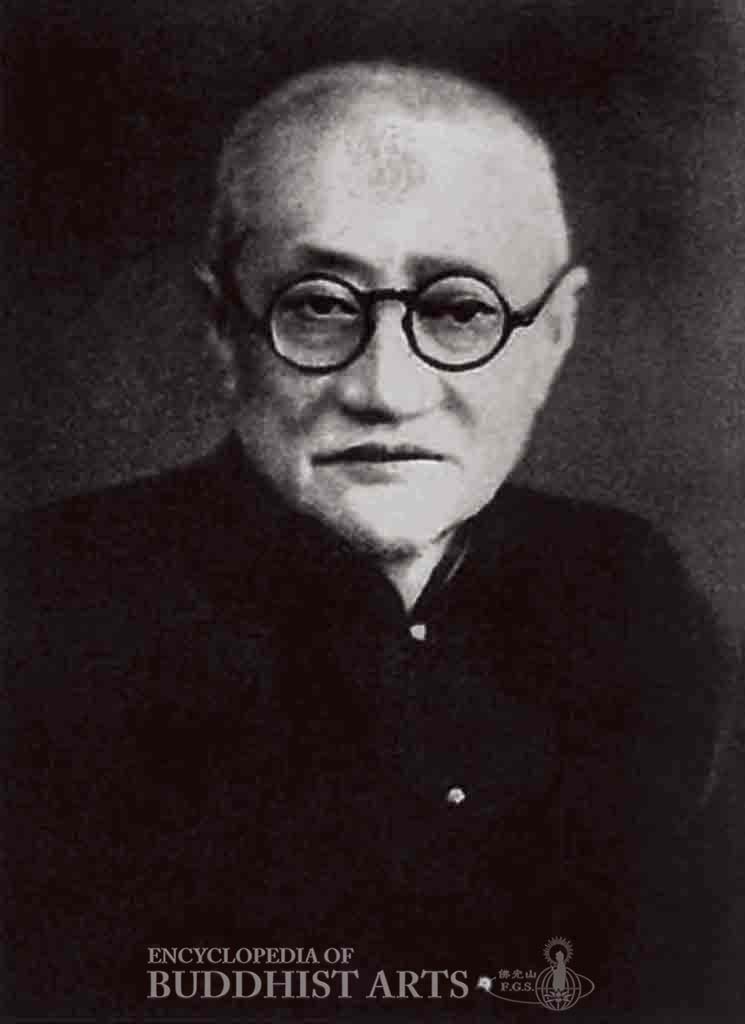
Wang Zhen
Wang Zhen
CHINA, Zhejiang, Huzhou; Qing dynasty
Wang Zhen, also known as Yiting or Meihua Guanzhu, was a painter, calligrapher, and seal engraver from Wuxing (present day Huzhou, Zhejiang). He studied under Ren Yi and Wu Changshuo, and was able to combine their styles into one. His paintings of figures, Buddhist images, flowers, birds, and landscapes showed a style of boldness and composure that was well respected by people of his time. Wang enjoyed studying Buddhism, and served as the president of the Buddhist Association of China in 1922.
Wang often painted portraits of historical figures such as Confucius, Lao Zhi, and Zhong Kui, and also enjoyed illustrating plum flowers, pine, lotus flowers, cranes, and sparrows. Devoted to Buddhism, he often painted Bodhisattvas, Bodhidharma, and Arhats. Two of his paintings, Amitabha Buddha and Bodhidharma, as well as a calligraphic inscription of a horizontal inscribed board entitled Harmony Without Hindrance, are kept at Tiantong Temple in Zhejiang. Another painting of Bodhidharma is found in the Dharma Hall of Qixia Temple in Jiangsu, as well as at the Sen-oku Hakuko Kan in Kyoto, Japan, alongside another work, Longevity of Pines and Cranes. Several of his other paintings are kept at the Palace Museum in Beijing, and an ink wash painting of Lotus Flowers is kept at the National Art Museum of China in Beijing.
Among Wang’s calligraphic works, the stele inscription In Praise of Amitayus Buddha can be found on the Stele Wall at Fo Guang Shan Monastery in Kaohsiung, Taiwan; and Ruyi Poem is kept at the Museum of Wenzhou in Zhejiang. In addition, his seal engraving works include My Buddha, Originally There Was Nothing, and Act Upon Mindful Thoughts.
For more details, go to the Encyclopedia of Buddhist Arts: People, page 288.
Cite this article:
author = Hsingyun and Youheng and Youlu and Pokorski, Stefanie and Yichao and Mankuang and Miaohsi,
booktitle = {Encyclopedia of Buddhist Arts: People },
pages = 288,
title = {{Wang Zhen}},
volume = 19,
year = {2016}}